
 01 · PLAN AROUND THE PEOPLE USING THE BUILDINGEntrances, busy periods, deliveries and accessible routes should be mapped before access equipment is set up.AI-generated illustration · not a customer property or job
At an occupied shop, office, school, surgery or block of flats, the gutter may be straightforward but the space below it is not. Customers arrive, staff use side doors, deliveries cross the yard and residents follow familiar routes. A safe plan must control the work above without creating a new problem at ground level.
Keeping the building open should be a deliberate decision, not an assumption. The client and contractor need to agree where the work zone will be, who may enter it, how pedestrians will be redirected and when the job must pause. If those arrangements cannot be maintained, the cleaning should move to a quieter period or a temporary closure window.
Start with a map of how the premises operates
A gutter plan needs more than a roof plan. Walk the outside of the building with the site contact and mark every public entrance, fire exit, staff door, delivery point, disabled parking bay, pedestrian path and vehicle route beneath or beside the gutter line. Note where people naturally walk rather than relying only on painted paths.
Ask when each route is busiest. A school gate at collection time, a shop entrance during lunch, a care setting at appointment changeover and a warehouse yard during deliveries all require different timing. HSE’s guidance on planning construction work recommends discussing methods before work starts, identifying risks created for other people and agreeing the controls.
The client should also identify vulnerable users and any site rules. HSE says work around schools and hospitals needs particular care, while children, older people and people with certain disabilities may need additional protection. A route that looks obvious to a contractor may not work for a wheelchair user, someone with limited sight or a visitor unfamiliar with the building.
Define the drop zone, not just the ladder position
The controlled area needs to cover everywhere a person could be affected by the work, not merely the footprint of a ladder or vacuum. Consider falling leaves, wet silt, a loose gutter fitting, a dropped hand tool, moving poles, trailing hoses and water released from an outlet. Wind can carry light debris beyond the point directly below the operative.
HSE’s public-protection guidance says boundaries and access arrangements should be planned and unauthorised people excluded. The proportionate boundary depends on the task and surroundings. Cones may help mark a low-risk area, but a busy entrance, public pavement or setting involving children can require a more substantial physical barrier and active supervision.
Do not create a route that sends pedestrians into a vehicle lane or off the pavement. HSE’s workplace-transport guidance prefers separate pedestrian and vehicle routes where reasonably practicable, with crossings clearly controlled where the two must meet. If a delivery vehicle or refuse collection will breach the work zone, programme a pause rather than asking people to squeeze around equipment.
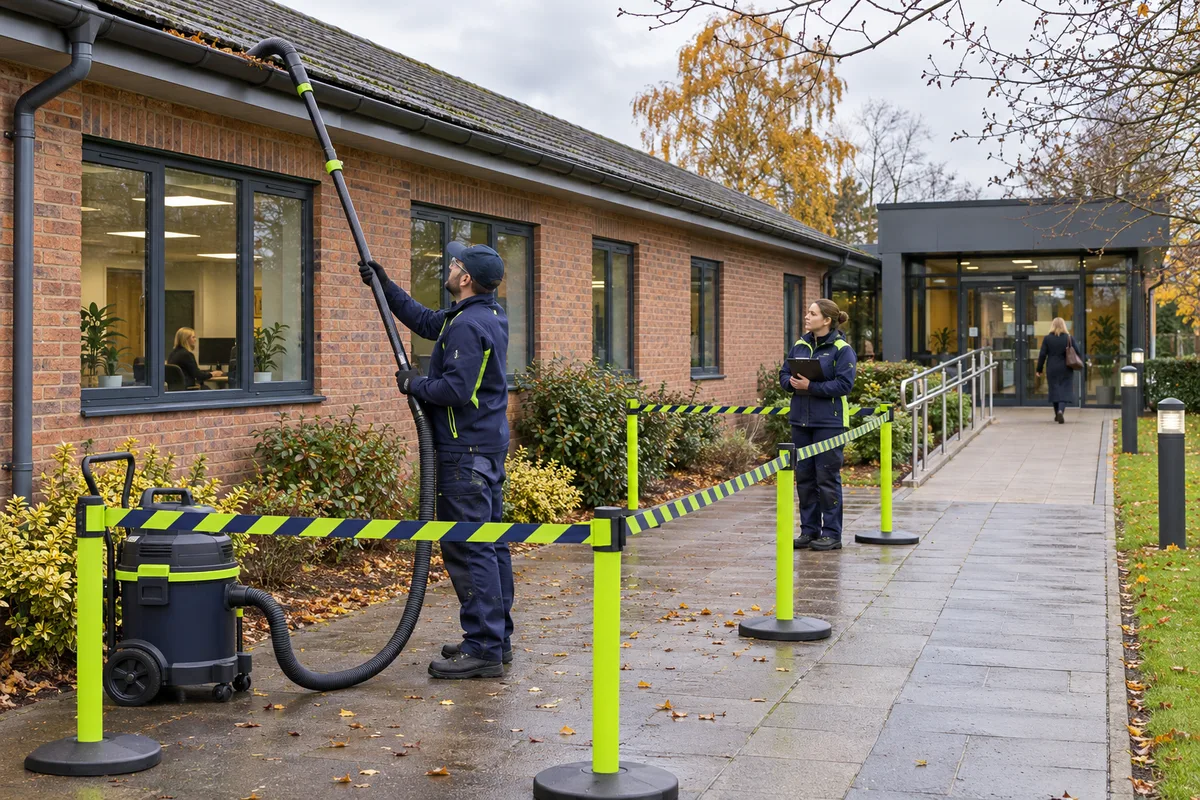 02 · KEEP THE WORK AND WALKING ROUTES APARTGround-based equipment reduces some access risks, but poles, hoses and falling debris still need a controlled area.AI-generated illustration · not a customer property or job
Choose access equipment for the whole location
HSE’s work-at-height guidance requires the task to be properly planned, organised and carried out by competent people using suitable equipment. The hierarchy starts by avoiding work at height where reasonably practicable. A ground-based gutter vacuum or camera may suit some elevations, but height is only one part of the decision.
A long pole needs working space and can cross windows, paths or overhead services. A ladder needs firm ground, security against slipping and a work position that allows safe contact. A tower, scaffold or mobile elevating work platform needs room, load-bearing ground and a route into position. Its movement must be separated from staff, visitors and vehicles.
Do not select the cheapest access method before the site walk. A narrow rear yard may suit a pole but not a platform; a deep commercial gutter may need hands-on access; a fragile roof changes the plan entirely. The method statement should identify the selected equipment, work sequence, supervision and what happens if the planned method cannot be used.
Keep an entrance open only if it stays protected
An entrance beneath the gutter should not remain in ordinary use while work continues above it. The practical choices are to clean that section while the door is temporarily closed, move users to a separate suitable entrance, or complete the work outside operating hours. A member of staff holding a door open is not a substitute for a controlled boundary.
The alternative route should be suitable for the people expected to use it and must not pass beneath another active section of gutter. Tell reception, security and delivery staff before the route changes. If someone needs to cross the zone unexpectedly, the operative should stop, make the equipment safe and only restart after the area is clear.
Emergency arrangements must remain workable throughout. HSE’s work-at-height FAQ also requires planning for emergencies and rescue where work at height is involved. The site contact and contractor should know who has authority to stop the work and how the work area will be left safe if the job is interrupted.
Agree a simple communication plan
One named site contact should meet the contractor, confirm the work zones and communicate with the building’s occupants. For a larger property, agree the order of elevations so reception or facilities staff know which entrance or yard is affected next.
- Before arrival: confirm the date, expected duration, access equipment, parking and any keys or permits.
- At the start: walk the boundaries, check weather and ground conditions, and confirm pedestrian and vehicle routes.
- During work: keep a reliable contact available for deliveries, visitors or operational changes.
- At each move: rebuild and check the boundary before poles, ladders or platforms are used in the next area.
- At completion: remove debris, check surfaces and reopen routes only after the area is safe.
Generic signs alone are not enough if people can walk around them or do not understand the changed route. The arrangement should be visible, physically clear and reinforced by the people managing the premises.
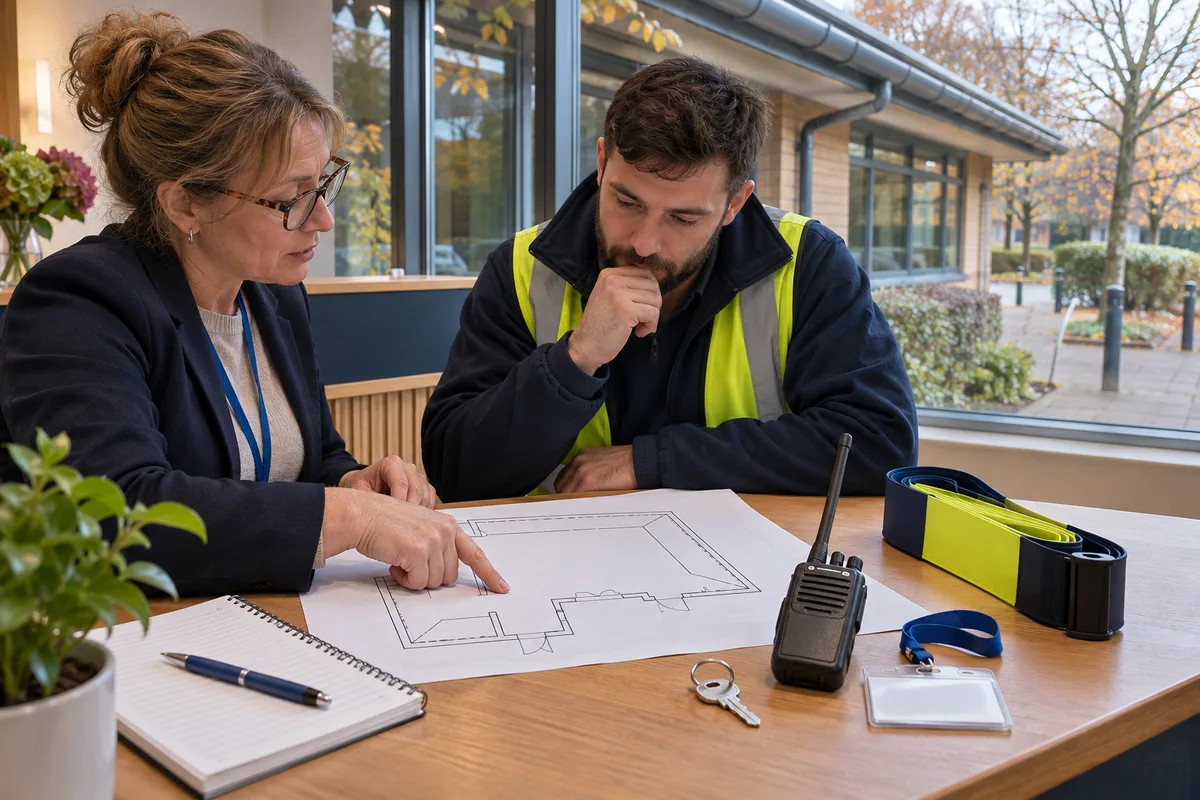 03 · COORDINATE WITH THE SITE CONTACTA simple sequence for doors, deliveries and work areas helps the premises stay open without weakening the boundary.AI-generated illustration · not a customer property or job
Set clear pause and stop conditions
The plan should say when work stops. Examples include someone entering the controlled area, a delivery arriving at the affected bay, a fire alarm, an unexpected event at the premises, loss of the agreed supervisor, a change in wind or rain, unstable ground, or equipment that cannot be positioned as planned.
Weather matters even when the building stays open. Wet paving can become slippery, wind can move poles or debris, and heavy rain can fill the gutter while it is being cleared. Our guide to gutter cleaning in rain explains why a light shower and an unsafe forecast are not the same decision.
If the premises cannot tolerate a controlled interruption, schedule the work before opening, after closing or on a quiet day. Out-of-hours work still needs safe access, lighting, lone-working controls where relevant and an authorised contact; an empty car park does not remove the need for planning.
Control the mess as well as the fall risk
Damp gutter debris should be contained and lowered or collected without spreading it across paths, entrances or parked vehicles. Do not leave silt where it can wash into a doorway or create a slip. If the contents include bird fouling, sharp objects or suspected hazardous material, the method and waste handling may need to change.
Before removing a downpipe or opening a blocked outlet, consider where retained water will discharge. The zone may need extending, and nearby doors, electrical equipment or stock may need protection. A clear completion record should distinguish gutter clearing from downpipe dismantling, drainage work or repairs.
Handover before the barriers come down
At the end, the contractor and site contact should walk the work area. Confirm that tools, hose, loose debris and temporary barriers have been removed; paths are clean; gutters and accessible outlets have been checked; and doors, parking spaces and delivery routes can return to normal use.
Keep dated before-and-after photographs with the maintenance record. Record any inaccessible section, damaged fitting, recurring blockage or downpipe that was not proved clear. For businesses and landlords, this gives the next contractor a reliable starting point instead of relying on memory.
Related guides cover commercial gutter maintenance records, access planning for taller buildings, useful before-and-after photographs, and checks after roof or building work.
The practical rule
If people cannot be kept reliably outside the area beneath and around the work, do not clean that section while the route is open. Change the route, change the time or pause the work.
Sources and further guidance
- HSE: Protecting the public
- HSE: Work at height frequently asked questions
- HSE: Assessing all work at height
- HSE: Separating pedestrians and vehicles
- HSE: Site rules and induction
Share this guide
Know someone responsible for a shop, office, school or occupied block? Share this guide to planning a safe gutter-cleaning work zone around people and entrances.
Share on FacebookShare on WhatsApp