
 01 · START WITH THE WHOLE ELEVATIONA useful record identifies the roofline, gutter run and outlet before moving to close views of debris or defects.AI-generated illustration · not a customer property or job
A single close-up of a clean gutter can look reassuring without showing which part of the property it belongs to—or whether the other runs and outlets were included. A better photo record works like a simple map: wide views establish location, close views show condition, and the after set mirrors the same areas.
That matters to homeowners checking a completed clean, landlords keeping maintenance records and businesses managing several elevations. The aim is not to create a glossy gallery. It is to make the scope and visible result easy to understand later.
Photograph the property before the close-ups
Begin from safe ground-level viewpoints with one clear image of each accessible elevation. Include enough of the building to recognise the roofline, downpipes and any separate gutters above porches, extensions, bays or dormers.
Then work in a consistent order—front, side, rear, outbuildings—and capture the same five details for each rainwater route:
- the complete gutter run or a sequence that covers it;
- the outlet and accessible top of the downpipe;
- debris, standing water or vegetation before removal;
- joints, stop ends, brackets and the fascia or wall below; and
- the next visible connection, such as a hopper, gully or lower gutter.
Historic England recommends regular inspection and recording of rainwater systems, and notes that a roof plan can help organise the work. A simple elevation label in the file name or job notes serves the same purpose for an ordinary home or commercial property.
What the “before” photographs should show
The before set should record condition, not exaggerate it. One wide image identifies the area; a closer image should show what is restricting flow or why attention is needed. Photograph compact silt at an outlet, moss under a tile edge, a leaking union, a displaced bracket or staining below the gutter as separate subjects.
If debris is spread along a long run, use overlapping views rather than one extreme close-up. Include a fixed feature—a window, downpipe, corner or joint—so the position can be matched afterwards. Where a gutter cannot be seen safely, record that limitation instead of implying it was inspected.
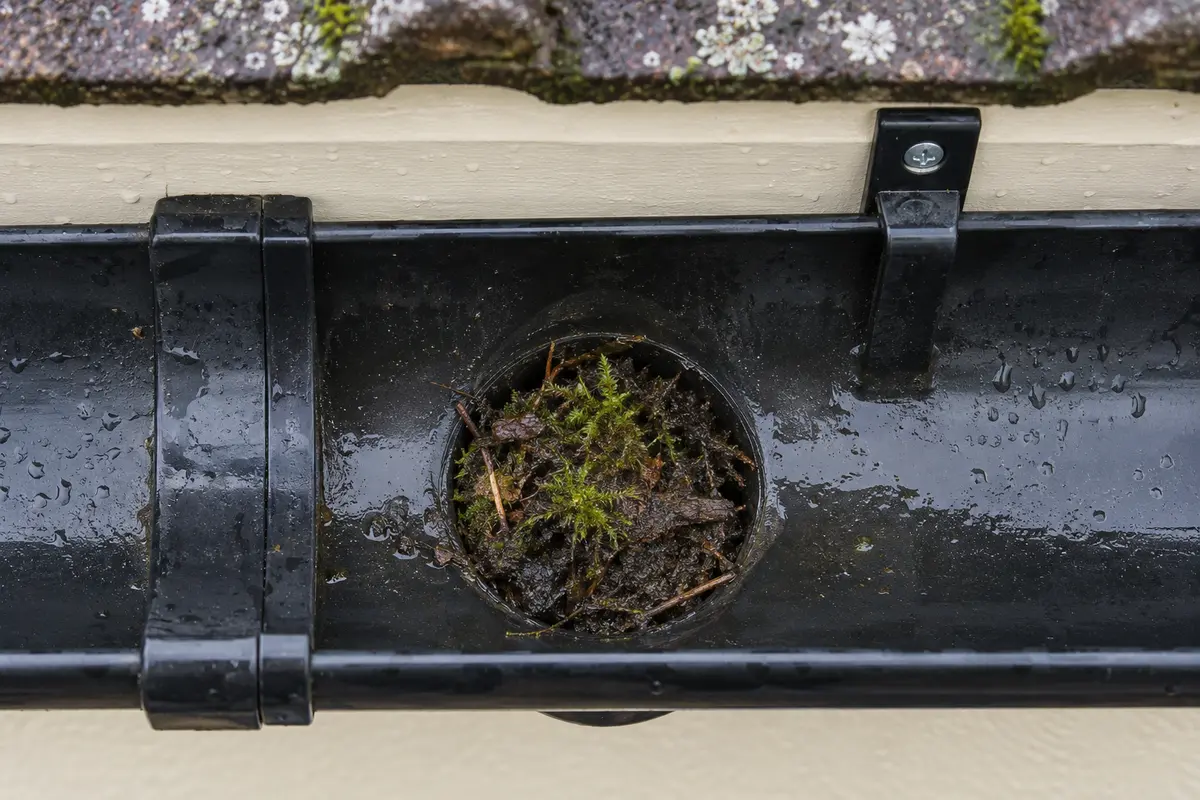 02 · RECORD THE OUTLET AND ITS LOCATIONA close view is useful when the debris, outlet, joint and a recognisable part of the run can all be related to the wider elevation.AI-generated illustration · not customer work
Make the “after” set comparable
After cleaning, return to the same elevations and repeat the sequence. The clearest record shows the open channel, each accessible outlet and the condition of nearby joints and supports. If a controlled water check is appropriate, a photograph can show water reaching the outlet without overflowing the gutter.
Do not rely on a single polished-looking section. A useful after set answers practical questions:
- Is the complete visible run clear rather than only the centre?
- Is the outlet open?
- Were short or separate rooflines included?
- Are visible joints, brackets and stop ends still in place?
- Was any defect found that needs repair rather than cleaning?
Keep cleaning and repair records separate. Clearing debris does not repair a split union, poor fall, loose bracket or damaged fascia. Label those issues clearly so a clean gutter is not mistaken for a fault-free rainwater system.
What photographs cannot prove
Photographs are helpful evidence, but they have limits. They cannot usually confirm that a buried drain is clear, that a concealed pipe has no restriction, or that a joint will remain watertight in future weather. A clear outlet image also does not prove the whole downpipe route is open.
The Royal Institution of Chartered Surveyors advises that photographs should supplement clear site notes rather than replace them. Record the date, elevation, areas not accessed and any further test or repair recommended. Keep original files where possible; heavy editing can remove useful context.
If water backs up at the outlet or returns from a gully, see our guide to a blocked downpipe or gully. For what suction equipment can and cannot deal with, read what a gutter vacuum can remove.
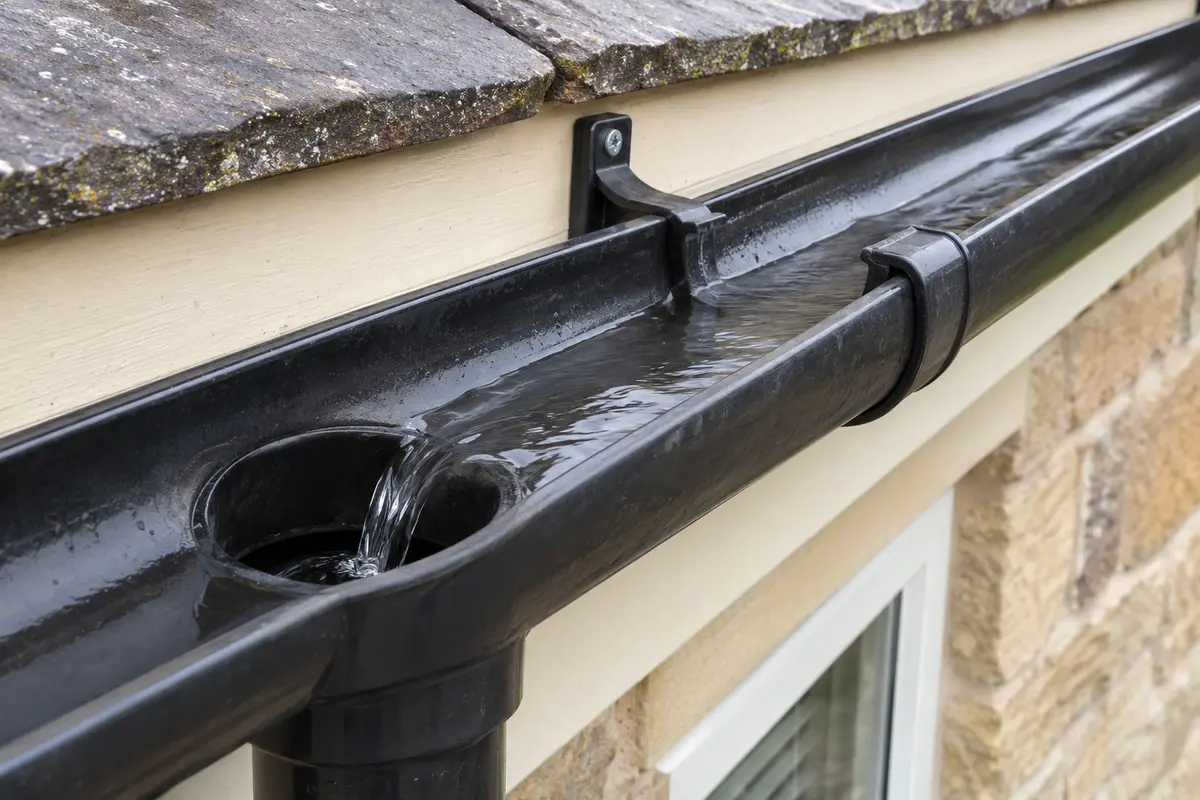 03 · SHOW A CLEAR ROUTE, NOT JUST A TIDY SURFACEThe after view should include the open outlet and enough of the channel, joint and support to make the completed area identifiable.AI-generated illustration · not customer work
A simple file-naming and storage system
Names such as front-left-outlet-before and front-left-outlet-after are more useful than a camera’s automatic number. For larger properties, add the building, elevation and date. Keep the photo set with the maintenance note, invoice or property record so it can be compared at the next visit.
Only capture what is necessary. Avoid neighbouring windows, people, vehicle registrations and private interiors where possible. Share the record with the property owner or authorised manager and store it securely.
Landlords can combine photographs with our landlord gutter-maintenance checklist. Facilities teams may prefer the repeatable structure in our commercial gutter-maintenance checklist.
Safe ways to obtain the pictures
Do as much as possible from the ground. A pole-mounted inspection camera can document many ordinary eaves without climbing, while upper or hidden gutters may need suitable professional access. The Health and Safety Executive says work at height should be avoided where reasonably practicable and that ladders must not be rested against weak surfaces such as plastic guttering.
Do not lean from an upper window, walk on a fragile roof or climb simply to obtain a better photograph. If safe access is not available, state which run could not be verified.
The practical rule
Use wide views to prove location, close views to show condition and matching after views to show the visible result. If someone unfamiliar with the property can understand which gutters and outlets were covered, the record is doing its job.
Sources and further guidance
- Historic England: inspection, maintenance and repair of rainwater systems
- Historic England: maintenance checklist
- Historic England: maintenance plans for older buildings
- RICS: Planned Preventative Maintenance of Commercial and Residential Property
- Health and Safety Executive: ladders and weak surfaces
Share this guide
Know someone arranging gutter maintenance? Share this guide so their before-and-after record covers every run and outlet clearly.
Share on FacebookShare on WhatsApp