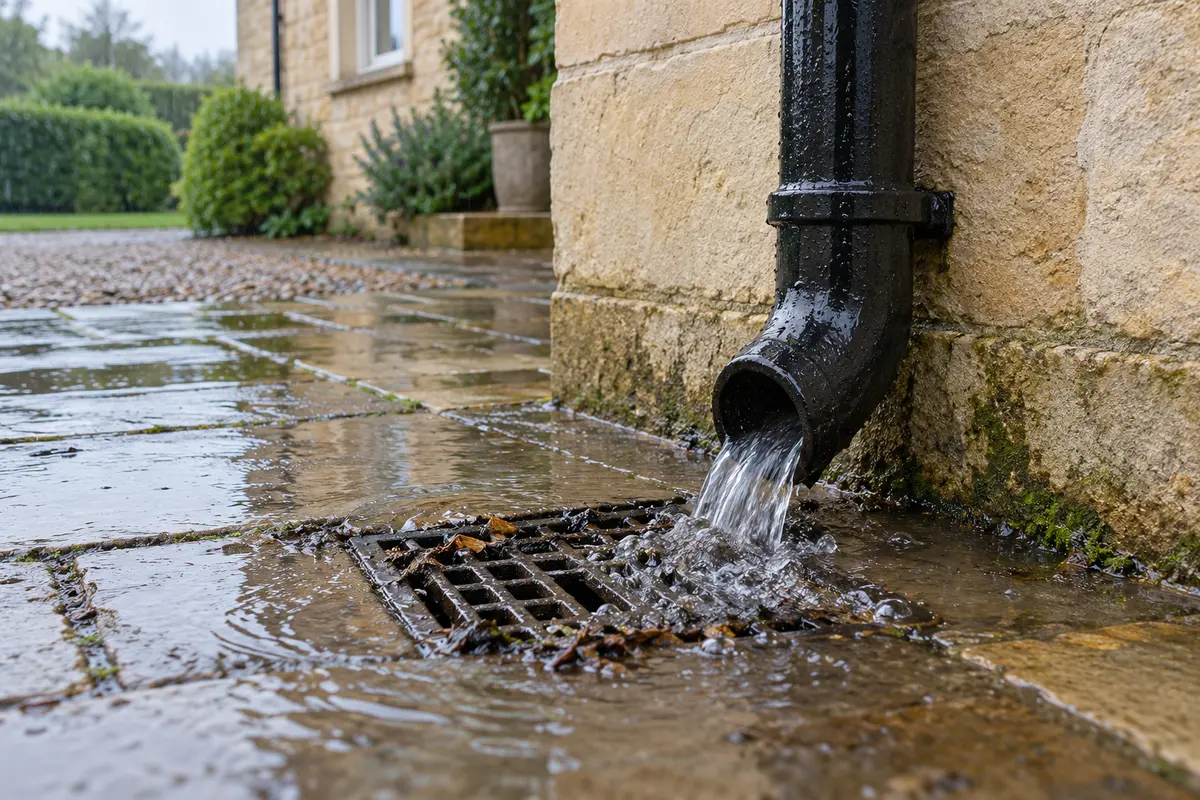
 01 · WATCH THE LAST VISIBLE POINTIf water leaves the downpipe but pools around the gully, the restriction may be at ground level or farther along the drain—not in the roof gutter.AI-generated illustration · not a customer property or job
Follow the water route before naming the blockage
Rainwater normally moves through several separate parts: roof gutter, outlet, downpipe, shoe or connection, surface gully and underground drain. A problem in any one of them can produce an overflow elsewhere. The visible splash is therefore a clue, not a diagnosis.
Start by recording the last place where water is definitely moving and the first place where it backs up, escapes or disappears. That short observation is often more useful than simply reporting “the gutter is blocked”.
Clue 1: the gutter overflows near the outlet
If water rises in the gutter around the outlet while little or nothing appears at the base of the downpipe, the outlet or upper downpipe may be restricted. It could also be a gutter alignment or capacity problem, so do not assume that pushing a pole into the pipe will solve it.
A professional clear should deal with loose debris in the agreed gutter runs and outlet openings, then check the accessible downpipe route. If the pipe connects directly underground, it can be harder to see where the obstruction begins.
Clue 2: water escapes from a downpipe joint
Water spurting or seeping from a socket joint during rain can suggest that water is backing up below that point. It can also indicate a loose, damaged or poorly sealed joint. Staining on the wall in dry weather shows where water has travelled before, but does not prove the current cause.
Record which joint leaks, whether the base is discharging, and whether the gutter above is overflowing at the same time. Do not dismantle a full pipe during rainfall: retained water and debris may be released suddenly.
 02 · A LEAKING JOINT IS A CLUEEscaping water may indicate a restriction below, a defective joint, or both. Photograph the whole pipe route before arranging the correct work.AI-generated illustration · not a customer property or job
Clue 3: the downpipe flows but the gully fills
If water is clearly leaving an open downpipe shoe yet the grated gully fills and spills across the paving, the gutter and downpipe may be doing their job. The restriction could be within the gully trap or the underground drainage beyond it.
Remove only loose surface debris that can be reached safely without taking the gully apart. If water remains standing, smells foul, returns quickly or affects more than one drain, stop treating it as an ordinary gutter-clear problem and seek suitable drainage advice.
Open shoes make the handover point easier to see
Historic England notes that downpipes connected directly to below-ground drains may become blocked over time and that an open shoe discharging into a surface gully can make maintenance and repair easier. Many properties have a different arrangement, and altering it may require building-specific advice.
An open connection gives a visible handover point: water leaving the shoe shows that the upper route is passing flow; a gully that backs up shows that attention may be needed below. A sealed direct connection needs a more cautious assessment because the handover is hidden.
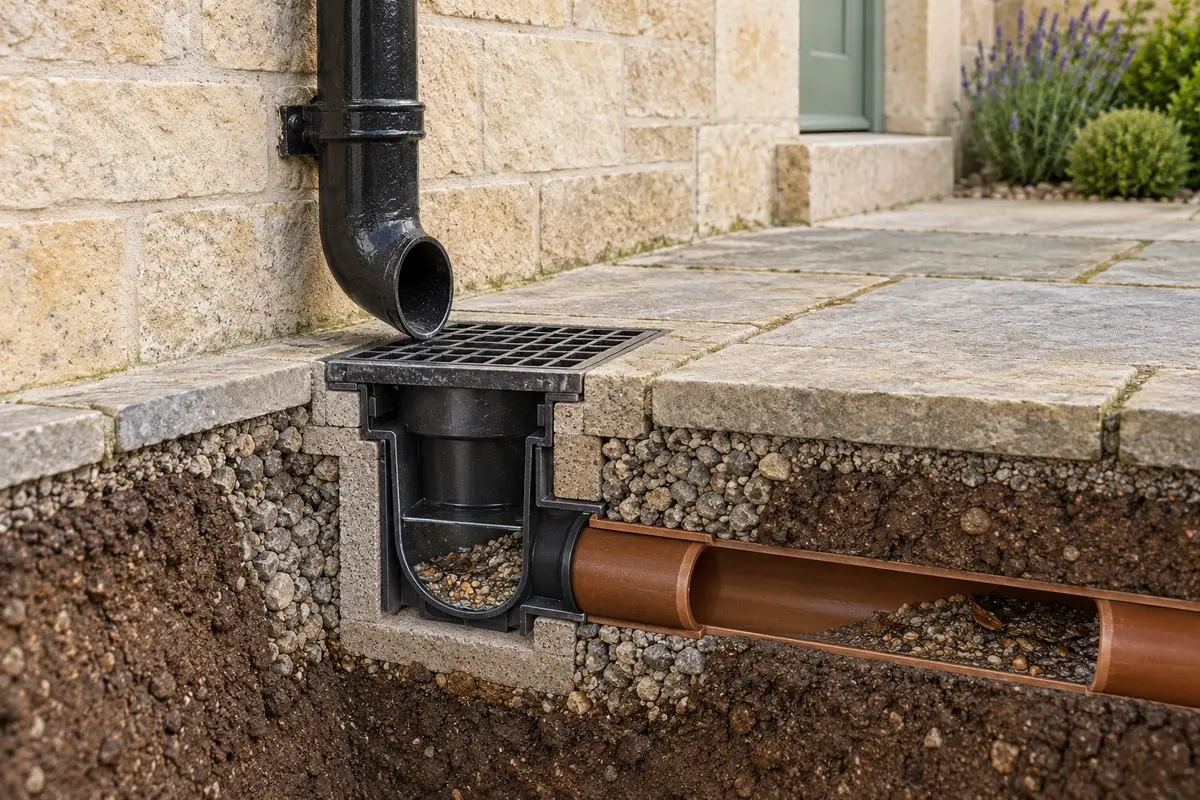 03 · KEEP THE SCOPES CLEARThe visible gutter and downpipe are one maintenance route; the trapped gully and underground pipe can require separate drainage work.AI-generated illustration · simplified cutaway, not a customer property or job
What a gutter-cleaning visit can reasonably check
- loose debris in the agreed gutter runs;
- the gutter outlet and accessible upper downpipe entry;
- visible joints, brackets and staining along the downpipe;
- whether an open shoe is discharging;
- whether a surface gully is visibly full or slow to clear;
- the result of any safe, agreed flow check;
- photographs showing where the maintenance scope ends.
A flow test confirms performance under that test at that time; it does not certify an underground drain. If a restriction is beyond the accessible downpipe or gully, it should be reported as a separate drainage concern.
Observe safely from firm ground
The Health and Safety Executive advises doing as much work as possible from the ground. During rain, keep clear of slippery paving, do not stand beneath an overflow and do not lean a ladder against a plastic gutter or weak surface.
A short phone video from a safe position can be valuable. Start with the gutter outlet, follow the downpipe down the wall, and finish at the shoe or gully. Include the surrounding paving so any pooling has scale and context.
What not to do
- do not force rods upward from a gully into an unknown pipe route;
- do not open a downpipe joint while it may be holding water and debris;
- do not mix chemical drain cleaner with mechanical clearing;
- do not claim an underground drain is clear because the roof gutter has been emptied;
- do not cover a gully grating or downpipe opening to hide an overflow.
Keep the handover clear: gutter clearing deals with the roof-level channel and agreed accessible downpipe work; a blocked trap, underground drain or shared drainage route may need a drainage specialist.
What to send with your quote request
- postcode, property type and number of storeys;
- a wide photograph showing the gutter outlet and entire downpipe;
- a close photograph of every leaking joint or wet stain;
- a photograph of the downpipe base, shoe, gully and surrounding paving;
- a short video during rain, taken safely from ground level;
- whether the gully empties after the rain stops and roughly how long it takes;
- whether any other gullies or drains on the property are also slow;
- access constraints such as locked side passages, extensions or neighbouring land.
For related advice, see our overflowing gutter checklist, roof moss and gutter guide and service areas across Bath, Bristol and surrounding towns.
Guidance checked on 16 October 2026: Historic England—inspection, maintenance and repair of rainwater systems; Historic England maintenance checklist; SPAB rainwater fittings advice; HSE work-at-height guidance.
Share this guide
Know someone trying to work out whether the blockage is in a downpipe or at ground level? Share this practical guide.
Share on FacebookShare on WhatsApp