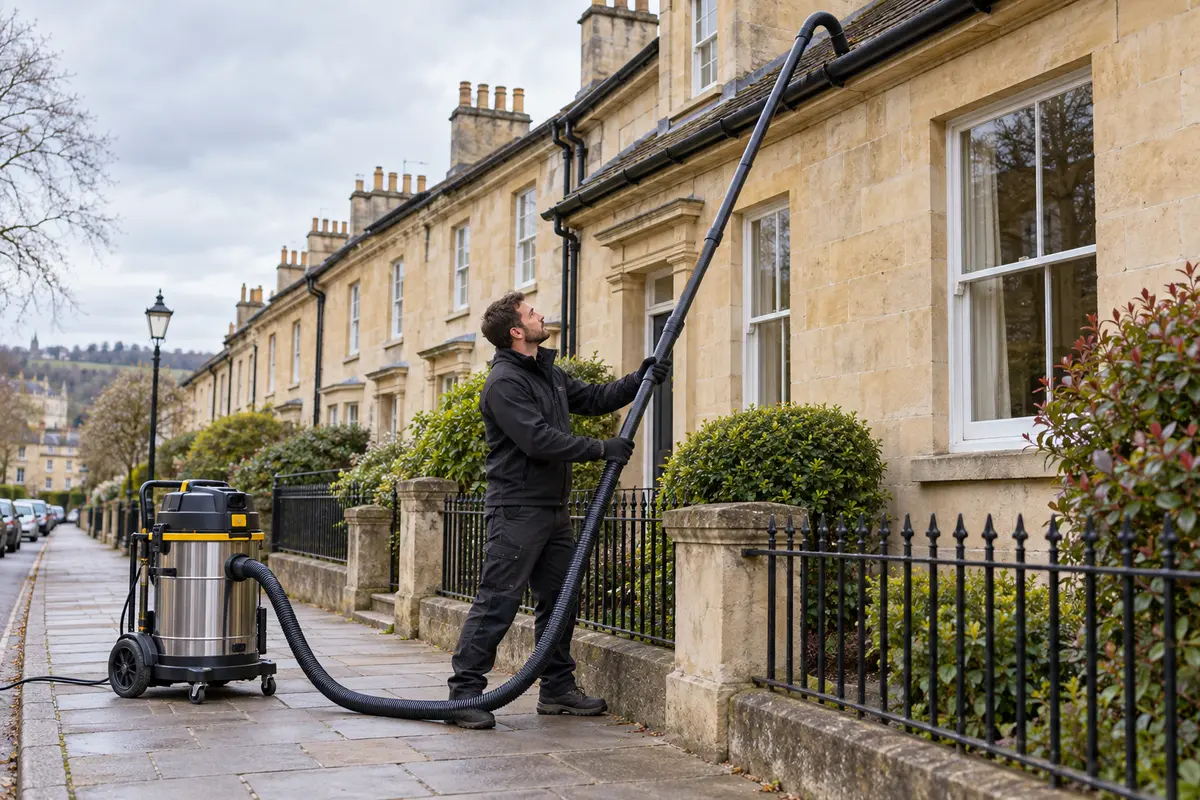
 01 · CLEANING FROM FIRM GROUNDA long hollow pole and suitable vacuum can remove loose gutter debris without placing an operator at the eaves.AI-generated illustration · not a customer property or job
Gutter vacuum cleaning uses connected poles and a powerful wet-and-dry vacuum to lift debris from the gutter while the operator remains on the ground. It can be an efficient way to clear many ordinary gutter runs, but it is not a promise that every obstruction, downpipe fault or damaged fitting can be dealt with from ground level.
The result depends on the material in the gutter, the route available to the pole, the height and shape of the building, and whether the outlet and downpipe can be checked properly. A useful quote should consider all of those points, not simply the total length of guttering.
What a gutter vacuum can usually remove
With the right nozzle and sensible access, vacuum equipment is well suited to loose or liftable material such as:
- dry leaves and small twigs;
- wet leaf sludge and loose organic matter;
- loose moss that has fallen from the roof;
- silt and grit gathered along the bottom of a gutter;
- small, loose fragments that fit safely through the nozzle.
Wet material is often much heavier than it looks. Pole length, nozzle shape and the vacuum specification all affect what can be lifted, so an operator may need to work in short sections and confirm progress with a camera rather than relying on suction sound alone.
Why ground-operated equipment can be useful
HSE guidance says work at height should be avoided where reasonably practicable and that as much work as possible should be completed from the ground. A suitable telescopic vacuum system follows that principle for accessible gutter runs.
Ground-based work still needs planning. The operator needs firm, clear space for the machine and poles, safe separation from passing people and vehicles, and a workable angle to the gutter. Overhead cables, fragile canopies and very confined spaces can change what is safe or practical.
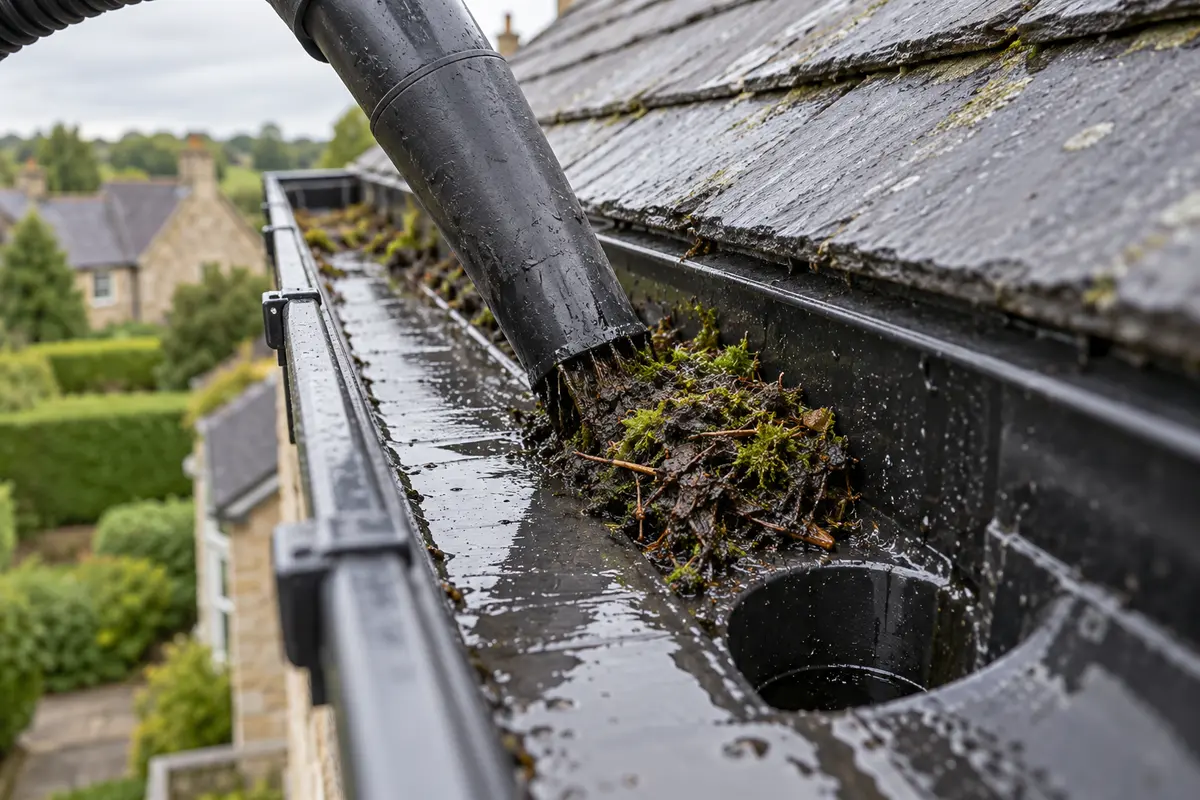 02 · REMOVE LOOSE MATERIAL FIRSTLoose silt, moss and small twigs can often be lifted cleanly, allowing the outlet and the bottom of the gutter to be seen.AI-generated illustration · not a customer property or job
Inspection matters as much as suction
A vacuum hose cannot by itself confirm that the whole run is clean. Before-and-after camera views help show whether debris remains behind brackets, around corners, under tiles or close to the outlet. They also help reveal defects which cleaning will not solve, including open joints, loose brackets, cracked stop ends or a gutter that has sagged away from its proper fall.
Historic England recommends understanding and recording how the complete rainwater system functions. For homeowners, landlords and facilities managers, that means identifying each outlet, downpipe and ground-level discharge point rather than treating the visible gutter as an isolated component.
What may not come out by vacuum alone
Some obstructions are too large, too firmly attached or too awkwardly positioned to lift through a vacuum nozzle. Examples include:
- established plants with roots matted beneath tiles or around an outlet;
- large pieces of slate, tile, mortar or building offcut;
- objects wedged below a bracket or inside a tight corner;
- material caught beneath a gutter guard or outlet cage;
- debris inside an inaccessible downpipe bend;
- a restriction in the underground drain or ground gully.
SPAB notes that leaves, moss and debris such as broken tiles can block gutters, downpipes and gullies. The correct response may be careful manual removal using suitable access, dismantling part of a fitting, clearing a downpipe separately or arranging drainage work. Those are different tasks and should be described separately in the quote.
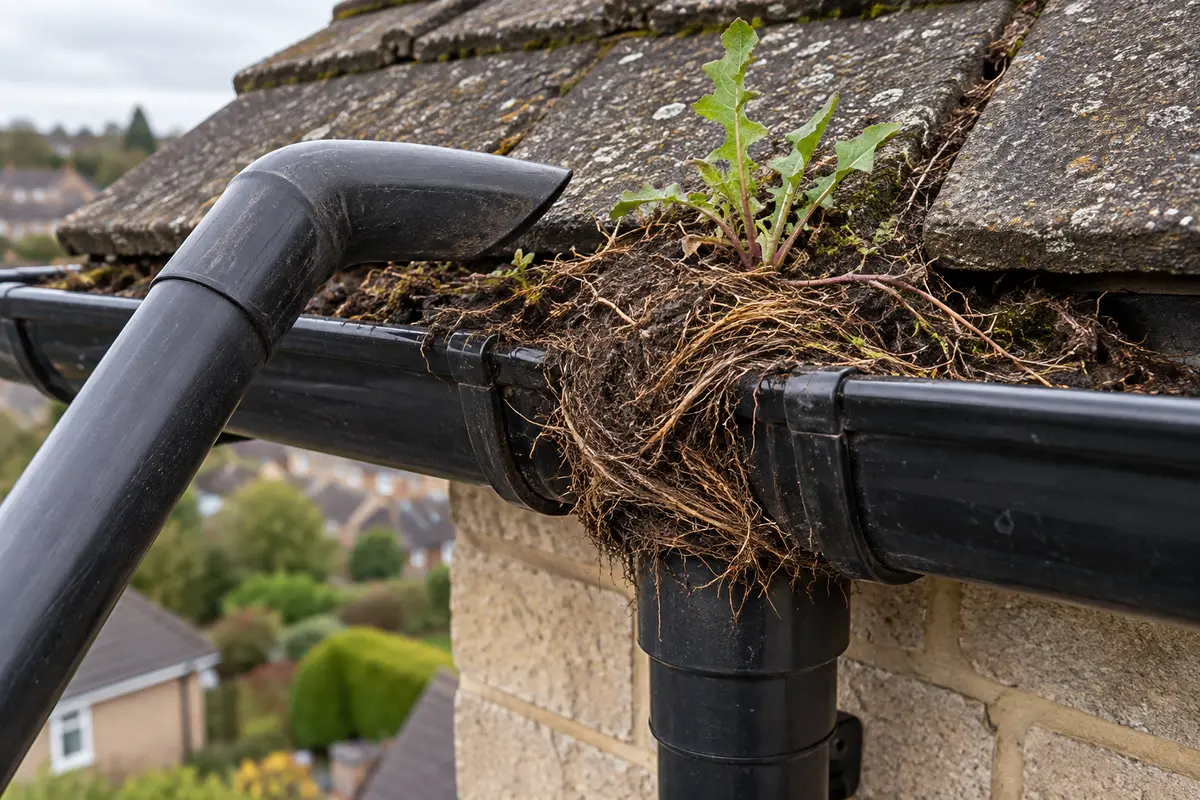 03 · KNOW WHEN VACUUM-ONLY CLEANING STOPSA rooted mass or wedged object may need planned hands-on access; pulling hard from below can damage the gutter or roof edge.AI-generated illustration · not a customer property or job
Awkward rooflines can change the method
Conservatories, extensions, deep porches, narrow side passages and roofs at several levels may prevent a pole from reaching the gutter at a useful angle. Valley, box and parapet gutters can also be hidden from ground view. A remote camera may improve inspection, but it does not automatically create safe physical access.
If hands-on work at height cannot be avoided, HSE says it should be properly planned, supervised and carried out by competent people using the right equipment. Homeowners should not climb onto extensions, conservatory roofs or improvised platforms to deal with what a vacuum has left behind.
Vacuuming does not prove the downpipe is clear
Clearing the gutter and exposing the running outlet is only part of the rainwater route. Once loose solids have been removed, a controlled flow check can help show whether water enters the outlet and travels through the downpipe to the intended gully, water-butt diverter or drain connection.
If the gutter is clear but water backs up at ground level, the restriction may be in the gully or below-ground drainage. If water leaks from a joint, spills behind the gutter or remains in a low point, repair or realignment may be needed rather than more vacuuming.
What to send when requesting a quote
A few clear details help establish whether ground-operated vacuum cleaning is likely to suit the property:
- the property type and number of storeys;
- photographs of the front, rear and side elevations;
- the position of conservatories, extensions, canopies and narrow passages;
- how many outlets and downpipes are visible;
- whether water is overflowing from the gutter, a joint, a hopper or the gully;
- any visible plants, roof debris, guards or damaged fittings.
For related advice, read our guides to gutters above conservatories and extensions, blocked downpipes and gullies and sagging gutters that need more than cleaning.
Guidance checked on 21 October 2026: HSE—working at height safely; HSE—step-by-step work-at-height guide; SPAB—rainwater fittings; Historic England—inspection, maintenance and repair of rainwater systems.
Share this guide
Know someone arranging a gutter clean? Share this practical explanation of what vacuum cleaning can remove and where its limits lie.
Share on FacebookShare on WhatsApp