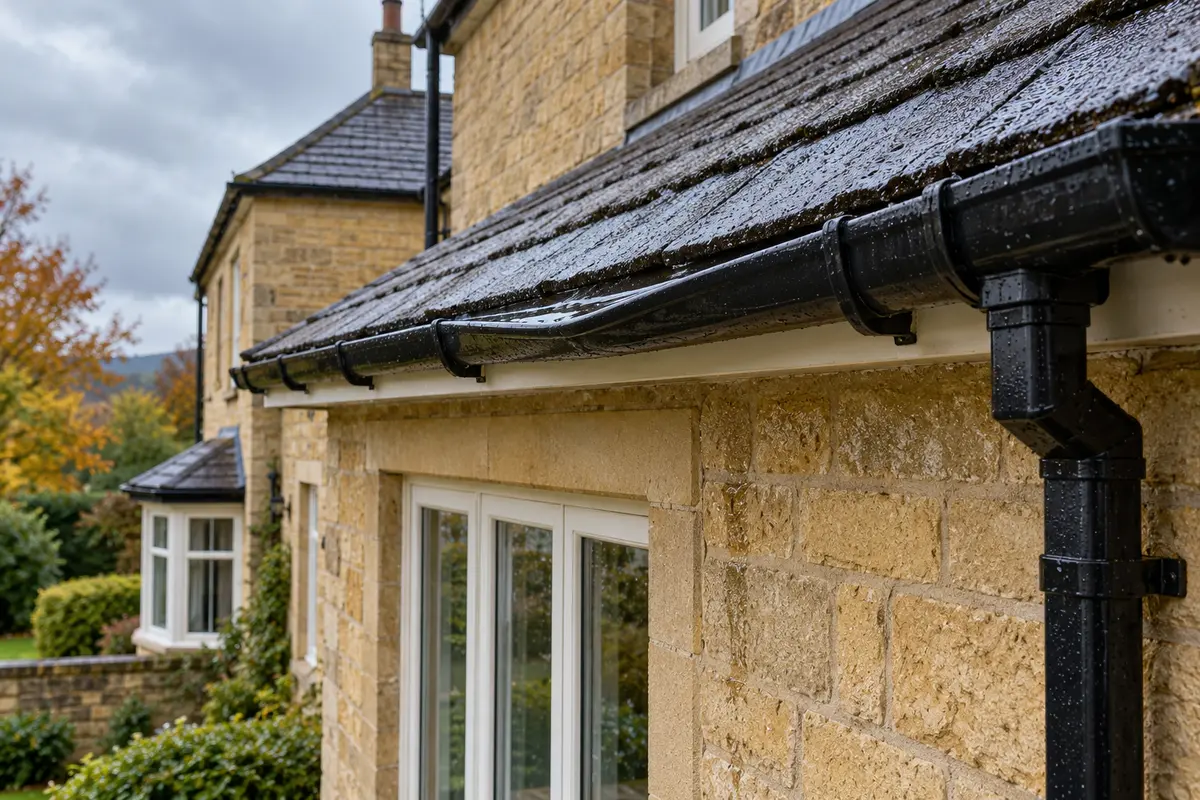
 01 · LOOK FOR A LOW POINTA sag can hold water between rain showers and send overflow over the wrong part of the wall. Removing debris may reveal the shape, but it will not restore failed support.AI-generated illustration · not a customer property or job
What a sagging gutter looks like
A healthy gutter run should be consistently supported and arranged to carry rainwater towards its outlet. A sag introduces an unintended low point. Water can remain there after the rest of the run has drained, and the gutter may overflow between downpipes rather than at an obvious blockage.
From firm ground, sight along the front edge of the gutter. A short dip between brackets, a joint sitting lower than the sections beside it, or a run that rises as it approaches the outlet can all justify a closer inspection. Long runs may have an intentional fall, so judge the route towards the outlet rather than expecting every gutter to appear perfectly level.
Clues you can record safely
- a visible bow or twist between fascia brackets;
- water spilling from the middle of a run while the outlet appears clear;
- a popped front lip or gutter section no longer seated in its bracket;
- joints that are stepped, pulled apart or repeatedly leaking;
- staining on the fascia or wall beneath one low section;
- a loose bracket, missing fixing or cracked fixing point;
- water still dripping from one area well after rainfall has stopped.
Photograph the whole run as well as the defect. A close-up alone may show a loose clip but not whether the gutter is falling towards or away from the outlet.
Why clearing alone may not solve it
Wet leaves, moss and silt add weight to a gutter. Clearing that material reduces the load and opens the water path, but a gutter will usually remain misshapen if its brackets are loose, too widely spaced for the installed system, damaged or fixed into an unsound fascia.
The Society for the Protection of Ancient Buildings notes that eaves gutters supported by too few brackets can sag. It also recommends refixing gutters that slope the wrong way or discharge water onto the wall. That distinction matters: cleaning removes an obstruction; refixing and realignment are repair work.
Common causes of a low point
- Loose or missing fascia brackets: fixings can work loose or brackets can crack, leaving the gutter unsupported.
- Insufficient support: bracket spacing must suit the specific gutter profile, material and manufacturer’s instructions.
- Weak fascia or fixing substrate: a sound bracket cannot hold securely if the board behind it is split, decayed or poorly fixed.
- Misaligned joints: a union bracket or angle fitted out of line can create a step or restrict normal movement.
- Impact or misuse: ladders, falling branches and accidental knocks can distort brackets or the gutter edge.
- Repeated heavy loading: retained debris, standing water and snow can expose an already weak support arrangement.
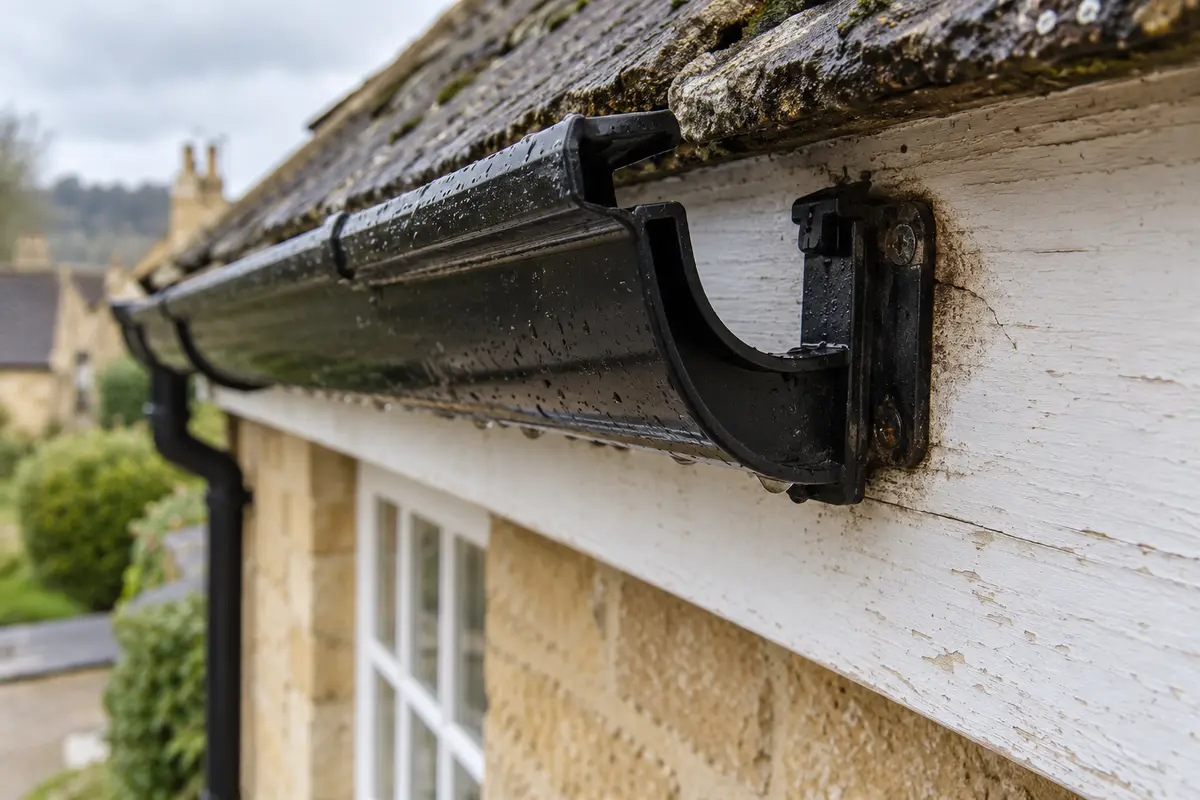 02 · CHECK WHAT THE BRACKET IS FIXED TOA loose fixing may be the visible problem, but the fascia behind it must also be sound enough to hold a repair securely.AI-generated illustration · not a customer property or job
The fascia board is part of the repair decision
Where brackets are fascia-mounted, the board is the fixing base. Dark staining, peeling paint, splits, softness or repeated movement around the screws can indicate that more than a replacement bracket is needed. Simply moving a screw into another weak area is unlikely to provide a durable repair.
If the fascia is timber, a roofer or suitable roofline specialist may need to assess local decay and the condition of the rafter ends behind it. With uPVC fascia, the installer must understand whether it is a structural replacement board or a cover board over timber. The repair scope should be agreed before the gutter is reloaded with water.
Bracket spacing is system-specific
There is no responsible universal spacing figure for every gutter. Profiles, materials, outlets, angles, local exposure and manufacturer requirements differ. A current FloPlast installation guide, for example, specifies maximum bracket spacing and closer support near angles and stop ends for its own systems. Those figures should not be copied blindly to another make or profile.
A repairer should identify the gutter type where possible, check the relevant technical guide and use compatible brackets and fittings. Mixing shapes that look similar can leave clips partly engaged or seals incorrectly compressed.
What a proper inspection should cover
- the complete run from stop end to outlet;
- debris load and whether the outlet is clear;
- bracket condition, fixing security and spacing;
- fascia condition at every affected fixing point;
- union brackets, angles, stop ends and seal positions;
- whether the gutter can move as its system requires;
- the fall towards the outlet and any retained low points;
- downpipe support and the receiving gully or drain;
- a controlled flow check after cleaning and agreed repairs.
FloPlast’s installation guidance illustrates using a line and checking the fall towards the outlet before the remaining brackets are fixed. The exact repair method depends on the installed system and the condition of the building, but alignment should be assessed as a whole run—not one bracket at a time.
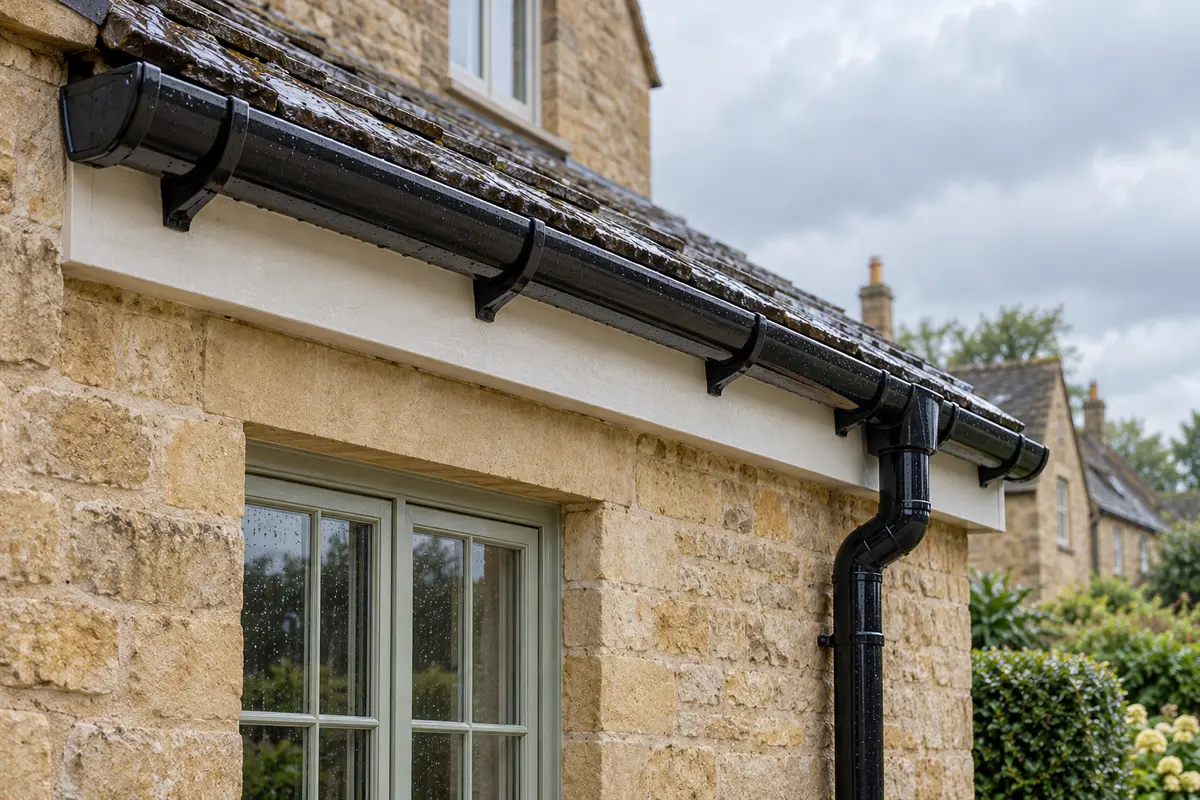 03 · ASSESS THE WHOLE RUNCompatible brackets, properly seated joints, sound fixings and a continuous route to the outlet need to work together.AI-generated illustration · not a customer property or job
When it is a clean, a repair or a roofline job
Cleaning may be enough when the gutter and brackets remain secure and correctly aligned once loose debris is removed, and a safe flow check confirms water reaches the outlet.
A gutter repair is likely when brackets, joints or short sections are damaged or misaligned but the fixing substrate is sound. The quote should identify which components are being refixed or replaced rather than describing everything as a clean.
A wider roofline repair may be needed when the fascia is decayed, distorted or insecure, several brackets have failed along the same board, or the roof edge itself shows movement. On older or listed buildings, retain appropriate traditional materials and seek suitable conservation advice before changing the system.
Observe safely from the ground
The Health and Safety Executive advises doing as much work as possible from the ground. Do not lean a ladder against a loose gutter, stand below a sagging section during heavy rain or try to push the gutter back into shape with a pole.
A short video taken from a safe position during or just after rain can show where water collects and spills. Start at the stop end, follow the full run and finish at the outlet and downpipe so the direction of travel is clear.
What to include with a quote request
- postcode, property type and number of storeys;
- a wide photograph of the complete gutter run and downpipe;
- close photographs of loose brackets, joints and fascia marks;
- whether the gutter holds water after rain or overflows during rain;
- roughly where the low point sits in relation to the outlet;
- whether the fascia is timber or uPVC, if known;
- access constraints such as conservatories, extensions or neighbouring land;
- any previous repairs to the same section.
For related advice, see our overflowing gutter checklist, fascia and soffit guide and service areas across Bath, Bristol and surrounding towns.
Guidance checked on 18 October 2026: SPAB—rainwater fittings; FloPlast—rainwater step-by-step installation guide; Historic England—inspection, maintenance and repair of rainwater systems; HSE work-at-height guidance.
Share this guide
Know someone with a gutter that bows, holds water or keeps overflowing? Share this guide to the signs and repair options.
Share on FacebookShare on WhatsApp