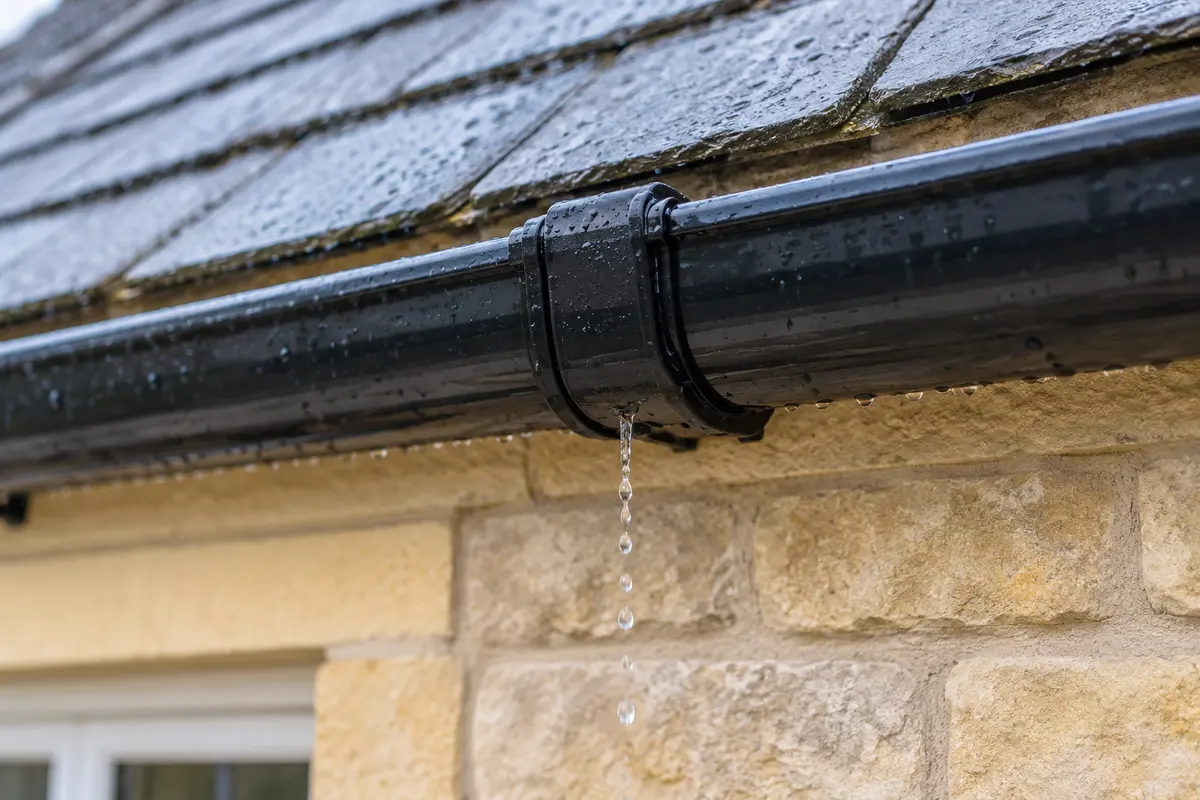
 01 · THE LOCATION OF THE DRIP IS A CLUEA narrow drip from the underside of one union joint is different from water rising along a blocked gutter and spilling over its front edge.AI-generated illustration · not a customer property or job
A drip directly beneath a uPVC gutter union does not automatically mean the whole gutter needs replacing. Dirt can sit on the rubber seal, a gutter length can move out of position, a poorly supported run can twist the fitting, or the seal and union itself may be damaged.
The right repair starts by identifying which of those conditions is present. Smearing sealant over the outside can hide the seam temporarily without correcting alignment, movement or a restriction that is holding water against the joint.
First decide: leaking joint or overflowing gutter?
Watch the rainwater from a safe position at ground level. A joint leak usually begins at the seam of a union, angle, outlet or stop end. An overflow normally appears as water rising in the channel and passing over the front or rear edge, sometimes along a wider section.
The distinction matters because a clean-looking joint may be under extra pressure from a blocked outlet, downpipe or gully. If the water level rises before the drip appears, clear the rainwater route first. If a precise seam still leaks during ordinary flow, inspect the fitting and support around it.
How a push-fit uPVC joint is meant to work
Common domestic uPVC systems join gutter lengths inside a union bracket fitted with rubber seals. The gutter ends clip into the fitting, while a marked allowance lets each length move as temperatures change. FloPlast and Brett Martin both instruct installers to preserve that movement allowance rather than forcing gutter ends too far into a fitting.
The union is also a support point. Brett Martin’s technical guide says joint brackets and outlets should be securely fixed and the remainder of the run established to a straight line or the required fall. A seal cannot compensate indefinitely for a fitting that is loose, twisted or carrying the load of a sagging length.
Cause 1: dirt is sitting on the seal
Fine grit, roof dust, moss fragments and decayed debris can gather at a joint. Material trapped between the gutter and rubber seal can create a narrow path for water. A blockage elsewhere can make this worse by keeping the joint submerged for longer than intended.
Where access and the fitting allow, the joint can be opened, the gutter ends and seal cleaned, and the components inspected before refitting. Do not scrape the rubber with a sharp tool or use an aggressive solvent that is not approved for that system.
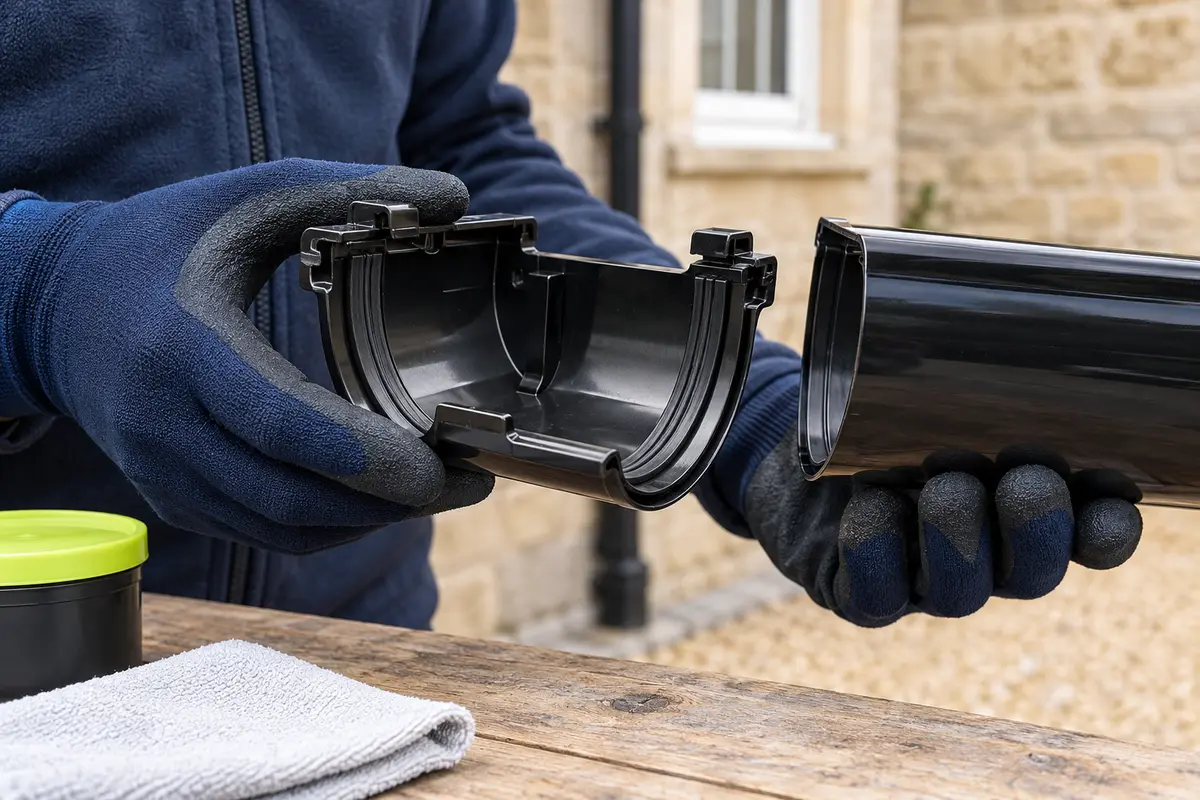 02 · INSPECT THE FITTING, NOT ONLY THE DRIPThe gutter ends, retained rubber seals and clips all need to be clean, intact and compatible with the same system.AI-generated illustration · not a customer property or job
Cause 2: thermal movement has pulled the gutter out of position
uPVC expands and contracts with temperature. FloPlast’s current rainwater FAQ says normal daily movement can be around 10mm over a four-metre gutter length, while Brett Martin explains that gutter ends should not pass beyond the expansion allowance line in the fitting.
A length inserted too far has no room to expand; one sitting too short may pull away from the seal. Repeated movement can also reveal a union that is not securely fixed. The repair should restore the manufacturer’s marked position and check the support on both sides rather than simply pushing the gutter back and leaving the cause unchanged.
Cause 3: poor alignment or support is twisting the joint
A loose fascia bracket, excessive spacing, a low point or a union fixed off-line can put uneven pressure on the seals. Clues include standing water beside the joint, a visible step between lengths, clips that do not engage evenly, or a run that moves when lightly checked by a competent person with safe access.
The support arrangement must suit the exact system and roof. Manufacturer bracket-spacing instructions vary, especially near angles, outlets and in areas exposed to snow. A lasting repair may involve refixing or replacing support components and realigning the run before the joint is closed.
Cause 4: the seal or fitting is damaged
Replace rather than improvise where the union is split or distorted, a retaining clip is broken, or the rubber seal is missing, cut, hardened or will not stay in its designed recess. Mixing profiles or fittings from different manufacturers can also produce a joint that looks close but does not seal or move as intended.
Use a compatible component for the existing gutter profile. A proprietary lubricant specified by the manufacturer is not the same as smearing general-purpose sealant around a push-fit union. FloPlast, for example, specifies its silicone spray lubricant on gutter seals to ease fitting and allow movement; follow the instructions for the actual system on the building.
What a proper joint repair should include
High-level work should be planned around safe access. HSE advises doing as much as possible from the ground and specifically warns against resting a ladder on plastic gutters. Once competent access is in place, a useful repair sequence is to:
- clear the gutter, outlet and accessible top of the downpipe so backed-up water is not masking the fault;
- identify the gutter make, profile and compatible union where possible;
- unclip the joint without damaging the gutter edge or retaining clips;
- clean and inspect both gutter ends, seals, clips and the union body;
- check the union is securely fixed and the adjoining run is correctly supported;
- refit each end to the system’s expansion allowance marks;
- use only the lubricant or replacement parts approved for that system;
- carry out a controlled water test and check the outlet and final discharge route.
A controlled test should add only enough water to confirm the joint and flow path. Stop if the gutter begins filling, the downpipe backs up or the receiving gully cannot accept the flow.
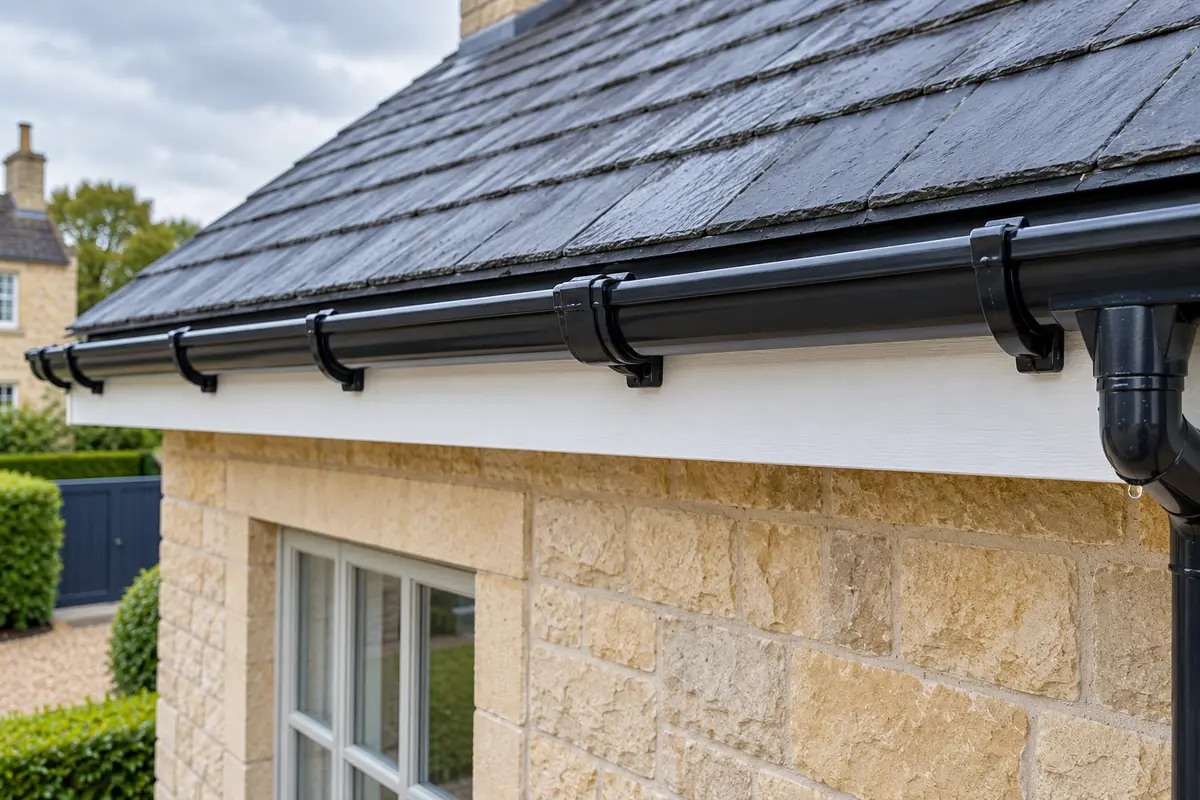 03 · ALIGNMENT AND SUPPORT PROTECT THE SEALA union works as part of the whole run. The joint, neighbouring brackets, gutter position and outlet route should be checked together.AI-generated illustration · not a customer property or job
When is more than one joint likely to need attention?
Several leaks along the same elevation can point to wider movement, poor bracket support, an incorrect fall or components that have reached a similar condition. Repeated failures soon after repair may also justify checking whether the system has been assembled from incompatible parts.
For older or metal rainwater goods, the repair method is different. Cast iron, aluminium and traditional systems can use bolted, sealed or soldered joints and may require material-specific preparation. Read our guide to cast-iron gutters on older homes rather than applying uPVC advice to them.
Useful photographs for a quote
From a safe position, send:
- a wide photograph showing the full gutter run and downpipe;
- a closer view of the exact joint, outlet, angle or stop end that drips;
- a short video during rain, if it can be recorded safely from ground level;
- front and rear access photographs;
- the number of storeys and any conservatory, extension or narrow passage;
- whether the gutter also fills or overflows before the joint starts leaking.
For related checks, see overflowing gutters: blockage or leaking joint?, when a sagging gutter needs more than clearing and how to trace a blocked downpipe or gully.
Guidance checked on 31 October 2026: FloPlast—rainwater FAQs; FloPlast—rainwater installation guide; Brett Martin—rainwater FAQs; Brett Martin—rainwater technical guide; Historic England—building construction and rainwater goods; HSE—working at height.
Share this guide
Know someone with a gutter joint that drips whenever it rains? Share this guide to the likely causes and the checks behind a lasting repair.
Share on FacebookShare on WhatsApp