
 01 · LOOK UP BEFORE EQUIPMENT IS UNLOADEDThe roofline, access route and full movement of long equipment must be checked against every nearby overhead line.AI-generated illustration · not a customer property or job
Overhead electricity lines are not just a concern for cranes and large building sites. Gutter cleaning can involve ladders, lightweight carbon poles, scaffold components or a mobile platform—each long or high enough to enter the danger area if its position and movement are not planned.
The key question is not simply whether a wire touches the gutter. It is whether a person, tool or item of access equipment could approach a live conductor while being carried, assembled, raised, used or moved. HSE warns that direct contact is not necessary: electricity may flash over when something comes too close.
Begin with a full ground-level survey
Before choosing the cleaning method, stand far enough back to see the whole elevation. Look above the front, side and rear of the property, along the route from the vehicle, and around every place where equipment may be assembled. A line that is clear of the gutter can still cross the approach or the space needed to raise a pole.
Note the utility pole, the direction of each wire, the gutter sections beneath or beside them, and any service cable fixed to the building. Include sloping gardens and changes in ground level because the working height and angle can change as equipment moves.
Do not identify a wire by guesswork. HSE says not to mistake electricity lines on wooden poles for telephone wires and to assume overhead lines are live unless their owner proves otherwise. A bundled or insulated-looking cable is not permission to work close to it.
Long poles change the working envelope
Ground-operated gutter vacuuming can avoid putting a person at the eaves, but it does not remove the electrical hazard. Pole sections may be carried upright, joined on the ground, lifted through an arc and moved sideways between gutter sections. Wind, loss of balance or an unseen branch can change that path.
Carbon-fibre and metal components must never be treated as protection from electricity. HSE also warns that electricity can bypass materials such as wood, plastic or rubber if they are dirty or damp. Safety depends on avoiding the danger and maintaining the site precautions—not on gloves, boots or the apparent material of a tool.
Plan unloading, storage, assembly, lifting, operation and dismantling. Keep unused sections horizontal in an organised area and prevent anyone from carrying a long item through a route where it could be raised towards a line.
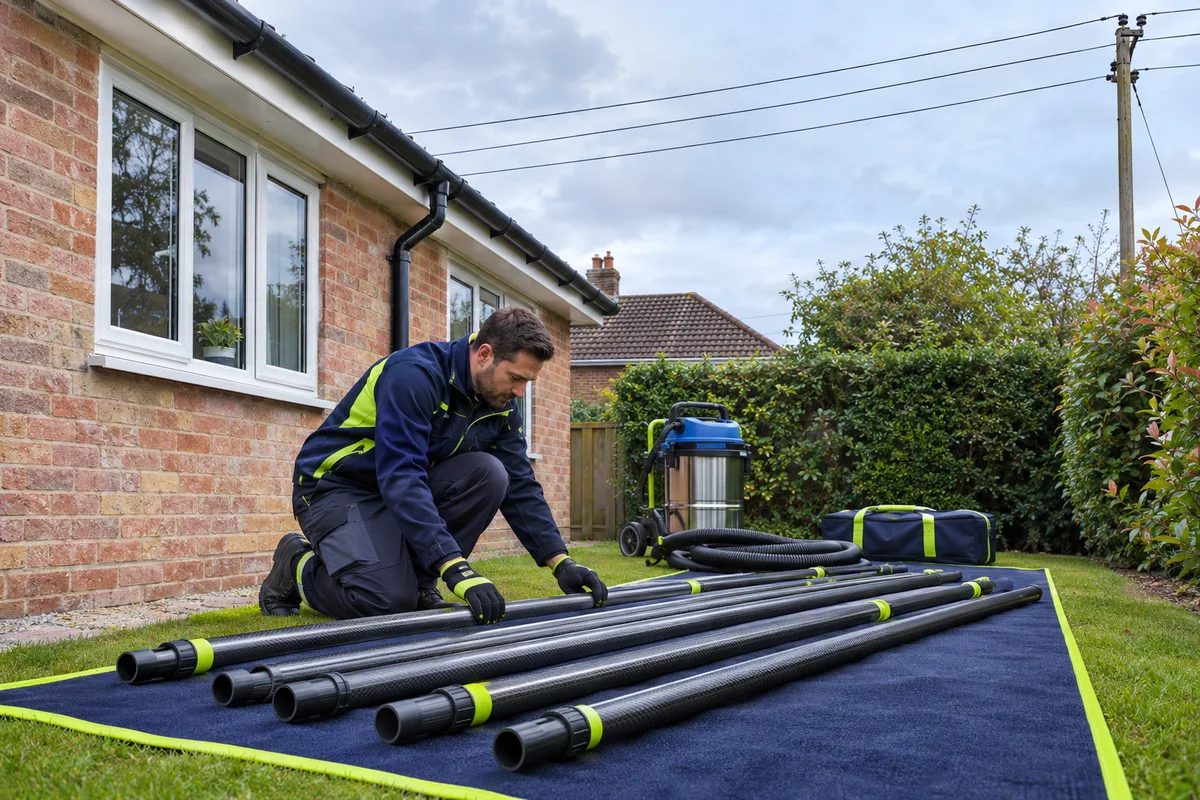 02 · INCLUDE THE FULL MOVEMENT OF EVERY POLEAssembly and carrying can be as important as the final working position, so long sections should stay controlled from start to finish.AI-generated illustration · not a customer property or job
A ladder position needs its own electrical check
A ladder can enter the danger area while it is being carried or raised even if its intended resting point looks clear. HSE’s ladder guidance says not to work within 6 metres horizontally of an overhead power line unless it has been made dead or protected with insulation. That is a planning rule for ladder work—not a distance to estimate casually from a photograph.
Do not lean a ladder on a plastic gutter, weak fascia or cable attachment. The chosen resting point must be structurally suitable, the ground stable and the ladder secured against movement. Electrical clearance is one part of the decision; the normal work-at-height assessment still applies.
If the available space does not let the task and ladder movement remain outside the danger area, the answer is not a shorter ladder, a person watching the wire or a quick attempt. The section needs a different method, advice from the line owner or a properly arranged isolation.
Contact the network operator early
The Distribution Network Operator (DNO) owns and maintains the local electricity network. HSE says the DNO should be consulted where lines are over or near the work area, site boundary or access route. The operator can identify its equipment and advise what measures are necessary for the proposed work.
Depending on the location and task, the safe decision may be to avoid that elevation, change the equipment or work position, have the line diverted, or arrange for it to be made dead. Only the line owner can confirm that its line is isolated or make arrangements such as temporary protection. These measures require advance notice and must not be improvised on the day.
In Great Britain, calling 105 connects you to the local network operator. Use the DNO’s normal planning channel for non-urgent work advice; keep 105 for faults, damage and electrical safety concerns.
Do not ignore the cable attached to the building
Some properties receive electricity through an overhead service cable that runs from a pole to a bracket, insulator or entry point near the eaves. It may cross a gutter-cleaning route or sit close to a downpipe. Weathering, movement, vegetation or previous building work can make the arrangement difficult to interpret from the ground.
Do not touch, lift, tie back or move a service cable to reach the gutter. Do not place a ladder, vacuum hose or tool against it. If its ownership, condition or clearance is uncertain, stop and ask the DNO to assess it before work is planned.
The electricity supplier that sends the bill is not normally responsible for the local poles and cables. The DNO is the correct contact for the network infrastructure.
Alternative access still needs a new assessment
Changing from a pole to a mobile elevating work platform, tower or scaffold does not automatically solve the problem. Taller equipment may create a larger danger area, while outriggers, delivery vehicles and assembly components need room beneath the work.
A suitable alternative may approach the gutter from an elevation away from the line, use a lower working height, or leave the affected section until the DNO has agreed precautions. The assessment must cover how the equipment arrives, turns, sets up, travels and is removed—not just its final position.
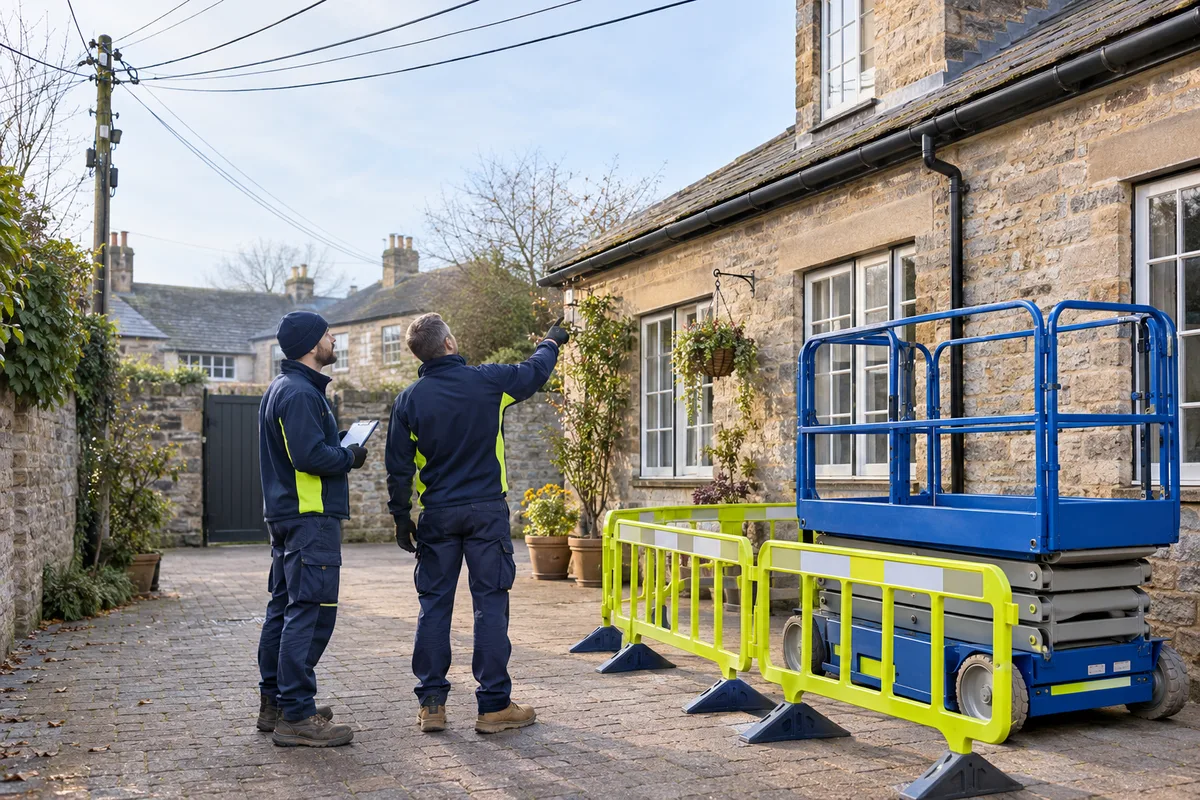 03 · A DIFFERENT MACHINE NEEDS A NEW ASSESSMENTPlatforms, towers and scaffold parts can create their own approach and movement risks near overhead conductors.AI-generated illustration · not a customer property or job
What to send with a quote request
Wide, uncropped photographs are more useful than a close picture of the gutter. Take them from a safe ground-level position—never by climbing, leaning out or approaching electrical equipment. Include:
- the whole elevation from ground to sky, with the gutter and every visible wire;
- the pole and the direction the conductors travel;
- the route from the road or driveway to the proposed work area;
- the point where any overhead service attaches to the building;
- side and rear views if the line position changes around the property; and
- trees, extensions, conservatories, slopes or narrow passages that limit movement.
Photographs help with initial planning but cannot prove voltage, ownership or a safe clearance. A site visit or DNO advice may still be needed before the affected section can be included.
Set non-negotiable stop conditions
Work should not begin—or should stop immediately—if an unrecorded line is discovered, equipment cannot be kept within the planned area, wind makes a long pole difficult to control, agreed line-owner precautions are absent, or someone proposes moving a cable to gain access.
If equipment contacts or comes dangerously close to a line, keep everyone away and do not touch the equipment or a person who may still be connected to it. Warn others, call 999 where there is immediate danger, injury or fire, and report the electrical hazard through 105. A line that appears to have tripped may re-energise without warning.
Record any section left uncleared
A completion report should state which gutter runs were cleaned, which could not be approached safely and why. Do not describe a whole property as cleared if a section beneath a service cable or overhead line was excluded. Mark it on a photograph and record the next action—such as DNO advice, alternative access planning or a return after isolation.
Related guides explain the limits of ground-operated gutter vacuuming, access planning for tall properties, how weather changes a gutter-cleaning job, and what useful before-and-after photographs should show.
The practical rule
If a ladder, pole, platform or component could enter the danger area around an overhead line at any point—from unloading to packing away—do not proceed on assumptions. Change the plan and involve the line owner where required.
Sources and further guidance
- HSE: Electricity—overhead power lines
- HSE: Overhead power lines—planning and precautions
- HSE GS6: Avoiding danger from overhead power lines
- HSE: Types of ladder and using them safely
- HSE HSG33: Health and safety in roof work
Share this guide
Know a homeowner, landlord or facilities manager with overhead lines near the roof edge? Share this guide before ladders or long poles are brought to site.
Share on FacebookShare on WhatsApp