
 01 · START WITH THE WHOLE PROPERTYMap every roof edge and rainwater route before deciding what needs cleaning or repair.AI-generated illustration · not a customer property or job
The first weeks after buying a property are a good time to establish a rainwater-maintenance baseline. You have the survey, you are learning which roof belongs to which room, and old stains or repair notes have not yet disappeared behind new paint or landscaping.
The aim is not to repeat a building survey or climb onto the roof. It is to turn the information you already have into a practical map: every gutter run, every outlet, every downpipe, where each pipe finishes, what is blocked or leaking, and what could not be inspected safely.
Begin with the survey—but do not treat it as a cleaning certificate
GOV.UK advises buyers to use a qualified surveyor before purchasing a home. The survey may mention blocked gutters, ageing rainwater goods, staining, difficult access or parts that could not be seen. RICS explains that more detailed home surveys can also include repair and future-maintenance advice.
Read the external roof and drainage sections again after completion. Highlight each reference to gutters, valleys, hopper heads, downpipes, gullies, damp staining and restricted access. Then compare those notes with the property as it now stands.
A survey describes condition at a point in time. It does not confirm that debris has since been removed, that every outlet flows, or that a concealed downpipe connection is clear. Equally, a cautious survey comment does not always mean the whole gutter system needs replacing. A clean and closer inspection can separate routine maintenance from an actual defect.
Draw a simple roofline map
Walk around the property from ground level and list each separate catchment. Start with the main front and rear eaves, then add side returns, porches, bay windows, dormers, rear extensions, garages, workshops and other outbuildings. Include flat-roof outlets and hidden valley, box or parapet gutters if the building has them.
For each section, record:
- the gutter material and visible profile;
- the nearest outlet and downpipe;
- whether another roof or downpipe feeds into it;
- where the lower pipe appears to finish;
- trees, roof moss or nearby higher roofs that may add debris; and
- anything obscured by conservatories, extensions or boundary access.
Historic England treats gutters, outlets, hoppers, downpipes, gullies and below-ground drainage as parts of one rainwater system. That whole-route approach is useful on any property, not just an older one. A clean eaves gutter is not enough if the downpipe is restricted or its gully is buried beneath a planter.
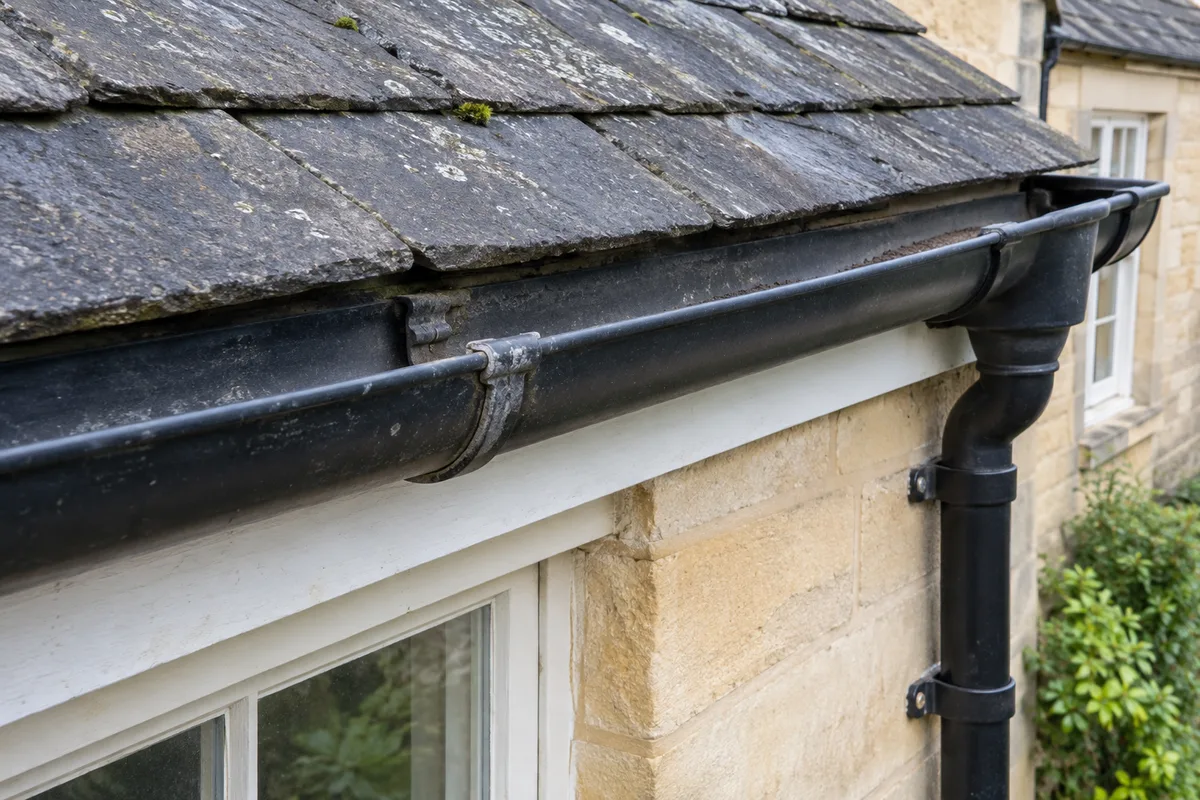 02 · RECORD CONDITION, NOT JUST DEBRISPhotograph joints, supports, outlets and pipe connections so cleaning and repair findings stay separate.AI-generated illustration · not customer work
Create a useful photo baseline
Take one wide photograph of each elevation, then closer views of each outlet, joint, stop end, hopper and downpipe connection that can be seen safely. Keep the sequence consistent—front left to right, then side, rear and outbuildings—so it can be repeated later.
A useful record should show both the component and its position on the building. A close-up of one dirty union without a wider view is difficult to identify six months later. For landlords or business premises, name the roof section in the file notes rather than relying on an image number.
Look for shallow silt lines, vegetation at outlets, displaced stop ends, joints with repeated staining, local sags, loose brackets, separated pipe sockets and green growth on the wall behind a downpipe. These clues should be recorded before cleaning, then photographed again once debris has been removed.
Do not diagnose every stain as an active leak. Old marks can remain after a repair, while a restriction may leave little evidence during dry weather. The value of the baseline is that later rainfall can be compared with a dated condition record.
Clear first, then judge alignment and leaks
RICS maintenance guidance recommends clearing debris from rainwater pipes and gutters at least annually, checking for leaks during rain, and looking for loose downpipe connectors and broken fixings. A newly purchased property may need an earlier check if there is no reliable maintenance record.
Debris can hold water, hide seals and make a correctly sized outlet appear inadequate. Once the accessible gutters and outlet mouths are clear, check whether water remains in one local pocket, escapes at a joint or fails to reach the outlet. Keep four findings separate:
- cleaning: leaves, moss, silt or roof granules removed;
- minor repair: a seal, stop end, clip or bracket needs attention;
- roof or building defect: water is passing behind the gutter or entering at a flashing or abutment; and
- drainage concern: the downpipe or gully backs up after the upper system is clear.
This avoids using sealant as a universal answer and prevents a clear gutter from being blamed for a blocked drain below it.
Trace every downpipe to its final discharge
Follow each pipe as far as you can from the ground. An open shoe may discharge over a gully; another pipe may enter the ground directly; a rear extension might feed a water butt; and an upper pipe can discharge onto a lower drained roof. Record the route rather than assuming all pipes connect in the same way.
Clear leaves and loose silt from visible gully grilles. If a pipe enters the ground, note that the connection is concealed—its condition cannot be confirmed from the eaves. Water rising around the gully, leaking from a low socket or appearing beside the wall needs separate drainage investigation.
On leasehold, shared or divided properties, confirm who is responsible for each roofline before authorising alterations. A pipe may serve more than one section of roof, and a short gutter visible from one garden may form part of a longer shared route.
 03 · FINISH THE RECORD AT GROUND LEVELPhotograph where each downpipe ends; a clear gutter still needs a working final discharge.AI-generated illustration · not a customer property or job
Use ordinary rain as a system check
After cleaning, observe the property during normal steady rain from a safe position. Watch where the roof water enters the gutter, whether it reaches the outlet, whether joints drip, whether the downpipe flows quietly and whether the final gully accepts the water.
Record the exact location and timing of any overflow. Water spilling along a full run suggests something different from a single drip at a union. A surge at the gully may point below ground, while water behind the gutter can relate to the roof edge or eaves detailing.
Do not wait for severe weather or stand beneath overflowing fittings. If active water is entering the building, saturating masonry or pooling beside the wall, move that item to the front of the repair list.
Prioritise the first jobs sensibly
Not every imperfection needs the same response. A practical order is:
- Active water entry or unsafe loose parts. Arrange prompt assessment.
- Blocked outlets, downpipes or gullies. Restore the route before judging capacity.
- Leaking joints, stop ends, clips and local sags. Repair the identified component and its supports.
- Hidden or inaccessible gutters. Plan suitable access rather than leaving them off the record.
- Cosmetic cleaning. Wash fascias and soffits after the source of staining has been addressed.
For listed buildings or traditional cast-iron and lead rainwater goods, retain sound historic material where appropriate and obtain suitable advice before replacement or rerouting.
Plan access rather than improvising it
The Health and Safety Executive says work at height should be properly planned and carried out by competent people using suitable equipment. It specifically warns against resting a ladder on plastic guttering or another weak upper surface.
Ground-operated cameras can provide useful evidence for many eaves gutters. Hidden valleys, roofs behind parapets and awkward sections above conservatories may need a different access method. Note anything not inspected; do not convert an access limitation into a guess.
A simple first-month record
Keep the survey extract, roofline map, before-and-after photographs, cleaning date, repair list and any access limitations together. Add the date of the next planned check and note whether nearby trees, roof moss or shared drainage are likely to change the frequency.
For a landlord, this becomes a handover baseline between tenancies. For a shop, office or managed building, it gives the facilities file a clear starting point. For a homeowner, it means the next stain, drip or overflow can be compared with something more useful than memory.
Related guides explain what before-and-after gutter photographs should show, how to distinguish a blocked downpipe from a blocked gully, when to include garages and outbuildings, and how to check hidden valley, box and parapet gutters.
The practical rule
Use the first weeks in a new property to create a complete rainwater baseline: map every roofline, clear the system, trace every downpipe, record the final discharge and keep cleaning, repair and drainage findings separate.
Sources and further guidance
- GOV.UK: How to buy a home
- RICS: house surveys, types and benefits
- RICS: home maintenance tips
- Historic England: inspection, maintenance and repair of rainwater systems
- Health and Safety Executive: working at height safely
Share this guide
Know someone who has just moved into a new home or taken over a property? Share this first gutter-check guide.
Share on FacebookShare on WhatsApp