
 01 · THE GUTTER MAY BE OUT OF SIGHTA parapet can hide the channel, lining and outlet from street level, so a clear-looking frontage does not prove the rainwater route is clear.AI-generated illustration · not a customer property or job
Not every gutter hangs at the edge of a roof. Valley, box and parapet gutters sit within or behind the roofline, where they can collect water from large roof areas while remaining partly or completely hidden from the ground. Their position makes inspection, access and record-keeping especially important.
A blockage in an ordinary eaves gutter often spills visibly over the front. A hidden gutter may instead send water into a roof void, behind a parapet or across masonry before the problem is noticed. That is why the complete route—from roof channel to outlet, hopper, downpipe and gully—needs to be understood.
What are valley, box and parapet gutters?
- Valley gutters carry water where two roof slopes meet. Some are open and visible from above; others are partly concealed by the roof covering.
- Box gutters are formed channels enclosed by roof or wall elements. They may sit between adjoining roofs, behind a fascia or beside an extension.
- Parapet gutters run behind a wall that rises above the roof edge. They are common on many older and architecturally detailed buildings.
The names can overlap in everyday use, and the construction varies from property to property. The useful question is not only what the channel is called, but where it starts, how it falls, how many outlets it has and where the water finally discharges.
Why hidden gutters deserve a separate check
Historic England advises that regular inspection, routine maintenance and scheduled repairs are essential for rainwater systems. It also recommends a roof plan showing how the system functions. For a hidden gutter, even a simple sketch can record the channel, outlets, hoppers, internal or external downpipes and any overflow route.
Maintenance frequency should respond to the building and its surroundings. Roof moss, nearby trees, nesting activity, wind-blown debris and fragments from ageing slates can all change how quickly a concealed outlet becomes restricted.
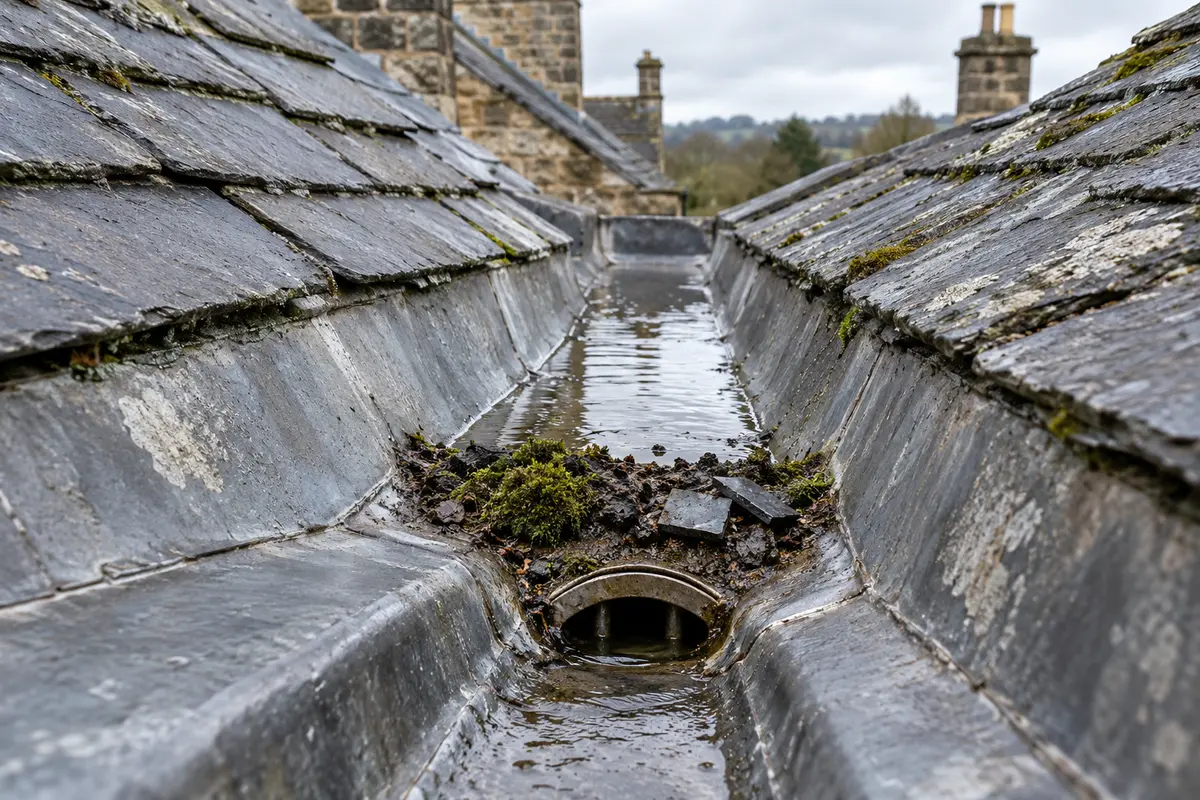 02 · OUTLETS ARE THE CRITICAL POINTSilt, loose moss and small slate pieces can form a compact dam at the outlet while the rest of the channel still looks relatively open.AI-generated illustration · not a customer property or job
What a proper inspection should include
A useful high-level inspection should look beyond loose debris. It should record:
- the full length and width of each accessible channel;
- standing water, silt lines or areas that do not drain towards an outlet;
- each outlet, sump, hopper and connecting downpipe;
- the condition of visible lead, asphalt, membrane or metal linings;
- open seams, splits, punctures, ripples or displaced coverings;
- loose coping stones, failed pointing or debris entering from the parapet;
- the condition and position of any designed overflow or weir;
- safe access arrangements for future maintenance.
Cleaning removes loose material. It does not repair a failed lining, create the correct fall or increase a channel that is too small for the roof area. Keep clearance, repairs and design alterations as separate items in the report and quote.
Remove solids before testing the flow
Loose leaves, moss, silt and roof fragments should be lifted from the channel and outlet before water is introduced. Washing solid debris into a narrow outlet or concealed downpipe can move the obstruction to a less accessible place.
After clearing, a controlled flow check can help confirm that water reaches the outlet and continues through the hopper or downpipe to the intended gully or drain connection. If the channel still holds water, the cause may be poor falls, deformation or an outlet set above the lowest point rather than remaining debris.
Warning signs visible from below
You may not be able to see the hidden gutter itself, but several clues justify a closer professional inspection:
- water spilling over a parapet or from the top of a hopper head;
- fresh dark staining or green growth high on the wall;
- damp patches or peeling finishes near the top-floor ceiling;
- drips appearing away from an ordinary eaves gutter;
- a downpipe that stays dry while water is visibly collecting above;
- repeated leakage during moderate rain, even after accessible gutters were cleared.
A stain only shows where water became visible; it does not prove the exact defect. The source may be a blocked outlet, failed joint or lining, displaced flashing, masonry defect or another part of the roof. Diagnosis needs the complete roof and rainwater route to be considered.
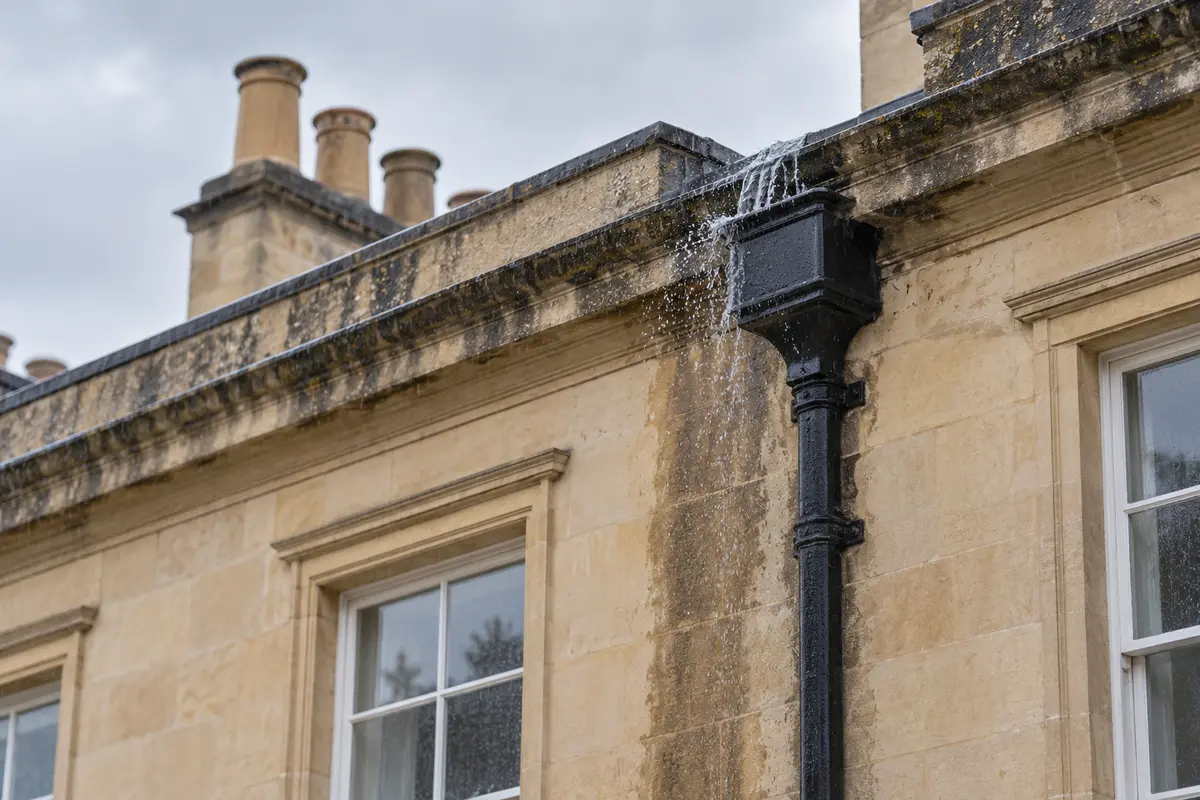 03 · LOOK FOR EXTERNAL CLUESAn overflowing hopper or new stain below the parapet can indicate that the concealed channel, outlet or downpipe needs checking.AI-generated illustration · not a customer property or job
Safe access cannot be assumed
Ground-operated cameras or extending equipment can sometimes help with an initial view, but many hidden gutters need close high-level inspection and hands-on clearance. HSE says work at height should be avoided where reasonably practicable and, where it cannot be avoided, properly planned, supervised and completed by competent people using suitable equipment.
A parapet is not automatically a safe guardrail, and an old roof surface may be fragile or slippery. Homeowners, tenants and untrained staff should not climb onto roofs or improvise access from windows. Depending on the building, suitable access might involve an existing protected walkway, scaffold, a tower or a correctly selected mobile elevating work platform.
Older and listed buildings need appropriate repairs
Bath and the surrounding area include many historic properties with traditional leadwork, cast iron, stone details and complex roof drainage. Routine clearing may be straightforward maintenance, but altering a historic gutter, outlet or downpipe can affect significant fabric.
Historic England notes that upgrades should minimise impact on listed or scheduled buildings. Before widening a channel, adding an outlet or replacing traditional materials, check whether conservation advice, listed-building consent or another approval is required. Like-for-like repair and careful recording are normally a better starting point than an unplanned alteration.
What to send when requesting a quote
Helpful information includes:
- front, rear and side photographs of the complete roofline;
- any safe existing photographs of the hidden channel—never climb to take them;
- the number and position of visible hoppers and downpipes;
- where water spills or damp appears and whether it happens only in heavy rain;
- the property height and any rear extensions, conservatories or narrow access;
- whether the building is listed, managed commercially or divided into several premises;
- details of any scaffold, roof hatch or permanent access already available.
For related advice, see our guides to cast-iron rainwater goods on older buildings, blocked hopper heads and safe checks after strong wind and heavy rain.
Guidance checked on 22 October 2026: Historic England—inspection, maintenance and repair of rainwater systems; Historic England—upgrades or alterations to rainwater goods; SPAB—rainwater fittings; HSE—working at height safely.
Share this guide
Know someone responsible for an older or complex roof? Share this guide to hidden valley, box and parapet gutters.
Share on FacebookShare on WhatsApp