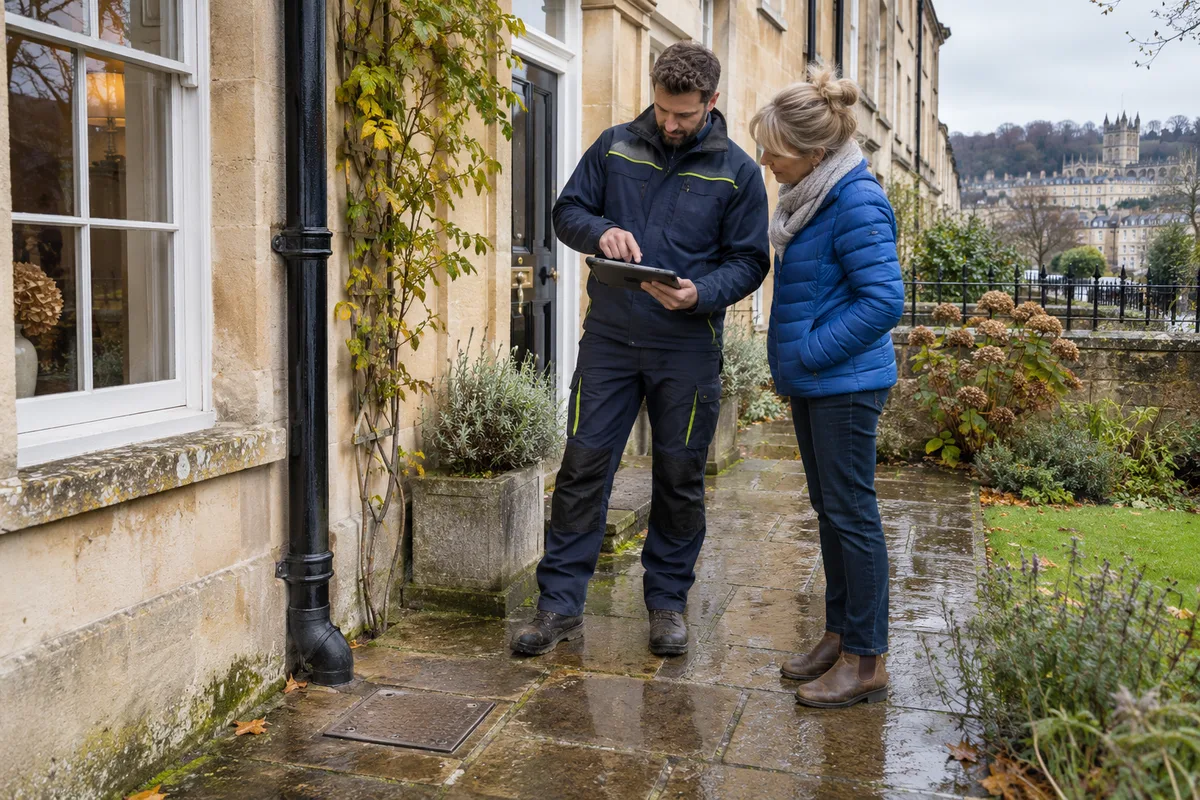
 01 · FOLLOW THE WATER BEYOND THE DOWNPIPEThe visible pipe may feed a gully, private drain, soakaway, watercourse or sewer. The destination changes what should be inspected next.AI-generated illustration · not a customer property or job
When a downpipe ends in a shoe above paving, its discharge is visible. When it enters a sealed socket or ground-level chamber, the rest of the route is hidden. An overflow at the base can therefore be caused by the downpipe, the entry point, an underground pipe, a soakaway or a downstream network—not necessarily by debris in the gutter.
The first job is to separate what can be observed from what is only assumed. Record the roof area feeding the pipe, the type of ground connection and when the problem appears. Do not describe a concealed route as “clear” simply because the gutter and upper downpipe have been cleaned.
Identify how the pipe enters the ground
From ground level, look at the last visible fitting. A downpipe may discharge over an open grated gully, enter a trapped rainwater gully, connect directly into a sealed underground socket or feed a water butt before the overflow continues elsewhere. These arrangements behave differently when a blockage develops.
An open gully gives a useful break point: you can see whether water is arriving from the downpipe and whether the chamber is holding or passing it. A direct sealed connection hides that evidence. Staining around the socket, movement in the lower pipe, silt pushed onto the paving or water escaping at a joint may show where the route is backing up, but they do not prove why.
Photograph the connection before disturbing anything. Include nearby inspection covers, gullies, changes in paving and the direction of the garden or driveway. On older or altered properties, several plausible routes may exist and the closest cover is not automatically connected to that downpipe.
Read the timing of the overflow
- Water spills from the gutter before reaching the downpipe: start with the gutter outlet, bends and upper pipework.
- The lower pipe or gully fills almost immediately: a restriction near the base or in the first underground section is possible.
- Flow starts normally, then backs up during prolonged rain: the underground route or its outfall may not be accepting water at the same rate.
- A lawn or border becomes persistently wet near the route: record the pattern and arrange drainage assessment; do not excavate on a guess.
- Several neighbouring properties have problems together: the issue may be beyond a single private connection and should be reported to the relevant drainage authority or water company.
These are clues, not final diagnoses. Rain intensity, the roof area served and water already in the ground all affect what you see. A controlled flow test can be useful when performed by a competent person, but flooding a doubtful pipe with a hose can simply move the problem or force water where it should not go.
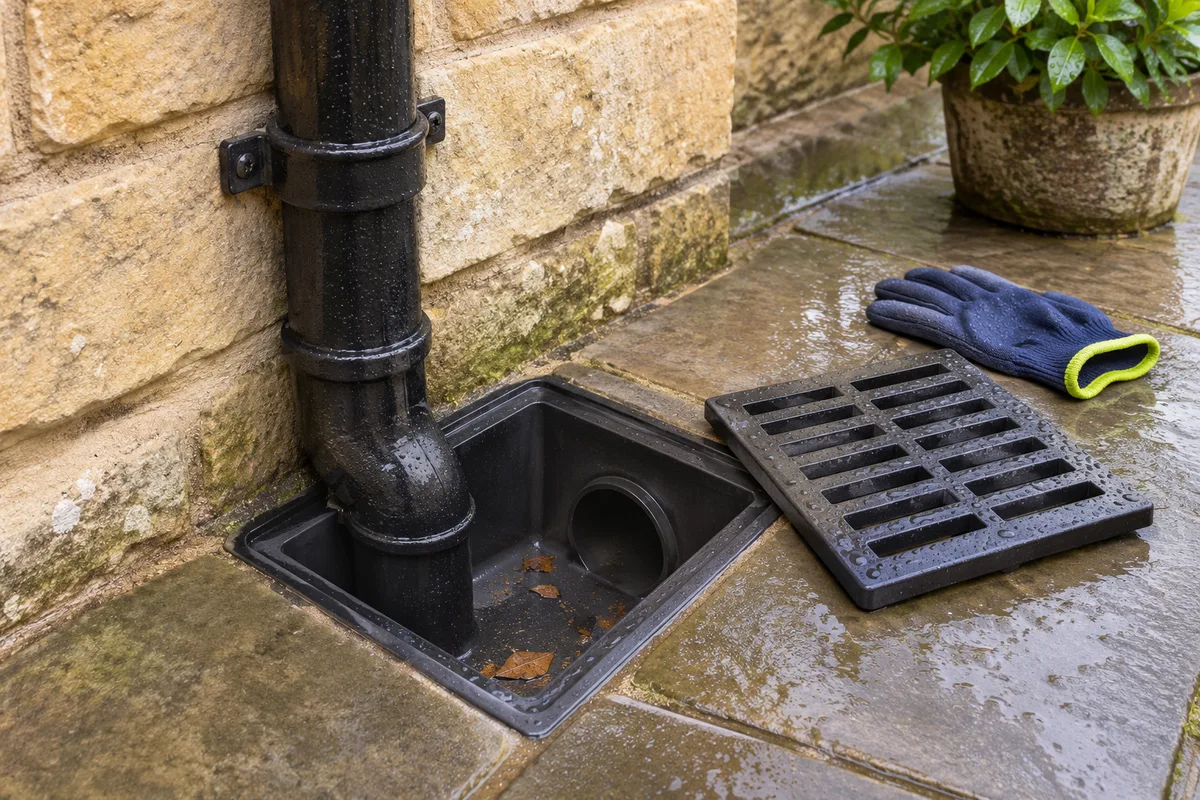 02 · USE THE ENTRY POINT AS EVIDENCEAn accessible gully can show whether water reaches ground level and whether the hidden route is accepting it.AI-generated illustration · not a customer property or job
Understand the possible destinations
In England, the Building Regulations require adequate provision for roof water and list the preferred discharge order for relevant new building work: an adequate soakaway or other infiltration system, then a watercourse where infiltration is not reasonably practicable, and finally a sewer. Approved Document H also says a rainwater system should minimise blockage and leakage and be accessible for clearing blockages.
That hierarchy is useful context, but it is not a shortcut for identifying an existing route. A Bath terrace, later extension and detached garage may each have been built at different times. Older properties can use combined sewers; newer layouts often separate foul and surface water. Some downpipes may enter a soakaway while others connect to a sewer.
Never redirect rainwater into a convenient foul drain or assume that an unlabelled pipe is suitable. Alterations can affect neighbours, public sewers, building foundations and local watercourses. Drainage design and new connections need the correct permissions, capacity checks and competent advice.
What a soakaway changes
A soakaway receives rainwater and lets it infiltrate into suitable ground. It is not simply an underground empty box that should remain dry. Performance depends on the soil, groundwater, construction, distance from buildings and the area draining to it.
During prolonged wet weather, slow ground infiltration can make a marginal or damaged system more obvious. Silt entering from an unprotected route can also reduce performance. Warning signs may include delayed backing-up, localised soft ground or repeated overflow after the visible pipework has been checked.
Do not dig beside foundations or services to search for a suspected soakaway. Existing drawings, a drainage survey and non-destructive tracing are safer starting points. If excavation is necessary, the route and underground services must be located first.
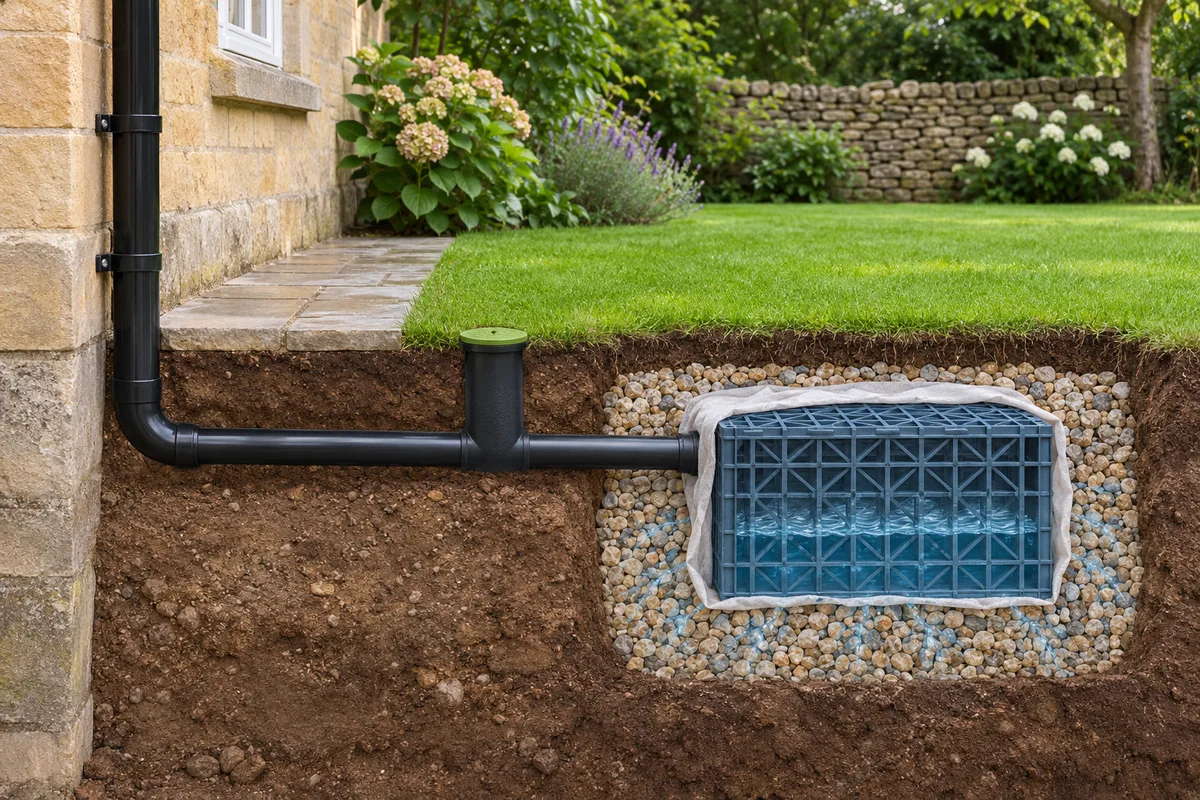 03 · A SOAKAWAY IS PART OF THE WHOLE ROUTEIts position, ground conditions and condition all affect how quickly roof water can leave the property.AI-generated illustration · not a customer property or job
Trace the route without guessing
Start with documents. Purchase surveys, extension drawings, Building Control records, drainage plans and previous invoices may identify a soakaway or connection. Wessex Water can provide sewer records showing the approximate position of public pipes, although private rainwater routes may not appear.
Then map what is visible: every downpipe, gully, inspection cover, water-butt overflow and known outfall. Number them on a simple property sketch. During rainfall, note which points flow, which remain dry and where water first backs up. For a landlord or business, keep the dated map with maintenance records so later visits compare the same points.
Where the route remains uncertain, a drainage contractor may use a camera, tracing equipment or a controlled dye test. Dye should only be used with a clear plan and suitable product; releasing colour into the wrong system or watercourse creates a new problem rather than solving the old one.
Know where responsibility may change
Wessex Water explains that property owners are usually responsible for pipework serving their home up to the boundary or the point where it joins shared pipework, whichever is closer. It also lists soakaways and rainwater systems that do not connect to a public sewer as private responsibilities. Public and shared sewer responsibilities can differ, so confirm the route before arranging work.
If sewage, foul smells, tissues or wastewater appear, stop treating the issue as routine rainwater maintenance. Keep people away from the area and report it through the appropriate wastewater route. Likewise, roadside gullies are normally a council matter, not part of a house gutter-cleaning job.
When gutter cleaning is enough
A gutter and downpipe clean may resolve the problem when debris is found and removed from the outlet or above-ground pipework, the ground connection remains sound and water then passes freely to the known discharge. The completion record should say what was cleared and what was actually tested.
Separate drainage assessment is sensible when the base continues to overflow after the visible system is clear, the route is unknown, a chamber is damaged, the ground stays saturated, or the suspected blockage lies beyond the accessible rainwater pipe. A gutter cleaner should not claim to have repaired a soakaway or underground drain without evidence and the right scope.
Inspect safely
Do not lift heavy inspection covers without suitable tools, enter chambers, put hands into standing water or use caustic drain chemicals. Avoid improvised rods in an unknown pipe: they can become stuck, damage fittings or push debris into a less accessible section. Keep the area clear if a cover, paving or chamber is unstable.
Most useful first observations can be made from ground level with photographs and rainfall notes. If the cause is concealed, record the limit and arrange the correct drainage investigation rather than dismantling or excavating by trial and error.
Related guides explain how to separate a blocked downpipe from a blocked gully, common downpipe endings, how water butts change the route, and how to investigate a repeat local blockage.
The practical rule
Follow rainwater from the roof to its final known destination. If the visible gutter and downpipe are clear but the base still backs up, stop calling it only a gutter blockage and identify the hidden route.
Sources and further guidance
- GOV.UK: Approved Document H — drainage and waste disposal
- The Building Regulations 2010: rainwater drainage requirement H3
- Planning Portal: drains and sewers
- Wessex Water: sewer pipe responsibility
- Wessex Water: managing rainwater runoff
Share this guide
Know someone whose downpipe disappears into the ground? Share this guide to tracing the hidden rainwater route before deciding what needs clearing or repair.
Share on FacebookShare on WhatsApp