
 01 · TRACE WHAT FEEDS THE TROUBLE SPOTA valley, upper roof or nearby branch can direct much more water and debris into one short section than the rest of the gutter receives.AI-generated illustration · not a customer property or job
A repeat blockage is rarely random. The same short gutter section may sit below a roof valley, collect debris from an overhanging branch, contain the only outlet on a long run or have a local low point where fine material settles.
Clearing the visible clump restores flow, but it does not explain why that position filled first. A useful inspection follows the route backwards—from the blocked section to every roof surface, junction and source of debris above it—then follows the water forwards through the outlet, downpipe and final discharge.
Start by mapping the roof catchment
Stand at ground level and identify which roof areas drain towards the affected section. A simple straight eaves gutter may receive water from one slope. A short run below an intersection can receive concentrated flow from two slopes, a valley, a dormer cheek or an upper downpipe as well.
Take one wide photograph that includes the roof geometry, gutter, outlet and downpipe. Then photograph the debris before it is removed. The wide view explains the route; the close view records what accumulated. For a landlord or business, mark the elevation and date so the same location can be compared at the next visit.
Do not judge the workload from gutter length alone. Two metres below a valley may collect more material than a much longer open run. The question is not simply “how much gutter is there?” but “what drains into this point?”
Roof valleys concentrate water and debris
A roof valley carries water from adjoining slopes towards the eaves. It also becomes a route for moss fragments, lichen, roof grit, twigs and leaves. Where the valley finishes above a short gutter section, that material arrives in a narrow zone rather than being spread evenly along the roofline.
Look for a compact wedge directly below the valley mouth, especially after prolonged rain or wind. Check whether the visible valley is clear and whether its discharge lands inside the gutter. Overshooting water, damaged valley details or a concealed high-level blockage are roofing or access issues, not problems to solve by leaning from a window.
Historic England’s rainwater guidance says regular inspection and maintenance are essential. It also notes that valley, box and parapet gutters may need close high-level assessment because a ground-level view is not always enough.
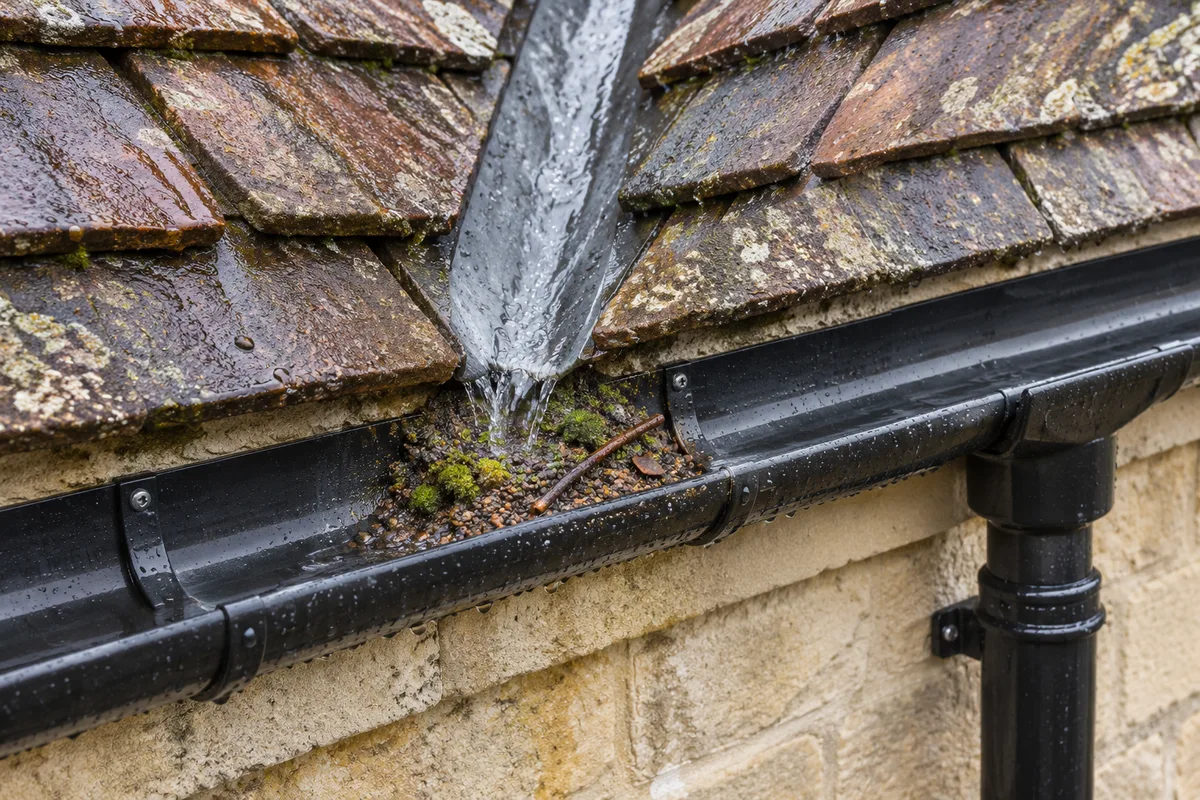 02 · READ THE DEBRIS PATTERNA compact wedge beneath a valley points to a concentrated feed from the roof above rather than a uniform whole-run problem.AI-generated illustration · not a customer property or job
Match the material to its likely source
- Whole leaves and small twigs usually point to nearby or upwind trees. One branch over a corner can affect a local section while the rest of the roofline stays open.
- Moss fragments and fine grit often arrive from the roof covering. Clearing the gutter removes the consequence; it does not treat the roof source.
- Mortar flakes, paint or corrosion products may indicate deterioration higher on the building and should be recorded rather than discarded without comment.
- Nesting material needs a careful wildlife check before disturbance. Never assume every clump is ordinary leaf debris.
A photograph of the removed material can be useful, but avoid claiming that a gutter clean has treated moss on the roof or repaired a roof defect. Keep the scope clear.
The outlet is a common pinch point
Debris that moves along a half-round or square gutter can stop at the outlet opening. Fine roof grit settles around the rim; a moss fragment bridges the opening; twigs hold leaves in place. Water then ponds behind a small obstruction even though most of the run looks clean.
Inspect the outlet from above when safe access is available, then check the downpipe route. A clear-looking opening does not prove that the first bend, swan neck or lower section is clear. If water remains slow after the outlet is cleaned, the restriction may be inside the downpipe or at the gully.
Record whether the outlet sits at the true low point and whether the surrounding gutter is supported. Do not enlarge, cut or drill an outlet as an improvised cure. Outlet size, downpipe capacity and compatible fittings are system-design matters.
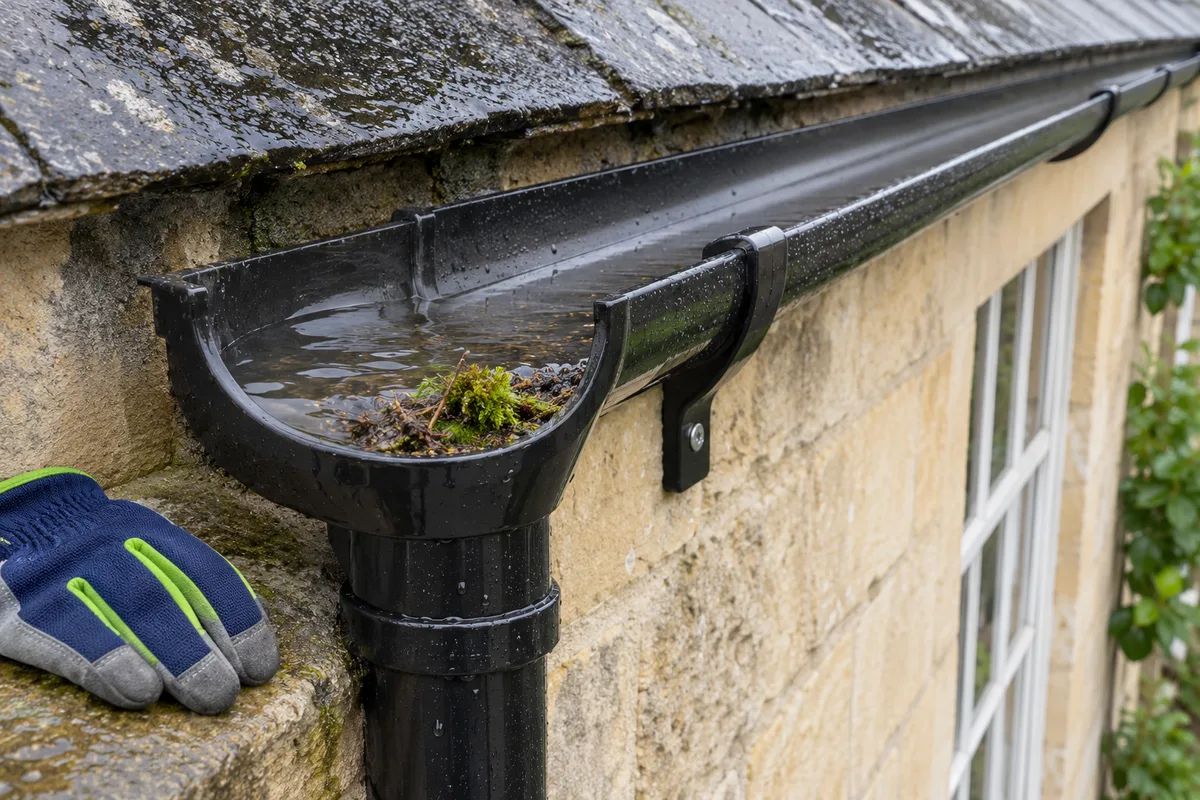 03 · CHECK THE OUTLET AND ROUTE BELOWA small restriction at the outlet can hold back water locally even when the gutter on either side is clear.AI-generated illustration · not a customer property or job
Check for a local sag or misplaced support
Fine silt settles where water slows. A gutter can appear straight from the garden yet contain a small low point caused by a loose bracket, distorted fitting, poor joint support or movement in the fascia. That pocket retains water after rain, allowing grit and organic matter to build up between visits.
Compare brackets and alignment on both sides of the trouble spot. Look for a dip, opened joint, twisted length or staining below the fascia. Do not assume every small amount of residual water means the whole run is incorrectly installed: profiles and manufacturers have different fitting instructions, so a diagnosis needs the actual system and levels.
If the section refills quickly after cleaning, a controlled flow test by a competent person can show whether water reaches the outlet or stays in a local pocket. Test the outlet and downpipe at the same time so a hidden restriction is not mistaken for a fall problem.
Use timing to separate seasonal and structural causes
When does the section block again? A repeat during the same few weeks of leaf fall suggests a local tree source. A blockage after windy weather may follow a fresh deposit of twigs or moss. Slow ponding throughout the year points more strongly towards alignment, outlet or downpipe flow.
Keep the record simple: date cleared, material removed, weather since the visit and condition at the next check. Two comparable records are more useful than a vague note that the gutter “always blocks”.
When cleaning is enough—and when to investigate
A targeted maintenance plan may be enough when the gutter and outlet are sound, the downpipe flows freely and the cause is predictable seasonal debris. The affected section can be checked after the main deposit rather than repeatedly clearing the whole property without evidence.
Further assessment is justified when the section refills unusually quickly, water remains after cleaning, brackets or joints move, the valley discharge misses the gutter, or the outlet and downpipe fail a flow test. The remedy might be a local repair, roof-level inspection, compatible outlet work or separate drainage attention—not simply another clean.
Guards and grilles are not automatic answers. They still need inspection and cleaning and should not cover poor alignment, insufficient capacity or a blocked route below. Historic England notes that accessible grilles can help prevent blockages in suitable locations, but maintenance remains essential.
Inspect safely
Wide photographs, rainfall observations and some camera-pole views can be taken from the ground. Roof valleys, dormers and concealed outlets may require planned access by competent people using suitable equipment. The Health and Safety Executive advises doing as much as possible from ground level and warns against resting a ladder on plastic gutters or glazing.
Do not lean from an upstairs window, walk on a wet roof or use a conservatory as an access platform. If the cause cannot be confirmed safely, record the limitation and arrange the right access.
Related guides explain how nearby trees change autumn timing, what roof moss in gutters can reveal, gutter fall and standing water, and how to separate a blocked downpipe from a blocked gully.
The practical rule
Trace the roof area above the repeat blockage, identify what is collecting, check the local gutter shape and support, then test the outlet, downpipe and final discharge as one route.
Sources and further guidance
- Historic England: inspection, maintenance and repair of rainwater systems
- Historic England: maintenance checklist
- Historic England: upgrades or alterations to rainwater goods
- RICS: home maintenance tips
- Health and Safety Executive: working at height safely
Share this guide
Know someone whose gutter always blocks in the same place? Share this guide to tracing the roof catchment, debris source and outlet route.
Share on FacebookShare on WhatsApp