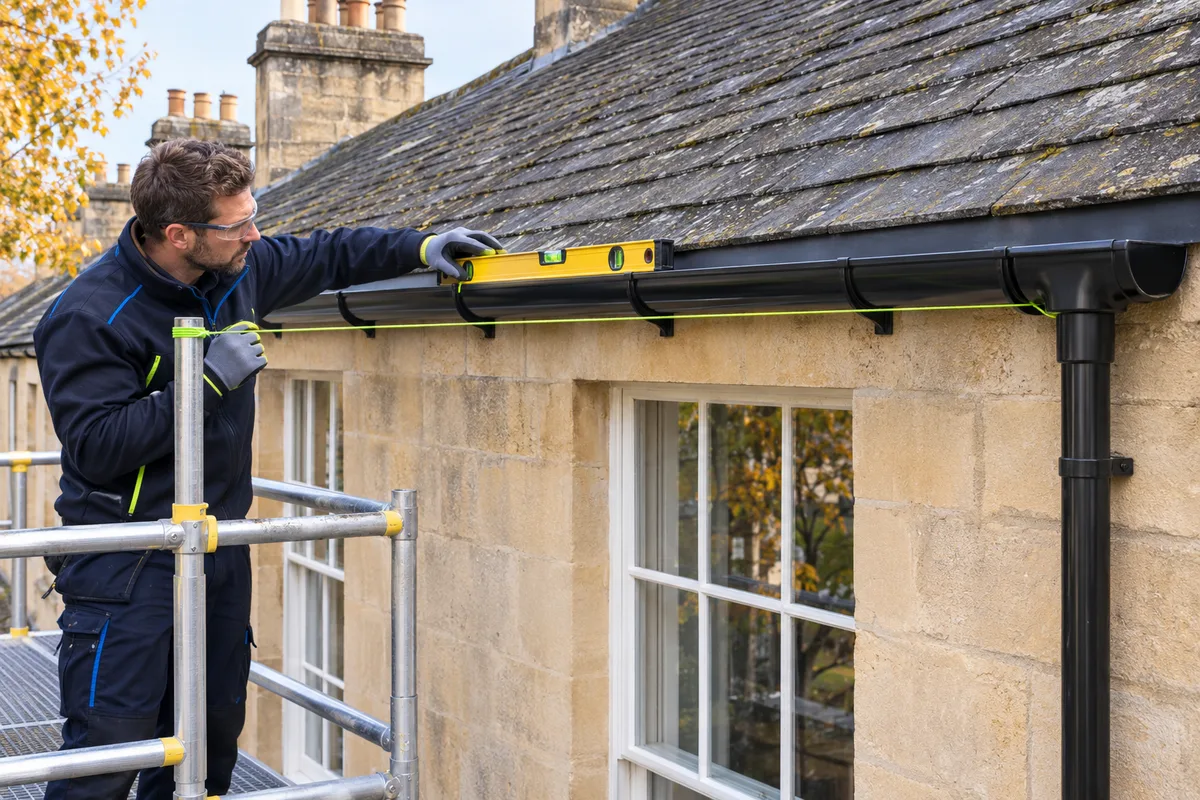
 01 · STRAIGHT LINE, GENTLE FALLA string line sets a consistent route between the highest bracket and the outlet. The gradient can be too slight to judge reliably from the pavement.AI-generated illustration · not a customer property or job
People often expect guttering to show an obvious downhill slope. In practice, the designed fall is usually gentle, some systems may be fitted level, and the important defect is often not the overall angle but a local low point.
“Fall” means the gradual drop along the gutter towards its running outlet. It is not the same as a sag between brackets, a twisted union or a section that rises again before reaching the outlet.
The short answer: follow the exact gutter system
There is no single visible angle that proves every domestic gutter is correctly installed. Manufacturer instructions differ by range and profile. FloPlast’s domestic rainwater guidance recommends a fall of 1:350 where a gradient is used, while also warning that it should not be so steep that it creates an excessive gap between the roof edge and the gutter. Brett Martin says its gutters may be fitted level or to a gradient of 1:600.
Those ratios describe very small drops. A fall of 1:600 is 1 mm for every 600 mm of gutter; 1:350 is 1 mm for every 350 mm. Over a three-metre run, that works out at about 5 mm or 8.6 mm respectively. Normal rooflines, fascia details and perspective can easily hide a difference of that size from ground level.
The relevant installation guide—not a rule copied from a different brand—should decide the target. The outlet position, roof area, gutter profile and number of outlets also influence how the system performs.
What a correctly set fall should look like
A planned fall is continuous. The upper bracket, intermediate supports, unions and outlet should form a straight line that gradually descends to the discharge point. Installers commonly fix the outlet, set the far bracket at the required height and stretch a taut string line between them before positioning the remaining brackets.
The gutter still needs to sit under the roof edge correctly. If the fall is exaggerated, the lower end can sit too far below the tile or slate line. Water may then overshoot or run behind the gutter even though the gutter itself drains quickly.
A suitable check therefore considers both directions:
- along the fascia, is the route straight and consistent towards the outlet?
- across the eaves, is the roof edge still positioned to discharge into the gutter?
A level run is not automatically wrong
Some current manufacturer guidance permits level installation. A level gutter can drain because water builds very slightly until it reaches the outlet; its flow capacity and outlet arrangement must still suit the roof and the product specification.
“Level” should mean a straight, supported run—not a series of high and low points. If a supposedly level gutter holds separate puddles between brackets or rises immediately before the outlet, the issue is its local alignment rather than the absence of a dramatic end-to-end slope.
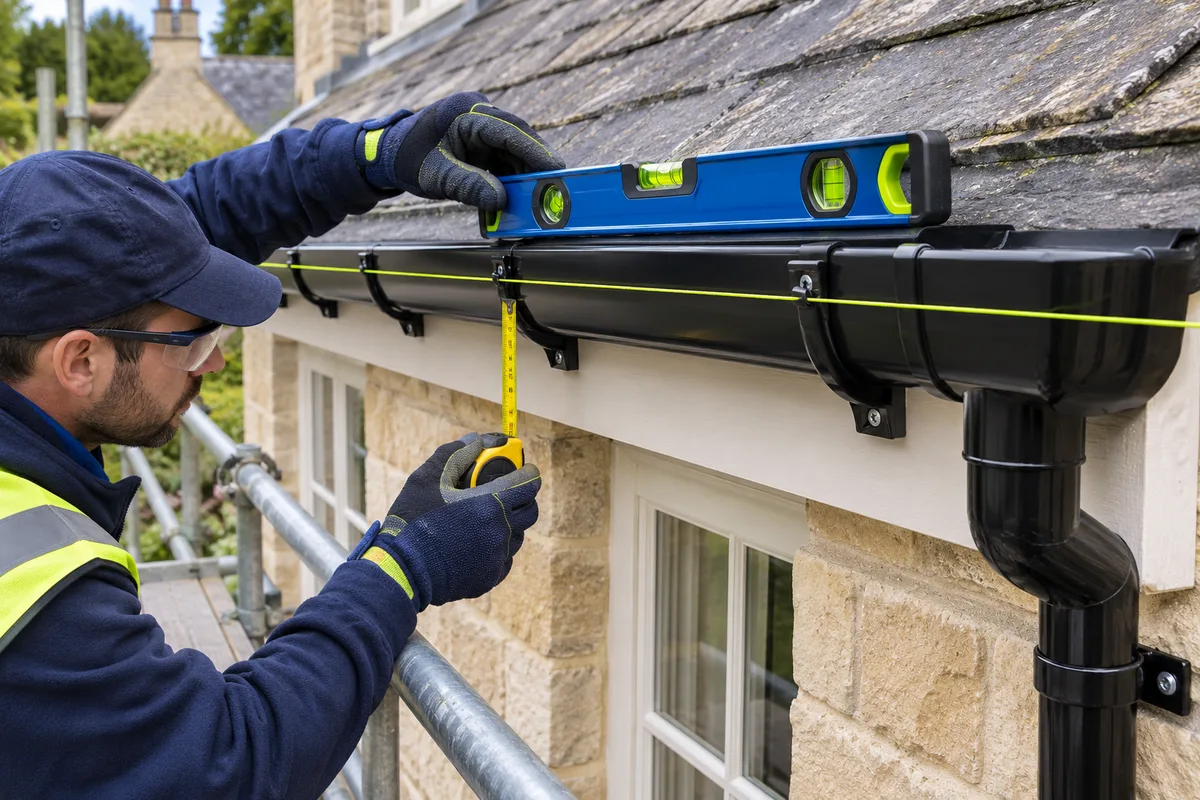 02 · CHECK THE OUTLET AND SUPPORTSThe outlet should be at the intended low point, with brackets and unions supporting a continuous line. One misplaced support can create a rise or dip.AI-generated illustration · not customer work
Fall versus sag: the useful distinction
A fall is gradual over the length of the run. A sag is local: the gutter dips and then rises again. That low point can trap water even when the outlet is clear.
Common causes of a local dip include:
- a loose, broken or missing fascia bracket;
- brackets fixed at inconsistent heights;
- bracket spacing that does not follow the product instructions;
- a soft or damaged fascia board that no longer holds fixings securely;
- a union, angle or outlet that is not fixed squarely;
- gutter lengths forced into a poor alignment; or
- distortion caused by impact, heat or prolonged load.
A sag can also change how joints sit. Water may remain against a union seal, and a twisted fitting can leak even after debris has been removed. The repair should address the support or alignment problem rather than simply adding sealant to the lowest joint.
Does any standing water mean the gutter is faulty?
Not necessarily. A thin film, beads of water or a small amount close to an outlet after rain is different from a defined pool in the middle of a run. The shape, depth and location matter more than the mere presence of moisture.
Standing water deserves closer inspection when it:
- forms a separate pool between supports;
- remains in a section that visibly dips and rises;
- sits behind debris or a restricted outlet;
- keeps a union or stop end continuously submerged;
- is accompanied by drips, stains or overflowing; or
- adds noticeable weight to a loose or distorted run.
Before changing bracket heights, clear the gutter and confirm the outlet and downpipe route are open. A plug of silt at the outlet can mimic poor fall by backing water up along an otherwise straight run.
Read the water pattern during rain
Rain can reveal whether the problem is capacity, blockage or alignment. Water that travels to the outlet but backs up during intense rain may point to outlet or downpipe capacity. Water that remains in a local dip after the rest of the run drains points more strongly to support or alignment.
Overflow location helps too. A spill close to the outlet suggests checking the outlet and downpipe first. Repeated overflow at one mid-run low point can indicate a sag or a section receiving concentrated flow from a roof valley. Water overshooting the front edge without filling the gutter may be an eaves-position problem rather than fall.
Do not create a test by pouring large amounts of water from unsafe access. A competent inspection can use controlled water and watch the complete route from gutter to downpipe and final discharge point.
A practical inspection sequence
- Observe from the ground. Note visible dips, bracket gaps, displaced joints, staining and where overflow occurs.
- Identify the system. Find the manufacturer and range so its fall, bracket spacing and fixing guidance can be checked.
- Clear the route. Remove debris from the channel, outlet and downpipe before judging alignment.
- Set a reference line. Use the outlet and far bracket with a taut string line or suitable level—not the fascia’s decorative edge alone.
- Check each support. Inspect bracket position, fixings, unions, stop ends, angles and the condition of the fascia.
- Correct the cause. Refix or replace failed supports and realign the run to the product guidance; do not force components.
- Test the whole route. Confirm water reaches the outlet, passes through the downpipe and discharges where intended.
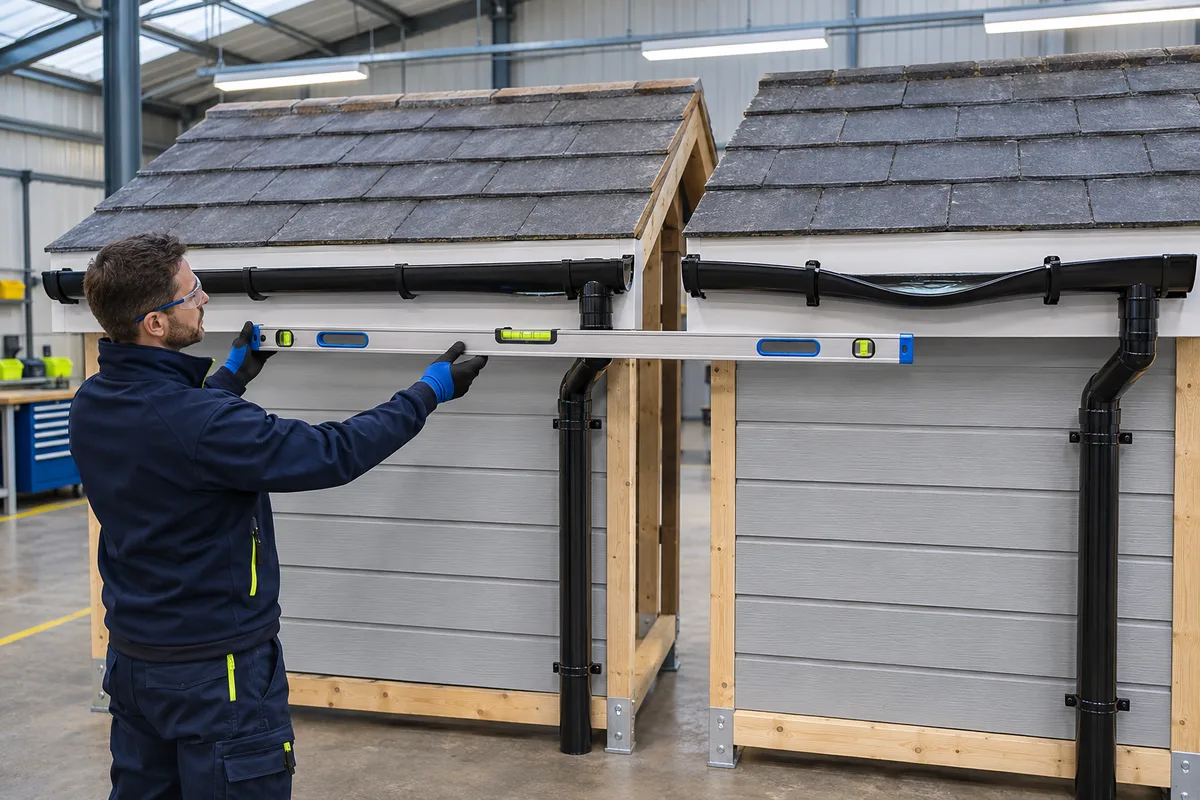 03 · CONTINUOUS FALL VERSUS LOCAL DIPA straight run can be level or gently graded. A sag drops between supports and rises again, creating an isolated pool away from the outlet.AI-generated illustration · not customer work
When should brackets be adjusted?
Adjusting one bracket may be enough if a sound fascia and compatible system have one obvious low point. Several inconsistent supports, failing timber, brittle guttering or a distorted fitting need a wider repair. Moving brackets without checking the roof edge can also lower the gutter too far to catch runoff.
The scope should remain proportionate. A local sag on one elevation does not automatically mean all guttering needs replacement. Conversely, repeatedly lifting one section will not last if the fascia cannot hold the fixings or the gutter profile is wrong for its brackets.
Keep checks at eaves level safe
Most initial observations can be made from the ground, especially during rain. The Health and Safety Executive says work at height should be avoided where reasonably practicable, planned and carried out with suitable equipment. It also specifically says ladders must not be rested against weak upper surfaces such as plastic gutters.
Measuring a fall, refixing several brackets and testing joints normally requires both hands and movement along the roofline. Appropriate access and a competent person are more important than trying to prove the gradient from a leaning ladder.
Related guides explain how to assess sagging gutters and failed supports, distinguish blockage from a leaking or overflowing run, and diagnose leaking uPVC gutter joints.
The practical rule
Do not judge a gutter by whether its slope is obvious from the pavement. Identify the system, follow its installation guidance, clear the water route and look for a straight continuous line to the outlet. A local dip that traps water is a different problem from a deliberately level run.
Sources and further guidance
- FloPlast: PVC-U rainwater installation guidance
- FloPlast: rainwater FAQs and gradient guidance
- Brett Martin: rainwater FAQs, level fitting and 1:600 gradient
- Brett Martin: rainwater gutter installation guide
- Health and Safety Executive: working at height safely
Share this guide
Know someone looking at a level gutter or a persistent low point? Share this guide to fall, support and standing water.
Share on FacebookShare on WhatsApp