
 01 · ONE ELEVATION CAN HAVE SEVERAL RAINWATER ROUTESThe main eaves, an upper dormer and a projecting bay may each have a separate gutter, outlet and connection to inspect.AI-generated illustration · not a customer property or job
A gutter clean can look complete from the pavement while a short run above a dormer or bay window remains untouched. These smaller rooflines collect less water than the main roof, but their outlets are also compact and their overflow often lands directly on windows, stonework or a lower roof.
Not every dormer or bay has the same arrangement. Some drain through a short eaves gutter, some use lead-lined channels or concealed outlets, and others feed into the main rainwater system. The useful question is not simply “where is the main gutter?” but “where does every roof surface send its water?”
Start by mapping every separate roof surface
Walk around the property from safe ground-level viewpoints. Look for the main roof, dormers, bay windows, porches, extensions and any small flat or pitched roofs. For each one, trace four things:
- the roof area that receives the rain;
- the gutter or channel that collects it;
- the outlet, hopper or short connector; and
- the downpipe or lower gutter that receives the flow.
One elevation may contain several short routes that eventually join one downpipe. Approved Document H notes that a downpipe serving more than one gutter must be large enough for the whole contributing area. Capacity is a design matter, but routine maintenance still needs to confirm that every visible outlet and connection is clear.
Dormer gutters: short runs with awkward junctions
Dormers vary greatly. A small pitched dormer may have a short gutter across its front, while a larger dormer can include side channels, cheek flashings, a flat roof or outlets hidden from the street. Water may then pass onto the main roof or into a separate pipe.
Because the run is short, a small amount of silt, moss or slate debris can sit close to the outlet. The surrounding roof junctions can also make the gutter difficult to see from below. Do not assume that a clean main eaves gutter means the dormer route is clear.
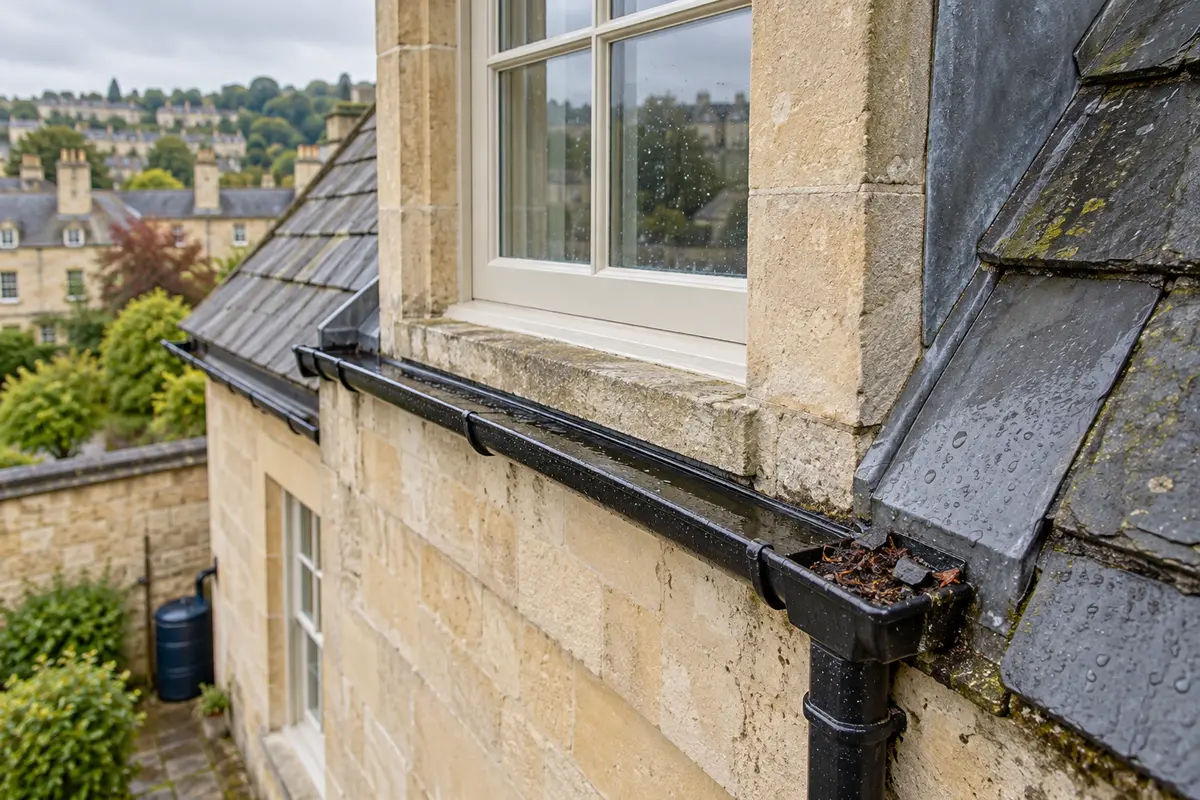 02 · A SMALL OUTLET NEEDS VERY LITTLE DEBRIS TO RESTRICT ITThe complete dormer run, outlet and receiving pipe should be checked rather than treating it as part of the main eaves by default.AI-generated illustration · not a customer property or job
Bay-window gutters: low level does not mean low importance
A projecting bay may have a small slate, tiled, lead or flat roof. Its gutter can wrap around several short sides and may discharge through a tiny outlet at one corner. The connection might join a nearby downpipe, run across the wall or discharge to another gutter below.
Bay gutters are often easier to see than dormer gutters, but they can be missed because attention goes to the larger roof above. Overflow may mark the stone below the outlet, drip across a window head or leave algae at one corner. A loose stop end or joint can produce a local drip even when the outlet is clear.
Warning signs worth checking after rain
- water passing over one corner of a dormer or bay gutter;
- dark staining, algae or washed-out mortar below a small outlet;
- drips from a stop end, angle or short connector;
- water landing on a lower roof rather than entering its receiving gutter;
- a small downpipe that moves, has loose clips or ends without a clear route;
- debris visible around a dormer cheek, valley or outlet; and
- damp appearing around a window head or inside the roof space.
These signs narrow the inspection but do not prove the source. A roof covering, flashing or window junction can leak independently of the gutter. Where damp continues after the rainwater route has been cleared and tested, separate roofing or building-fabric investigation may be required.
What a thorough clean should include
The work scope should identify every accessible gutter run rather than relying on a simple “front and back” description. For dormers and bays, a useful clean and check includes:
- removing loose debris from the complete short run;
- clearing the outlet and the accessible top of its connector or downpipe;
- checking stop ends, angles, joints and visible supports;
- confirming where the water goes next;
- checking the receiving lower gutter, hopper or downpipe; and
- recording any loose component, staining or suspected roof defect separately.
Historic England’s maintenance checklist recommends checking gutters for debris, leaking joints, pooling, correct drainage towards outlets and wall staining. It also recommends observing the system during rain where this can be done safely.
 03 · FOLLOW THE SMALL GUTTER TO ITS NEXT CONNECTIONA clean bay gutter still needs a clear outlet and a sound route into the receiving downpipe or lower drainage system.AI-generated illustration · not a customer property or job
Access has to suit each roofline
A low bay roof can block ladder positioning to the main eaves, while a dormer gutter may sit above a sloping or fragile surface. A method suitable for one elevation may not reach another. Before quoting, record conservatories, extensions, narrow passages, sloping ground and the number of storeys.
The Health and Safety Executive advises doing as much work as possible from the ground, using suitable access equipment where work at height cannot be avoided, and never resting a ladder against plastic guttering or glazing. A bay or dormer must not be treated as a convenient step or platform.
For more on choosing an access method, see our guides to gutter cleaning on tall properties and planning around conservatories and extensions.
Photos that make the quote clearer
From safe ground level, send:
- a full photograph of each elevation;
- a closer view of every dormer and bay-window roofline;
- the outlet and any short connecting pipe;
- where that pipe joins the main downpipe or lower gutter;
- any staining, pooling or overflow visible after rain; and
- the access below, including conservatories, extensions and narrow passages.
A short video during rain can be useful if it can be taken safely from indoors or ground level. Do not open or lean from an upper window to film the gutter.
Do not confuse a visible gutter with a concealed channel
Some dormers, bays and older roof details use lead-lined or concealed channels rather than ordinary eaves guttering. Those may need closer access and material-specific inspection. Our guide to hidden valley, box and parapet gutters explains why ground-level observation may not show the full route.
If recent roofing work has taken place, small offcuts, slate fragments and mortar can reach these short gutters. See our post-roof-work gutter checklist for a practical handover check.
The practical rule
Count rooflines, not just elevations. If a property has a main roof, two dormers and a projecting bay, the cleaning scope may contain several separate gutters and outlets even though they are all on the front of the same building.
Sources and further guidance
- Historic England: maintenance checklist
- Historic England: inspection, maintenance and repair of rainwater systems
- GOV.UK: Approved Document H — drainage and waste disposal
- Health and Safety Executive: working at height
Share this guide
Know someone with dormers or a projecting bay window? Share this guide so the smaller gutters are included in their next maintenance check.
Share on FacebookShare on WhatsApp