
 01 · CONNECT INSIDE WITH OUTSIDERecord where the stain appears, then inspect the rainwater route directly above and beside it.AI-generated illustration · not a customer property or job
Yes, a blocked or leaking gutter can help create damp inside a building. Water that should be carried to an outlet may spill against masonry, pass behind the gutter or saturate the wall around a faulty joint. Yet the same room could also be affected by a roof defect, plumbing leak, condensation or another source entirely.
The useful question is therefore not simply “is this damp?” but “what evidence connects this patch to this rainwater route?” A careful sequence—record, compare, clear, test and monitor—helps homeowners, landlords and facilities managers avoid both guesswork and unnecessary treatment.
What kind of damp can a gutter cause?
GOV.UK’s English Housing Survey glossary describes penetrating damp as moisture caused by leaks from external components such as the roof covering and gutters, or by internal plumbing. RICS likewise lists leaking or blocked gutters and rainwater pipes among possible causes of water passing through a wall, ceiling, roof or floor.
That does not mean every mould patch near an outside wall is penetrating damp. Condensation tends to form when indoor water vapour meets cold surfaces and can show around windows, external corners or behind furniture. A plumbing leak may continue when the weather is dry. Moisture at low level can have several causes and should not automatically be labelled “rising damp”.
The pattern, timing and route matter more than one visual symptom or a single handheld meter reading.
Start with the room, not a ladder
Before touching the gutter, make a dated record of the inside. Photograph the whole wall and a close view of the affected finish. Note the room, height, width, smell, whether the surface is wet or merely stained, and when it changes.
Ask three practical questions:
- Does the mark become darker during or soon after rain?
- Is it high on an external wall, below an eaves line, roof junction or downpipe?
- Does the problem continue through a settled dry spell?
A strong rain-related pattern makes the external fabric a sensible place to investigate. A patch that tracks pipe use or appears mainly during cold, humid mornings may point elsewhere. Keep the possibilities open until the external evidence is checked.
Match the stain to the outside elevation
From ground level, locate the same area on the outside wall. Look above it as well as directly opposite it: water can travel along roof timbers, wall cavities and ledges before it becomes visible indoors.
Trace the complete rainwater route. Begin where the roof sheds water into the gutter, follow the run to its outlet, then follow the downpipe to the gully, drain, water butt or lower roof. Include valley, box and parapet gutters, upper downpipes feeding lower roofs, hopper heads and flat-roof outlets where present.
Useful external clues include:
- debris or vegetation around an outlet;
- a tide mark showing that water has stood above the normal gutter level;
- repeated staining, algae or washed mortar below a joint or behind a pipe;
- water marks on the fascia or soffit where water may have passed behind the gutter;
- a slipped socket, cracked fitting, loose clip or local sag; and
- a gully that is full, buried or backing up around the wall.
Historic England’s maintenance checklist specifically treats wall staining, algae growth and washed-out mortar behind rainwater pipes as signs that deserve closer inspection. One mark is not a diagnosis, but a matching pattern above the affected room is useful evidence.
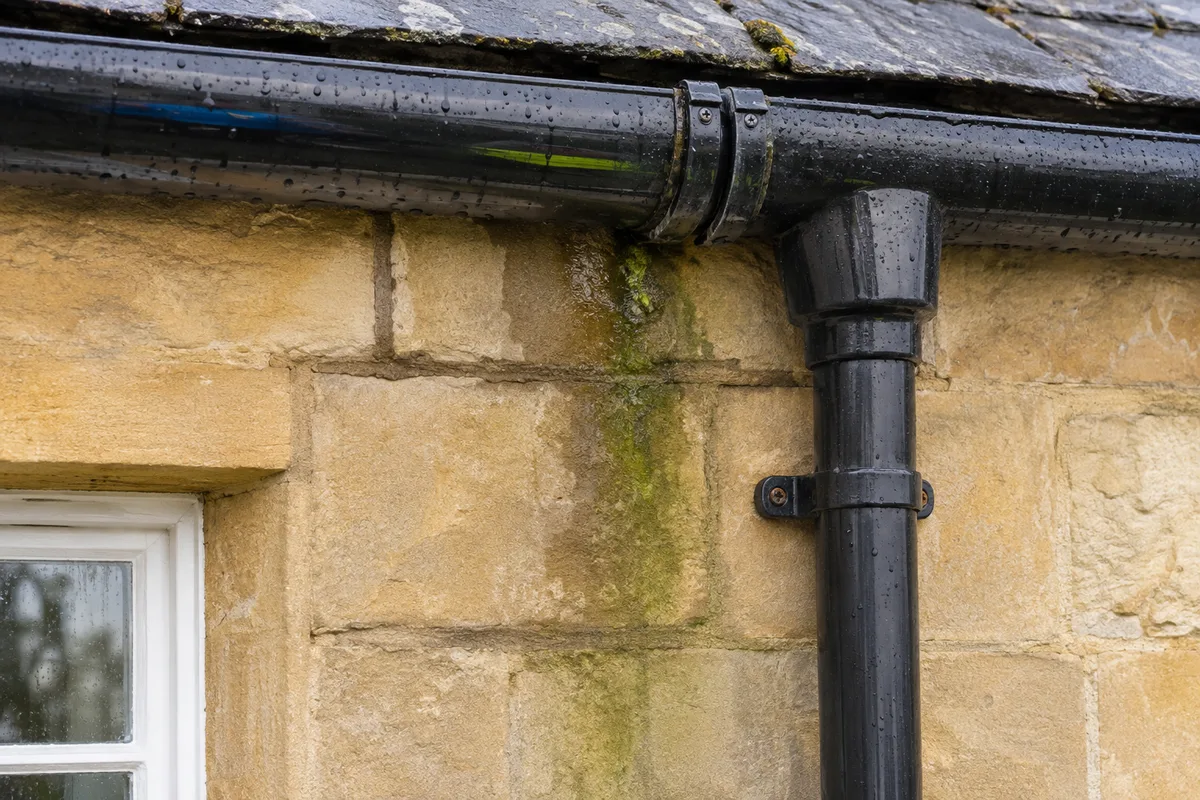 02 · LOOK FOR A REPEATED WATER PATHStaining beneath a joint or outlet is a clue to compare with rainfall and the internal patch—not proof on its own.AI-generated illustration · not a customer property or job
Observe what happens in ordinary rain
A dry-weather inspection can show debris and damage, but rainfall shows how the system behaves. Watch from a safe position during normal steady rain. Do not stand beneath loose fittings or wait for a severe storm.
Note the exact sequence. Does water overshoot the front edge, rise behind a blocked outlet, drip from one union, escape behind the fascia, leak from a downpipe socket or surge out of the gully? A photograph or short video with the location and time is much more useful than the note “gutter leaking”.
Also check whether the wetting lines up with the interior change. If the internal patch darkens after the corresponding gutter spills, the link becomes more plausible. If the gutter and downpipe work correctly while the patch changes independently of rain, widen the investigation.
Clear the restriction before judging the repair
Leaves, moss and silt can hold water above a joint, cover an outlet and make a sound gutter appear too small. Clear the accessible gutter, outlet mouth and visible gully first. A downpipe may need separate clearance if water still cannot pass.
Once the route is open, check again in rain. This separates four different outcomes:
- Cleaning solved the overflow. Keep the date and before-and-after photographs, then monitor the internal patch while the wall dries.
- The clear gutter still leaks at a joint or stop end. The fitting or seal may need repair rather than more cleaning.
- Water passes behind the gutter. The roof edge, felt support, flashing or eaves detailing may need a roofer or building professional.
- The downpipe or gully still backs up. The restriction may be lower down or below ground and need drainage investigation.
A clear gutter does not rule out every rainwater problem, but it removes one variable and makes the next observation far more useful.
Do not stop at the downpipe
Historic England advises treating gutters, outlets, downpipes, gullies and below-ground drains as one system. Water can leave the eaves correctly yet still saturate the wall if a low pipe joint leaks, an open shoe misses the gully, or the gully overflows beside the building.
Check the ground-level end from a safe position. Clear loose leaves from a visible grille, record whether the shoe discharges over the opening and look for local pooling. If the pipe disappears directly into the ground, note that the connection is concealed rather than assuming it is sound.
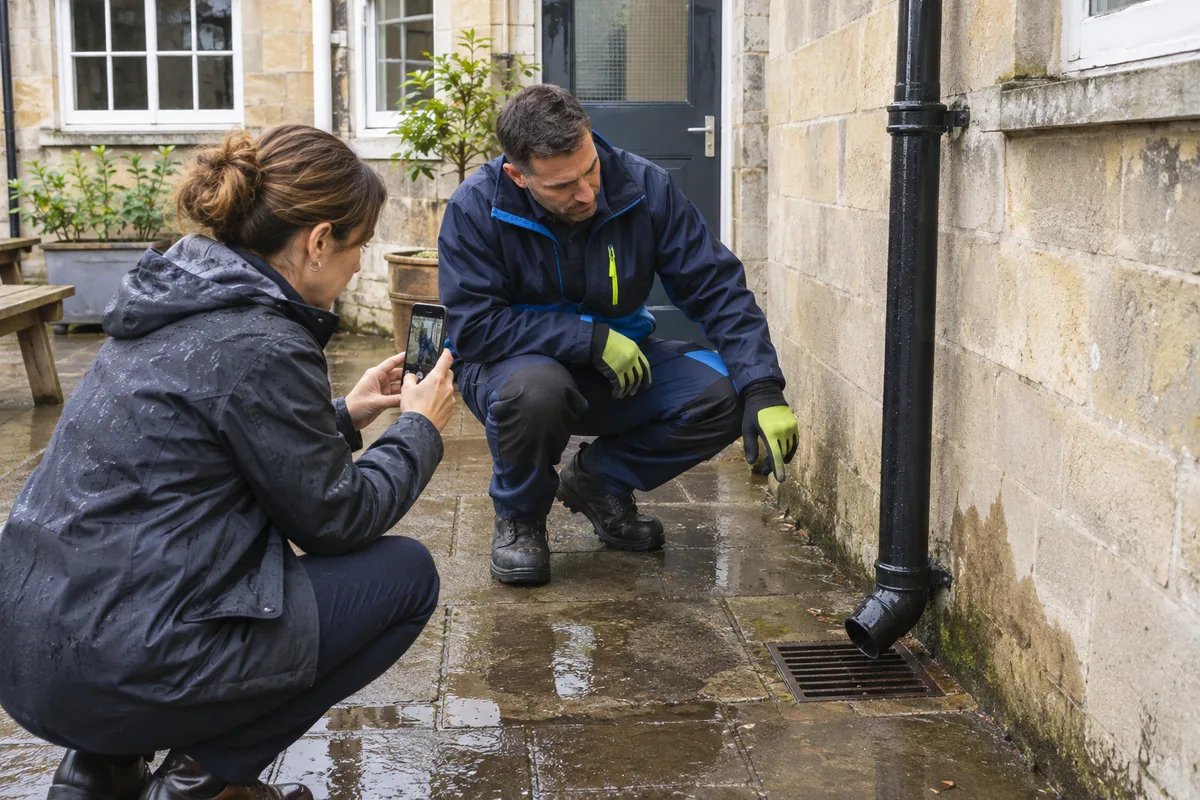 03 · FOLLOW THE WATER TO GROUND LEVELA clear eaves gutter still depends on a sound downpipe, open gully and working final discharge.AI-generated illustration · not a customer property or job
Allow time for the building to dry
Removing the source does not make an established damp mark vanish overnight. Masonry and plaster may need time to dry, and the period varies with the material, weather, ventilation and how long it was wet.
Keep the room reasonably ventilated and heated for the season, continue the photo record and compare the same area after later rain. Avoid redecorating or applying a stain-blocking finish until the source has been addressed and the surface condition is understood; otherwise a returning mark may be hidden temporarily rather than solved.
For a rental or commercial property, record the report date, affected room and elevation, rain conditions, cleaning or repair carried out, photographs, any access limitations and the next review date. That creates a useful evidence trail without pretending the first visit proved more than it did.
When the gutter is probably not the whole answer
Arrange wider investigation when the rainwater system is clear and working but damp persists, when several unrelated areas are affected, when the mark follows plumbing use, or when mould and condensation appear across cold surfaces. Roof coverings, flashings, pointing, render, windows, internal pipes and ventilation may all need consideration.
RICS warns that finding the cause of damp can be complex and recommends a suitably experienced building surveyor for significant or uncertain cases. An independent, evidence-led assessment is particularly valuable before expensive damp-proofing or extensive replacement work.
Inspect safely
Use ground-level observation, photographs and normal rainfall wherever practicable. Work at height should be planned and carried out by competent people with suitable equipment. Do not rest a ladder on plastic guttering or lean out of an upper window to reach a blockage.
Hidden valleys, high parapets, gutters above conservatories and tall commercial rooflines may need specialist access. Record what could not be inspected rather than filling the gap with an assumption.
Related guides explain how to distinguish an overflow from a leaking joint, how to trace a blocked downpipe or gully, what black marks on fascias and soffits can mean, and why water can run behind a gutter.
The practical rule
A blocked gutter can contribute to penetrating damp, but the strongest case comes from matching evidence: the internal patch, the external water path, the timing of rain and the result after cleaning or repair.
Sources and further guidance
- RICS: damp and mould consumer guide
- GOV.UK: English Housing Survey glossary—damp
- Historic England: inspection, maintenance and repair of rainwater systems
- Historic England: maintenance checklist
- Health and Safety Executive: working at height safely
Share this guide
Know someone trying to work out whether a damp patch is connected to the gutters? Share this evidence-led guide.
Share on FacebookShare on WhatsApp