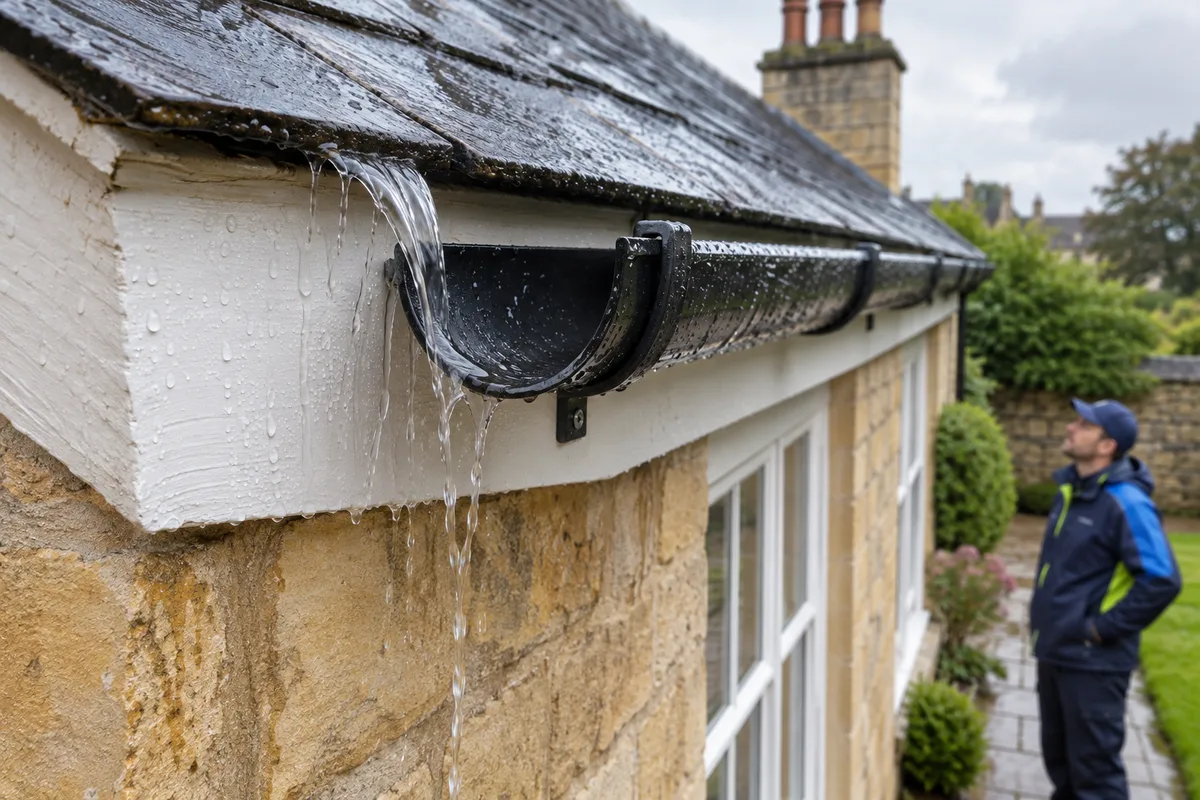
 01 · FOLLOW THE WATER AT THE ROOF EDGEWater emerging above the rear of the gutter points to a different fault from a joint leaking underneath or debris causing water to spill over the front.AI-generated illustration · not a customer property or job
A gutter can be clean and watertight yet still leave the fascia wet. For the rainwater route to work, water from the roof covering and any moisture on the underlay must arrive inside the gutter. If the roof edge, underlay or gutter position no longer lines up, water can pass behind it instead.
The visible symptom may be a wet stripe on the fascia, droplets from the soffit edge or staining on the wall below. The correct repair starts by finding where the water leaves its intended route.
First distinguish “behind” from “over”
Observe the area from ground level during rain if it is safe to do so, or inspect the drying pattern afterwards. Useful clues include:
- water beginning above the rear lip: inspect the roof covering, tile projection, underlay and eaves detail;
- water rising inside the gutter and spilling over an edge: check for debris, a restricted outlet, poor fall or insufficient capacity;
- a drip directly below a joint: the fitting, seal, alignment or nearby support may need attention;
- a long wet band on the fascia: the roof-edge relationship may be wrong along more than one bracket bay; and
- an isolated stain beneath one tile or slate: look for a local displacement, crack or damaged eaves detail.
The pattern is evidence, not a final diagnosis. Wind can move rain sideways, and water can track along a surface before it becomes visible.
What should happen at the eaves?
At a conventional pitched-roof eaves, the roof covering should project far enough for rain to fall into the gutter, while the underlay or a suitable support detail provides a secondary route for any water beneath the tiles. The exact arrangement depends on the roof covering, pitch, ventilation design and manufacturer’s system.
NHBC’s pitched-roof guidance for new homes shows roof coverings projecting at least 50 mm across the gutter and the underlay dressed into the gutter below. That measurement should not be copied blindly onto every existing roof: tile profiles and proprietary eaves systems vary, so the correct detail is the one specified for the roof covering and gutter combination.
Common reasons water misses the gutter
- Gutter set too far forward: water drops behind the rear edge instead of landing in the channel.
- Gutter set too low: wind or a short roof projection can carry water across the gap.
- Short, damaged or deteriorated underlay: moisture beneath the tiles is no longer directed into the gutter.
- Underlay sagging behind the fascia: water can pond or track backwards rather than reaching the eaves.
- Missing or damaged support tray: the underlay may have lost the firm final section that guides it over the fascia.
- Incorrect fascia or tilting-fillet height: the first course of tiles may not continue in the intended roof plane.
- Displaced or broken eaves tiles: a local gap can change where water leaves the roof.
- A blocked gutter: water can rise high enough to spill over the rear as well as the front.
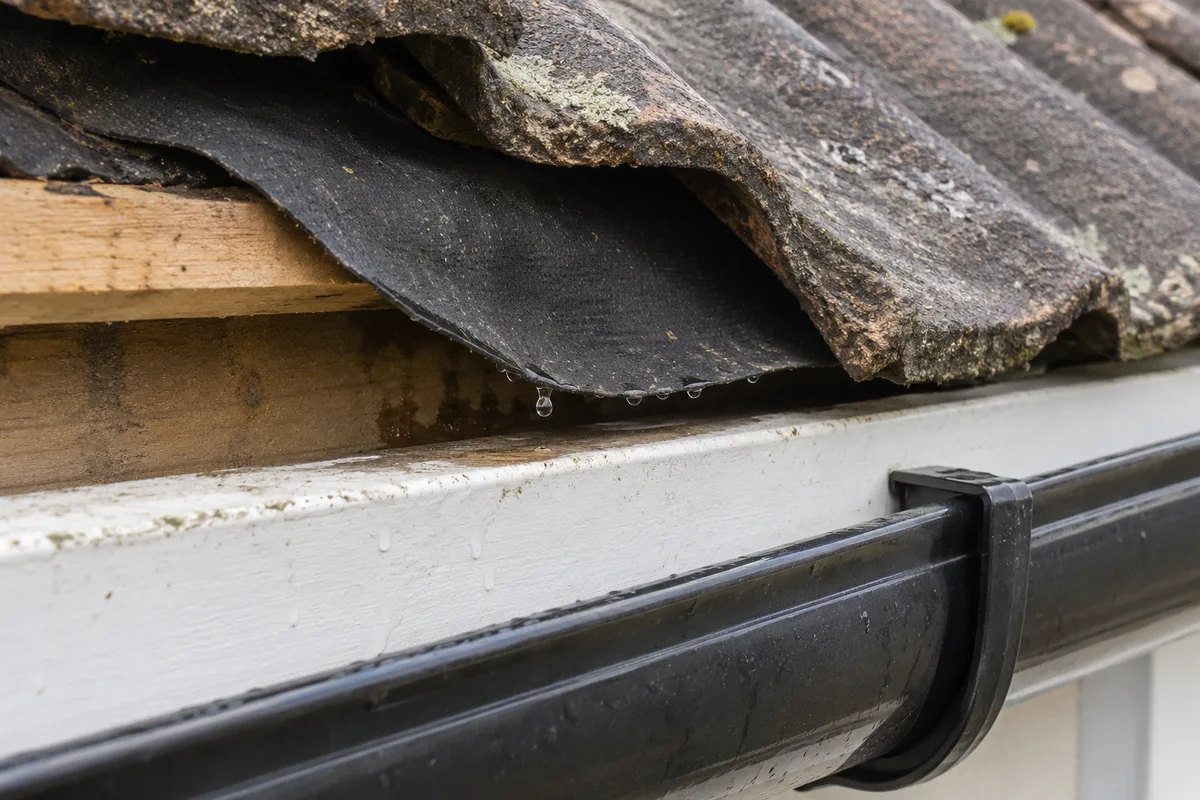 02 · CHECK THE SECONDARY DRAINAGE PATHOld underlay can become brittle, sag or finish short of the gutter. The condition must be inspected before deciding whether the gutter only needs repositioning.AI-generated illustration · not customer work
Why the underlay and support tray matter
Roof tiles and slates are the primary weather covering, but the underlay has an important secondary role. Marley describes its felt support tray as a rigid eaves component that supports the underlay, prevents sagging and ponding behind the fascia, and guides water into the gutter. The Roof Tile Association similarly advises using underlay support trays at the eaves and lapping the underlay over them.
An eaves support tray is not a cure for every roof-edge defect. It must be compatible with the roof build-up and installed without blocking the required ventilation path. If the underlay is extensively deteriorated, the repair may need roofing work beyond the visible gutter edge.
Why cleaning alone may not solve it
Clearing debris and confirming the outlet is open is a sensible first step because a full gutter can spill water in several directions. However, if a clean gutter still receives water behind its rear edge, repeated clearing will not change the roof projection or restore damaged underlay.
Equally, moving the gutter without checking the roof edge can create another problem: the gutter may catch the main tile flow but interfere with ventilation, sit at the wrong height or become poorly supported. The gutter and eaves should be assessed together.
A practical inspection sequence
- Take a wide ground-level photograph showing the roof edge, complete gutter run and nearest outlet.
- Record whether the water starts above, inside, below or behind the gutter.
- Clear the gutter and confirm the outlet and downpipe route are open.
- Check whether the issue affects one short section or the full elevation.
- Inspect tile or slate projection, the first roof course, underlay edge and any support tray.
- Check gutter height, setback, bracket condition and alignment.
- Identify the roof covering and gutter system before adjusting parts.
- Water-test the completed route where appropriate, then recheck during natural rain.
When it is a gutter repair—and when it is roofing work
A sound roof edge with a gutter mounted in the wrong position may only need bracket or alignment work. A leaking joint or distorted gutter section can also be repaired as part of the rainwater system.
By contrast, brittle underlay, displaced eaves tiles, rotten fascia timber or an incorrect eaves build-up may require a roofer. Treating those defects as a cleaning job can hide the symptom without restoring the drainage path. On older Bath properties, materials and construction details may differ across extensions and later alterations, so each roof section should be checked on its own merits.
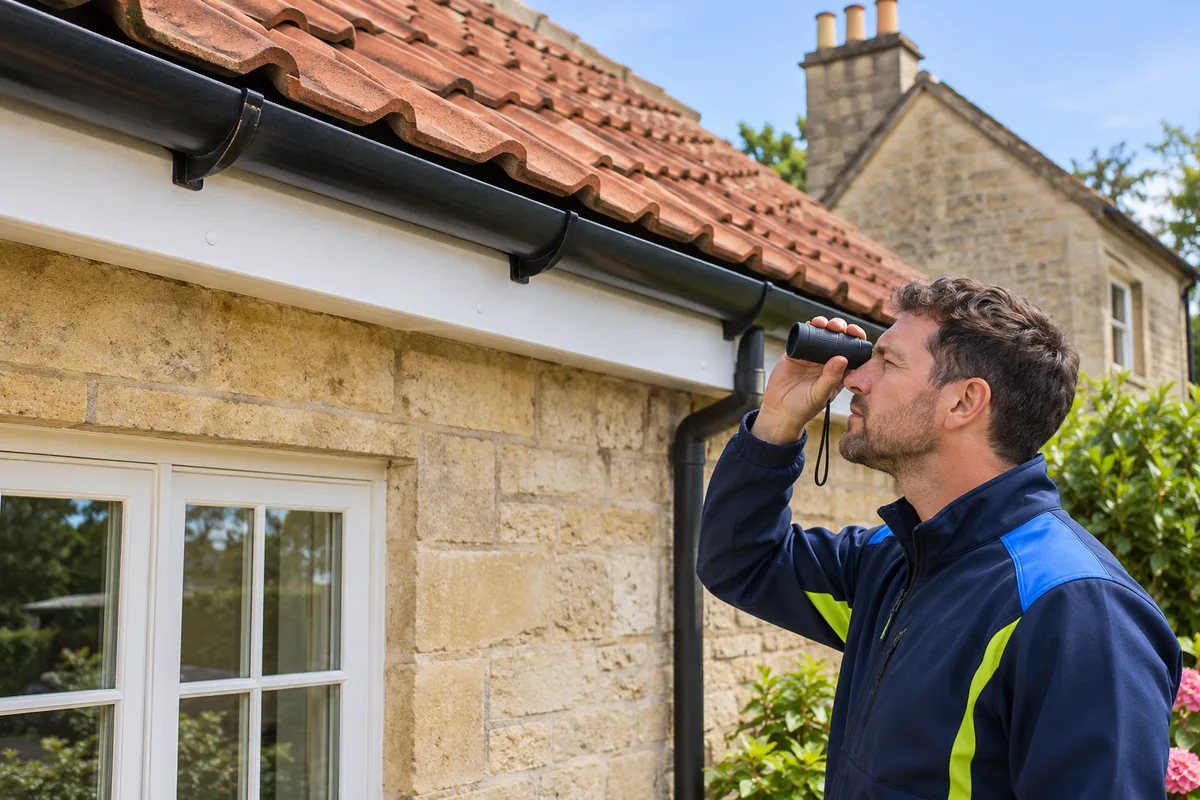 03 · ASSESS THE WHOLE EAVES LINEA useful inspection compares the roof projection, gutter position, brackets, fascia and outlet rather than adjusting one component in isolation.AI-generated illustration · not customer work
Safe checks for homeowners and property managers
Use photographs taken from ground level and avoid leaning from windows or climbing to lift tiles. The Health and Safety Executive advises doing as much work as possible from the ground, using suitable equipment where work at height cannot be avoided and never resting a ladder against plastic guttering.
For rented or commercial premises, record the affected elevation and whether the symptom appears in light rain, heavy rain or only with wind. That information helps the contractor plan access and distinguish a capacity problem from a roof-edge defect.
What a useful repair record should show
Keep a before photograph of the water path or staining, a close view of the roof-edge detail and a wider view showing the outlet. After the repair, repeat the same angles and record what was cleared, adjusted or replaced.
Related guides explain how to read black marks on fascias and soffits, distinguish water overshooting a gutter and create a useful before-and-after photo record.
The practical rule
Do not assume the gutter is leaking just because the fascia is wet. Follow the water back to the roof edge, clear the rainwater route, then check the tile or slate projection, underlay support and gutter position as one connected detail.
Sources and further guidance
- Marley: felt support tray and eaves drainage
- Roof Tile Association: installing underlay and tile battens
- NHBC Standards: pitched-roof eaves detailing
- Health and Safety Executive: working at height safely
Share this guide
Know someone with water staining the fascia behind a gutter? Share this guide so the complete roof-edge drainage path is checked.
Share on FacebookShare on WhatsApp