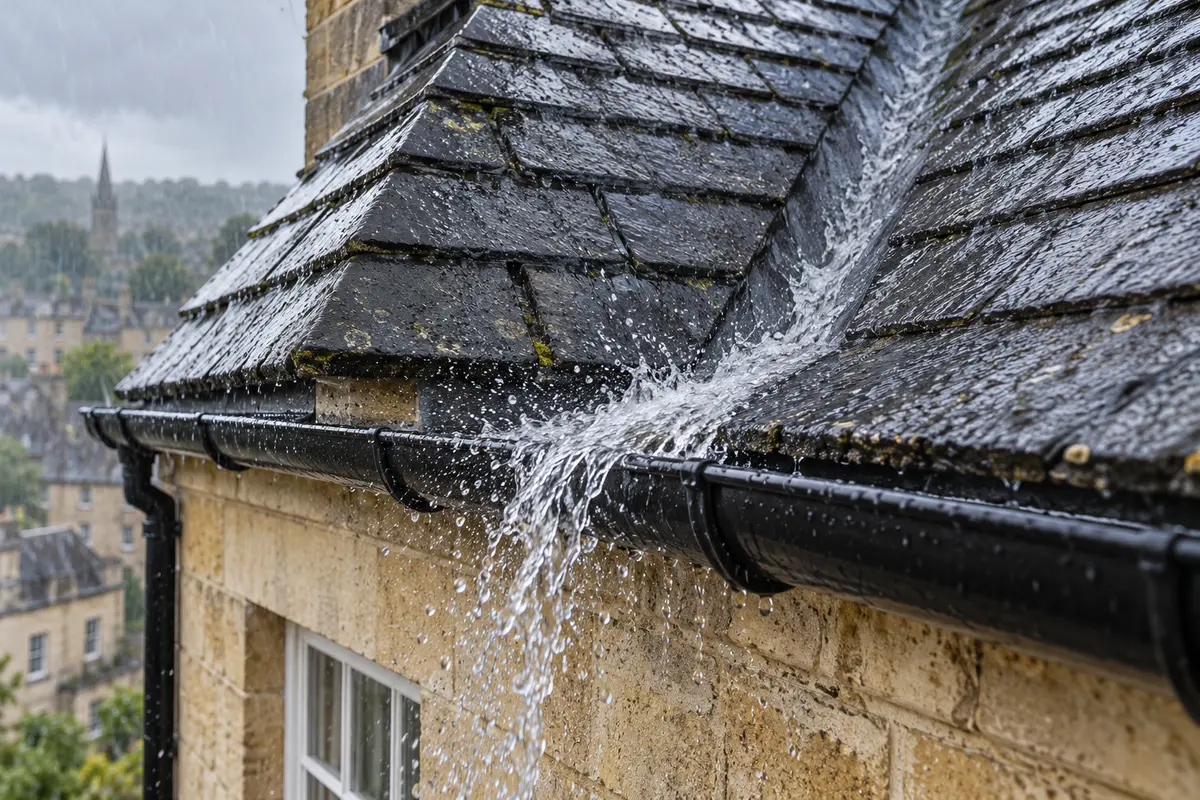
 01 · A VALLEY CAN CONCENTRATE THE FLOWA gutter may look clear along most of its length yet still be overwhelmed where two roof slopes feed rainwater into one narrow point.AI-generated illustration · not a customer property or job
Water shooting over the front of a gutter is often described as a blockage, but the visible spill does not identify the cause on its own. A restricted outlet is one possibility; concentrated flow from a roof valley, poor alignment at the eaves, an undersized gutter or exceptional rainfall can produce a similar result.
The location, timing and direction of the water are the useful clues. Observe them from a safe position and let the rainwater route guide the inspection—from the roof area above, into the gutter, through the outlet and down to the final discharge point.
Start with the pattern, not a ladder
During rain, stay at ground level or watch from a safe window. Record a short video if it can be done without leaning out or standing in traffic. Note whether the water:
- spills at one exact point beneath a roof valley;
- runs over a long section of gutter;
- passes behind the gutter and down the fascia or wall;
- escapes from a joint rather than the front lip;
- appears only in very intense rain or during ordinary showers;
- starts near the outlet, a stop end or a downpipe connection;
- also backs up at a hopper, downpipe shoe or ground gully.
Do not attempt a ladder inspection while it is raining. HSE guidance says work at height should be avoided where possible and, where it cannot be avoided, planned with suitable equipment and competent people.
Clue 1: water rises along a long section
If a broad run fills and overtops, first consider a restricted outlet or downpipe. Silt, moss and small debris can settle around the outlet even when the visible part of the gutter looks reasonably clear. A blockage lower in the downpipe or at the receiving gully can also slow the route.
A proper clear should remove gutter debris, open the outlet and check the top of the downpipe. Where safe and appropriate, a controlled water test can help confirm that water continues through the route. It cannot prove that buried drainage is sound, and it should not be used to flood an already restricted system.
Clue 2: water shoots past one point below a roof valley
A roof valley collects water from two adjoining slopes and delivers it towards the eaves in a concentrated stream. NHBC guidance says roof drainage should be sized to cope with concentrated flows, while Approved Document H bases gutter design on the effective roof area and roof pitch. A clean gutter can therefore still struggle if the local flow is greater than the arrangement can receive.
Check for debris at the valley mouth, damage or displacement to the valley lining, the position and depth of the receiving gutter, the nearest outlet and any evidence that the problem began after roof or fascia work. Valley alterations are roofing work, not part of a routine gutter clean.
Clue 3: water passes behind the gutter
Water down the fascia or soffit may indicate that the roof edge is not discharging into the gutter as intended. The gutter may sit too low or too far away, the tile or slate overhang may be unsuitable, or an eaves support detail may have deteriorated. Wind can also drive water in unusual directions.
Manufacturer guidance varies by roof covering, but the principle is consistent: the eaves course must project sufficiently for water to discharge into the gutter. Marley’s current sitework guide, for example, says its relevant tile courses should overhang so water reaches the centre of the gutter. That is a roof-detail check, not a universal measurement to copy onto every roof.
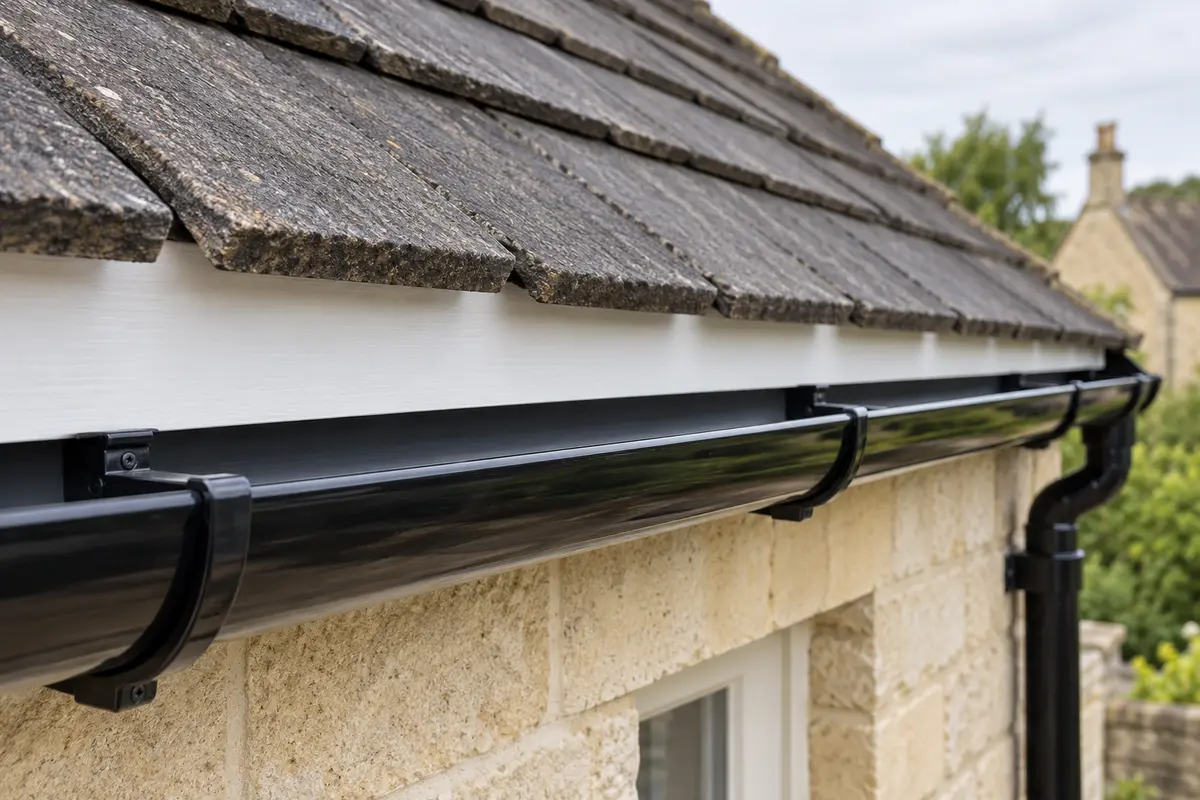 02 · ALIGNMENT MATTERS AT THE EAVESThe roof edge, fascia and gutter need to work together. Cleaning can open the water route, but it cannot correct a misplaced gutter or unsuitable tile overhang.AI-generated illustration · not a customer property or job
Clue 4: the spill appears only during the heaviest rain
Very intense rain can exceed the capacity of a system that appears satisfactory in lighter showers. Approved Document H explains that eaves-gutter sizing depends on effective drained area, roof pitch, gutter profile, outlet size and outlet position. NHBC also expects sufficient sizing for normal rainfall and concentrated flows.
This is why fitting a second outlet, changing the gutter profile or moving an outlet should be designed around the catchment rather than guessed. A larger gutter does not help if the downpipe or below-ground route remains the limiting point.
Clue 5: an upper roof discharges onto a lower roof
Extensions and split-level properties may combine several roof areas before water reaches the lowest gutter. One upper downpipe can send a concentrated stream across lower tiles, increasing the demand at one point of the receiving gutter.
Approved Document H gives a specific example: where more than 25m² of effective roof area discharges through one downpipe onto a lower roof, a distributor pipe should be fitted to the shoe so the flow reaching the lower gutter is spread sufficiently to reduce overtopping. The exact design still needs to suit the building, covering and drainage route.
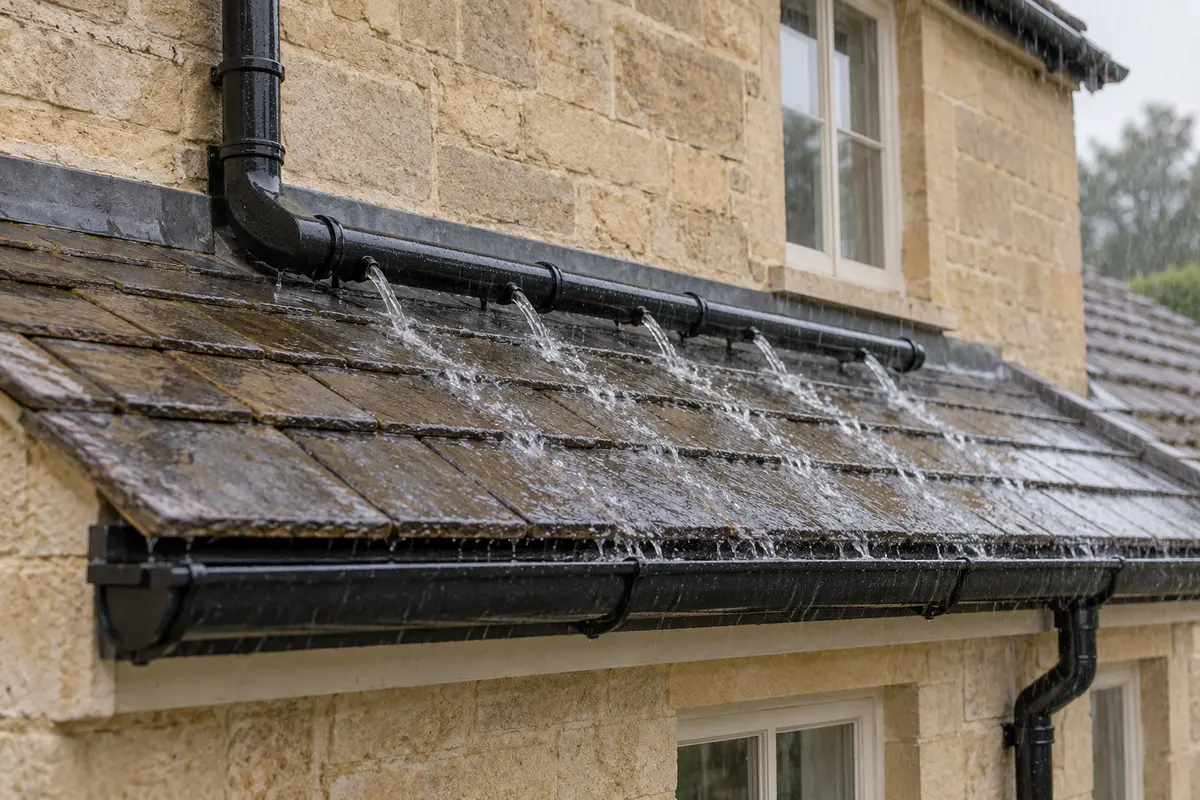 03 · UPPER ROOFS CAN ADD A CONCENTRATED LOADA designed distributor arrangement can spread flow across a lower roof. Do not improvise holes or alter rainwater pipes without checking the catchment and outlet route.AI-generated illustration · not a customer property or installation
What a useful inspection should check
Once conditions and access are safe, the inspection should follow the complete path:
- Roof catchment: the slopes, valleys, dormers and upper downpipes feeding the affected run.
- Eaves detail: tile or slate projection, felt support, gutter position and evidence of water tracking behind.
- Gutter condition: debris, silt, low points, loose brackets, stop ends, joints and visible distortion.
- Outlet: its position, opening and whether nearby flow reaches it.
- Downpipe: bends, offsets, hoppers and any section that may require dismantling to clear.
- Final discharge: shoe, gully, water butt, lower roof or below-ground drain.
FloPlast notes that gutter capacity depends on the system, outlet position and whether the gutter is level or laid to a specified fall. The manufacturer’s limits and fixing instructions matter when assessing an existing system or planning alterations.
Cleaning, repair or redesign?
- Cleaning may be enough where debris or silt is restricting the gutter, outlet or accessible top of the downpipe.
- A repair may be needed where brackets are loose, the run has a low point, a joint has failed or the gutter has moved away from the roof edge.
- Roofing work may be needed where the eaves, valley, underlay support or tile overhang is defective.
- Drainage work may be separate where the restriction continues below the downpipe or into a buried system.
- Design review may be needed where the catchment, concentrated flow or outlet arrangement exceeds the system’s capacity.
Do not fit an improvised splash guard where it could direct water back beneath the roof covering or into the building. Any change should preserve a safe overflow route clear of the property, as described in Approved Document H.
What to send for an accurate quote
From a safe position, send:
- a wide photograph showing the whole affected elevation;
- a closer photograph of the overshooting point and roof area above it;
- a short video recorded during rain, if safely possible;
- front and rear access photographs;
- the number of storeys and any conservatory, extension or narrow passage;
- details of recent roof, fascia or gutter work;
- whether the spill happens in ordinary rain or only during cloudbursts.
For related guidance, read how to distinguish an overflow from a leaking joint, how to trace a blockage towards the downpipe or gully and when a low gutter run needs more than clearing.
Guidance checked on 29 October 2026: GOV.UK—Approved Document H; NHBC Standards—roof drainage; Marley—Roofing Sitework Guide; FloPlast—rainwater FAQs; HSE—work at height.
Share this guide
Know someone whose rainwater shoots past the gutter? Share this guide to the likely causes and the clues worth recording.
Share on FacebookShare on WhatsApp