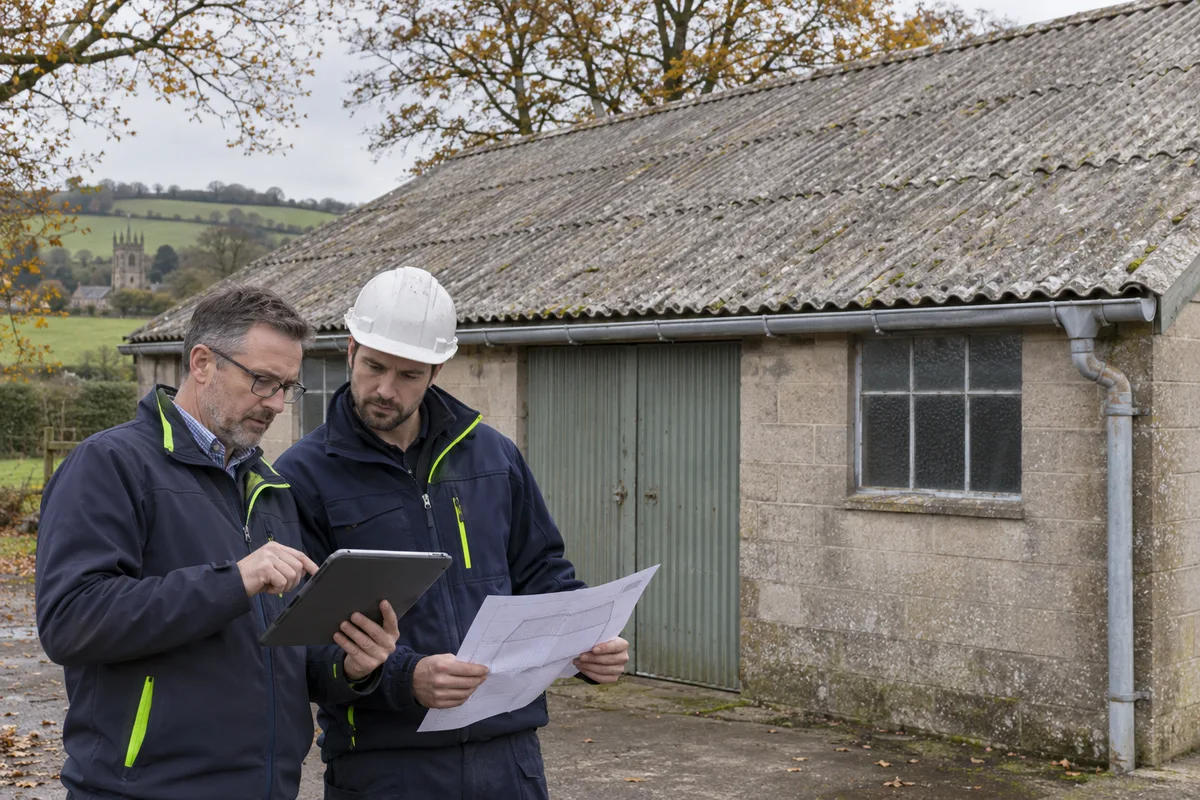
 01 · PLAN BEFORE THE GUTTER IS TOUCHEDOlder corrugated sheeting changes both the access plan and the way gutter debris must be handled.AI-generated illustration · not a customer property or job
A warehouse, workshop, garage or farm outbuilding may have a perfectly ordinary-looking gutter fixed below asbestos-cement roof sheets. The leaves and silt are visible, but the important hazards are not: the roof may be fragile, and the gutter contents may be contaminated by material weathered from the sheets.
The correct starting point is therefore information, not a ladder. The building owner or dutyholder should identify the roof material and share the asbestos information with whoever is pricing or planning the work. The access method, cleaning method, protective equipment and waste route can then be selected for that specific building.
Do not identify asbestos by appearance alone
Corrugated asbestos-cement and non-asbestos fibre-cement sheets can look similar, especially after years of weathering. Colour, age, moss or a photograph is not a reliable identification method. For non-domestic premises, ask for the asbestos register, management survey and any relevant refurbishment records. HSE’s duty-to-manage guidance explains that information about the location and condition of asbestos must be kept up to date and provided to people who may disturb it.
If the record is incomplete or the material is only suspected, pause the work and arrange competent identification or sampling as appropriate. Do not break off a corner for a DIY test. The decision also needs to distinguish asbestos cement from other asbestos-containing products: HSE’s gutter-cleaning task sheet is specific to asbestos cement and must not be casually applied to insulating board or more friable material.
Treat the roof as fragile
HSE’s task sheet A10: Cleaning debris from gutters on an asbestos-cement roof says asbestos-cement roofs are always fragile and cannot bear weight. HSE’s wider roof-work guidance says all sheeted roofs should be treated as fragile until a competent person confirms otherwise.
That means nobody should plan to walk the sheets, balance on the purlins or use a rooflight as a landmark for a safe route. Rooflights can themselves be fragile and difficult to see in poor light or beneath dirt. A short job is not a low-risk exception: HSE notes that falls through fragile surfaces occur during small cleaning and maintenance tasks as well as during major projects.
The safest approach is to avoid stepping onto the roof. Depending on the height, ground conditions, building shape and position of the gutter, a risk assessment may identify a mobile elevating work platform, suitable scaffold, guarded platform or another properly designed access system. The equipment must provide safe access to the work without transferring weight to fragile sheeting.
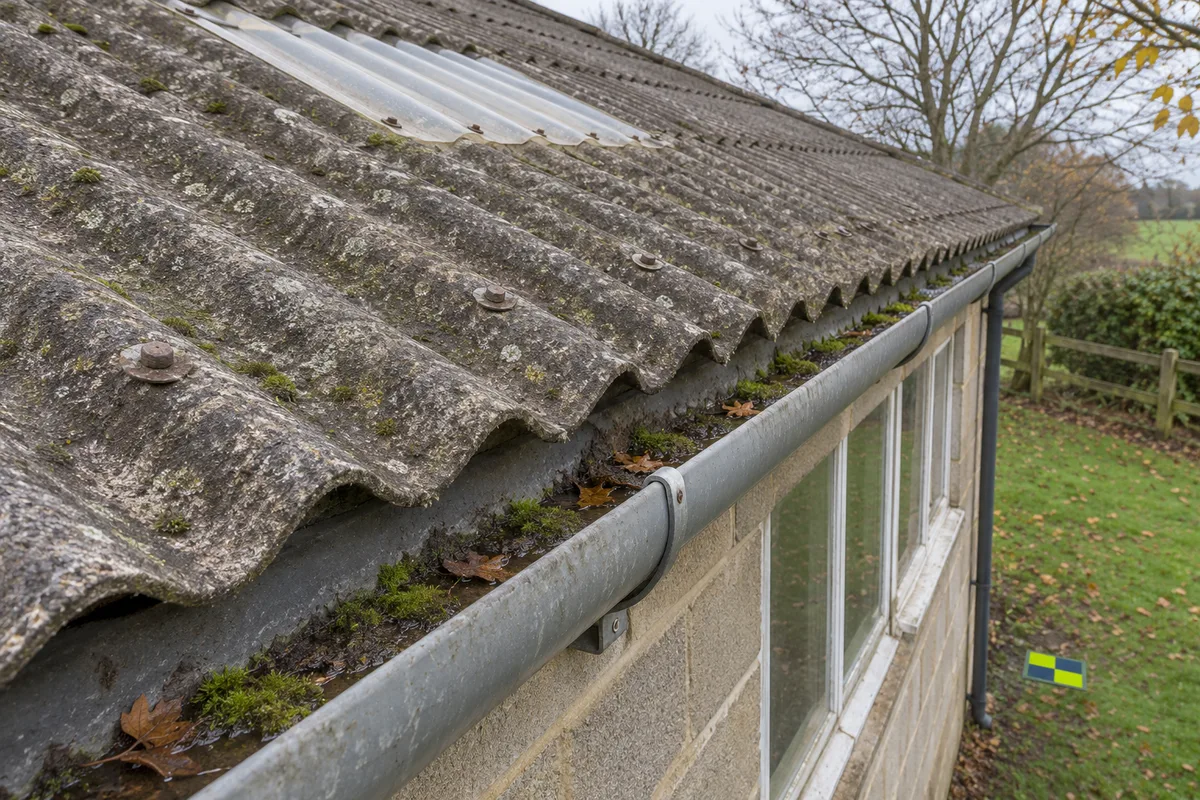 02 · THE DEBRIS MAY NEED CONTROLLED HANDLINGMaterial from weathered asbestos-cement sheets can collect with moss and silt, so ordinary dry sweeping is not the right method.AI-generated illustration · not a customer property or job
Use the asbestos task sheet as part of the method
Asbestos-cement gutter cleaning can fall within non-licensed asbestos work when the task and condition meet the relevant criteria, but “non-licensed” does not mean untrained or uncontrolled. The person doing the work still needs appropriate information, instruction and training, a suitable risk assessment and a written plan of work. Damaged material, extensive deterioration or a different asbestos product can change what is required.
HSE’s Asbestos Essentials system links the A10 task sheet to method sheets covering wetting, class-H vacuum cleaners, personal protective equipment, respiratory protective equipment, decontamination and waste. Those controls should be selected by a competent person for the actual task. In practical terms:
- Keep material damp using the controlled method described by HSE; do not create a spray or runoff problem.
- Do not dry-brush, blow or pressure-wash asbestos-cement debris. These methods can spread dust and contamination.
- Do not use an ordinary vacuum. Where vacuum cleaning is specified, HSE requires equipment suitable for asbestos work, including the relevant class-H standard.
- Choose PPE and RPE for the task, make sure it fits, and follow the correct decontamination sequence.
- Control the area below so occupants, staff, customers and passers-by cannot enter the work zone or be exposed to dropped material.
This is why a quotation based only on the number of gutter metres is incomplete. The planner also needs photographs, roof height, access constraints, sheet condition, asbestos records, occupancy and a place for controlled waste handling.
Plan the waste route before starting
Gutter debris collected beneath an asbestos-cement roof may contain asbestos and should not be tipped into garden waste, a general skip or a customer’s bin. HSE’s A10 sheet directs workers to the asbestos-waste method: keep the waste damp, use the correct asbestos waste bags or suitable sealed packaging, label it and use an authorised disposal route.
The waste plan must exist before the first handful is removed. It should cover how the material will be lowered without spilling, where sealed packages will be held, how reusable equipment will be cleaned and how the carrier and disposal records will be retained. Local arrangements vary, so the contractor must verify the current authorised route rather than assume a household recycling centre will accept trade waste.
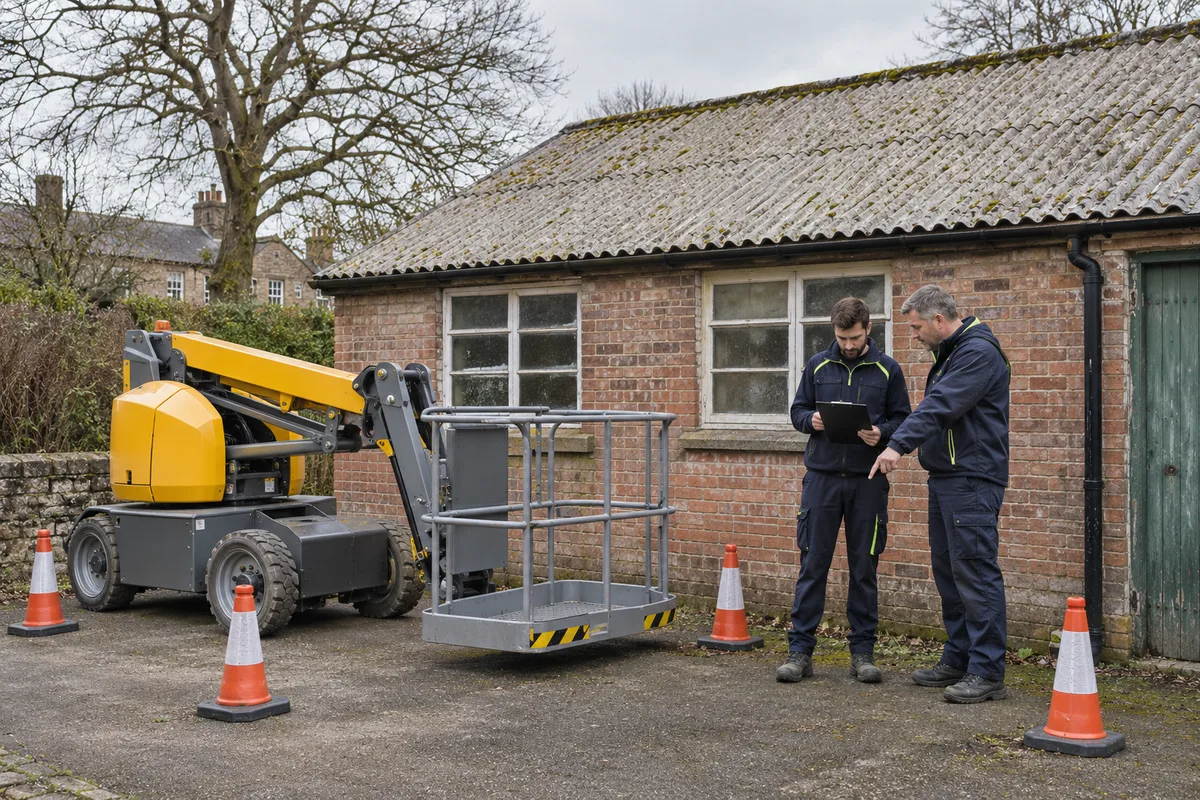 03 · ACCESS IS PART OF THE JOB SCOPEA suitable platform, firm ground and an exclusion zone should be planned before the method and price are agreed.AI-generated illustration · not a customer property or job
Know when an ordinary gutter-cleaning quote is not enough
Stop and obtain specialist advice if the roof material is unknown, the sheets are cracked or badly weathered, loose fragments are present, the gutter can only be reached by crossing the roof, or the job involves a valley or box gutter within the roof plane. Also pause if there is no safe way to isolate the area below, if rooflights or edges cannot be protected, or if the asbestos information conflicts with what is on site.
Roof repairs are a separate scope. Cleaning the gutter does not make damaged sheets safe, seal a leaking fixing or certify the roof’s condition. Similarly, clearing the gutter does not prove that a connected downpipe or underground drain is open. Each limitation should be recorded so the dutyholder knows what was and was not completed.
What the property manager should provide
- The current asbestos register or survey section covering the roof, gutters and downpipes.
- Clear photographs of every elevation, the gutter line, rooflights and access points.
- Building height, ground type, gates, overhead services and space for access equipment.
- How the premises will be occupied during the work and who can establish an exclusion zone.
- Known damage, previous repairs and any recent change in the roof or gutter condition.
For a landlord or business, keep the approved method, contractor competence information, before-and-after photographs, waste documentation and completion note with the building’s maintenance records. The photographs should show the cleaned gutter and accessible outlets without suggesting that the roof itself has been inspected or repaired unless that work was separately commissioned.
Separate the related work packages
One visit can reveal several needs: asbestos-controlled gutter cleaning, safe access equipment, replacement of a damaged gutter bracket, asbestos-cement roof repair and testing of a downpipe. These should not be bundled into a vague “gutter clean”. Each trade needs a clear boundary, and the sequence matters. For example, disturbing a damaged roof after the gutter has been cleaned can contaminate it again.
A useful quotation states the identified roof material, access method, cleaning method, waste route, work-area controls and exclusions. If the contractor is only carrying out a ground-level survey or remote camera inspection, it should say so. A careful “not yet” is better than starting a task without the asbestos or fragile-roof controls it needs.
Related guides cover access planning for tall properties, commercial gutter maintenance records, hidden valley, box and parapet gutters, and useful before-and-after photographs.
The practical rule
If older corrugated roof sheeting may contain asbestos, do not treat the gutter as an isolated plastic or metal channel. Confirm the material, keep everyone off the fragile roof, and agree the controlled cleaning and waste method before work starts.
Sources and further guidance
- HSE Asbestos Essentials A10: Cleaning debris from gutters on an asbestos-cement roof
- HSE: Asbestos Essentials task and method sheets
- HSE: Roof work
- HSE: Fragile surfaces
- HSE: Where asbestos can be found and asbestos-cement products
Share this guide
Know someone responsible for an older workshop, warehouse or outbuilding? Share this guide so the roof material, safe access and waste route are checked before its gutters are cleaned.
Share on FacebookShare on WhatsApp