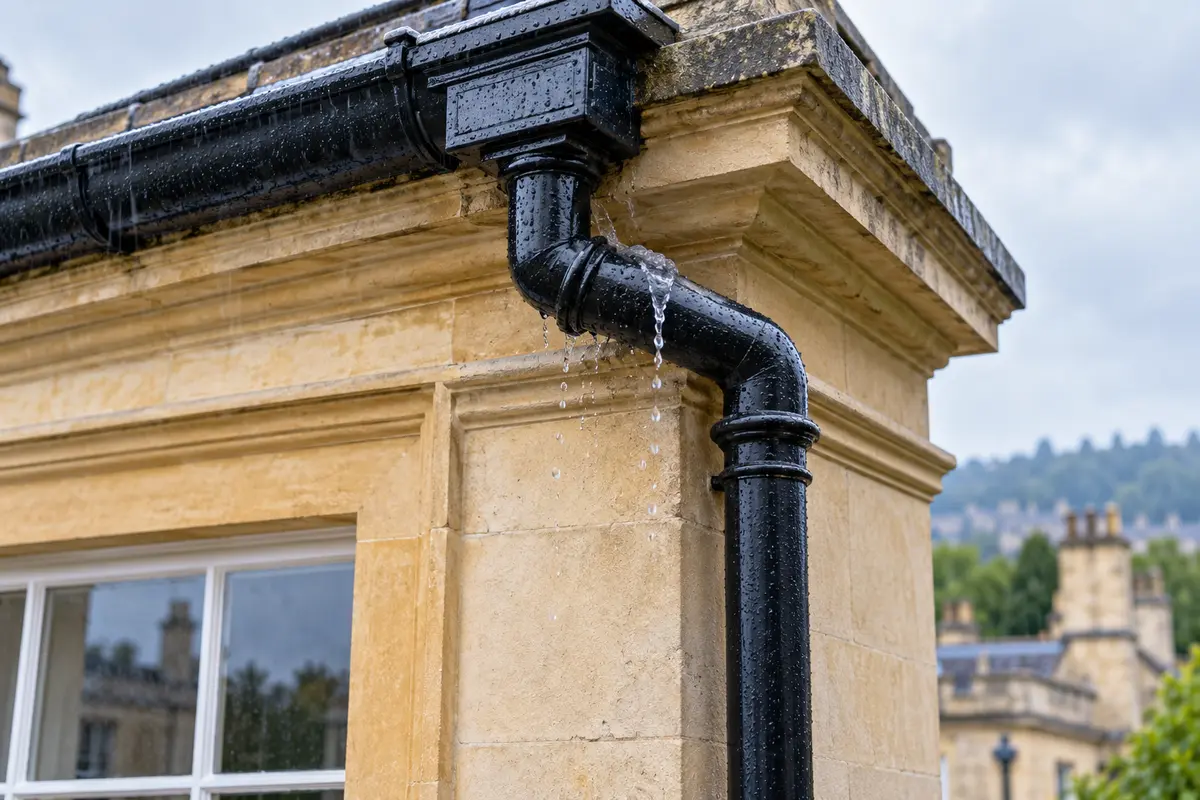
 01 · THE BENDS ARE PART OF THE WATER ROUTEA swan neck uses paired bends to carry water around a projecting eave or cornice before it enters the vertical downpipe. Those changes of direction can hold compacted debris.AI-generated illustration · not a customer property or job
A downpipe is not always a straight tube from gutter to ground. On many older terraces, townhouses and commercial buildings, the outlet sits away from the wall. Two or more angled bends bridge that gap. This offset is often called a swan neck.
The arrangement solves a practical problem, but it also adds joints and changes of direction high above the ground. If leaves, roof moss, grit or fragments pass through the gutter outlet, they can lodge inside a bend rather than travel down the vertical pipe.
What is a swan-neck downpipe?
A typical route is: gutter or hopper outlet, short drop, first bend, sloping offset section, second bend, vertical downpipe, then a shoe or connection to a gully. The exact arrangement varies. Some offsets are short and almost horizontal; others step around a deep stone cornice or a modern fascia.
The name describes the shape, not the material. Swan-neck sections may be cast iron, aluminium, zinc, steel or uPVC. Older Bath and Bristol buildings often retain traditional metal rainwater goods that contribute to the character of the elevation.
Historic England notes that even apparently simple traditional gutters and downpipes can contribute to a building’s architectural interest. That is one reason to diagnose the fault before replacing visible sections or altering their size and route.
Why blockages collect inside the bends
Water can pass around a bend far more easily than a tangled mat of leaves and moss. A rough internal surface, a slightly misaligned joint or a narrow step between components may give the first piece of debris somewhere to catch. More material then gathers behind it.
Offsets can also be difficult to inspect from below. A clear lower section does not prove that the upper bends are clear, and an open gutter does not prove that water has reached the vertical downpipe. The hidden section between them still needs considering.
Common material includes:
- wet leaves and small twigs entering through the outlet;
- roof moss breaking into dense clumps;
- silt and grit that settle at a shallow change of direction;
- fragments left after roofing or building work;
- nesting material after the lawful nesting season and a proper check.
A blockage can occur elsewhere too. Similar symptoms may come from the gutter outlet, hopper head, straight downpipe, shoe, surface gully or underground drain. The shape alone is not a diagnosis.
Clues that narrow the likely position
Watch the system during steady rain only from a safe position. Useful clues include:
- water backing up at the gutter outlet while the gutter further away remains below the rim;
- water escaping from an upper offset joint or staining the stone directly beneath it;
- a hopper filling even though the lower downpipe produces little or no discharge;
- the vertical pipe sounding hollow below the bends but holding water above;
- the same high-level overflow returning soon after only the gutter channel was cleared.
Brown staining, algae or washed-clean streaks can show where water has repeatedly escaped, but staining does not identify today’s blockage on its own. A failed seal, cracked socket or corroded joint can leak even when the pipe is clear.
 02 · INSPECT BEFORE DISMANTLINGA ground-operated camera can help confirm the outlet, bends, joints and access constraints before deciding whether cleaning alone is likely to solve the problem.AI-generated illustration · not a customer property or job
Trace the complete route rather than guessing
A useful check follows the water from roof to ground:
- Gutter or roof channel: is the channel clear and correctly directing water to the outlet?
- Outlet or hopper: can water enter the downpipe without debris bridging the opening?
- Offset bends: is there evidence of backing-up, leaking or a restriction inside the change of direction?
- Vertical downpipe: does the lower section pass water freely?
- Shoe and gully: does discharge reach an open gully, or is there a sealed connection to below-ground drainage?
This order matters. For example, pushing a plug out of the upper bends may simply move it into the vertical pipe or an inaccessible drain connection. Removing loose material upstream and keeping the discharge point under observation makes the outcome easier to verify.
How a professional may check and clear an offset
The method depends on height, material, access and how the sections are connected. A camera may provide an initial view. Where an accessible joint or cleaning point exists, the section may be opened carefully and debris removed into a controlled container. Some systems can be tested with a limited, controlled flow once loose debris has been taken out.
Blindly forcing rods, high-pressure water or improvised tools around bends can separate a joint, crack brittle plastic, damage old cast iron or drive the blockage further into the system. Cast-iron components are heavy, and corroded fixings or sockets may not tolerate dismantling without a repair plan.
Clearing and repair are different outcomes. If a joint leaks after the water route is clear, the remedy may involve resealing, refixing or replacing a compatible section. A cracked fitting, loose bracket or badly corroded socket will not be repaired by removing leaves.
High-level bends need the right access
Swan-neck fittings are commonly at the most difficult point of the elevation: just beneath the eaves and sometimes above a pavement, conservatory, lower roof or basement area. The access method should be chosen for the actual property rather than assumed from the number of storeys.
HSE guidance says work at height must be planned, supervised and carried out by competent people using suitable equipment. Ladders may be appropriate for some low-risk, short-duration tasks after assessment, but they should not be rested against weak surfaces such as plastic gutters and should not be used where the task requires overreaching or strenuous work.
Ground cameras and gutter-vacuum poles can reduce work at height for some inspections and clearing, but they cannot repair every joint or safely dismantle a heavy offset. A tower, scaffold or mobile elevating work platform may be more appropriate where direct controlled access is needed.
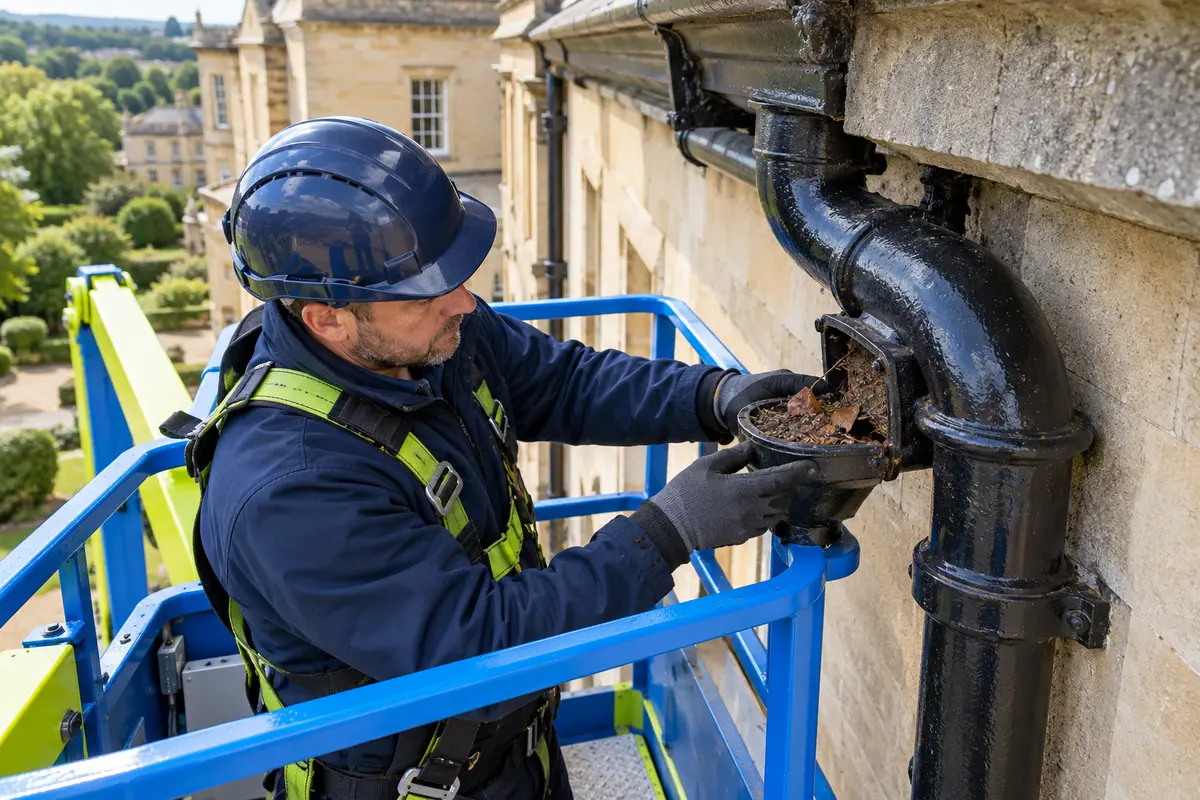 03 · CLEARING MAY REVEAL A REPAIRDirect access can allow a removable joint to be checked and debris captured, but loose fixings, failed seals or damaged metal remain separate repair issues.AI-generated illustration · not a customer property or job
Extra care on older and listed buildings
Traditional rainwater goods may be decorative or specifically shaped to the building. Historic England recommends regular inspection, routine maintenance and timely repair, and warns that altering the size or appearance of downpipes can change a historic building’s character.
On a listed building or a property in a sensitive setting, seek appropriate conservation advice before changing material, profile, route or visible fittings. Clearing a blockage is maintenance; replacing or redesigning significant rainwater goods is a different decision and may need consent.
SPAB recommends regular clearing of rainwater fittings, particularly after the autumn leaf fall, together with checks for defects. For ironwork, suitable periodic redecoration also helps inhibit corrosion.
What to photograph before asking for a quote
Safe, ground-level photographs can prevent surprises at the visit. Send:
- a wide image showing the full elevation and total height;
- a closer image of the gutter outlet, hopper and both offset bends;
- the full vertical downpipe down to its shoe or ground connection;
- any water staining, open joint or repeated overflow point;
- the ground and access route, including gates, steps, conservatories and shared paths;
- a short rain video if it can be taken safely from shelter or ground level.
For landlords and property managers, label the elevation and downpipe so the same route can be found in future records. A photograph after clearing and a note of any outstanding joint or access issue make the next inspection more useful.
The practical takeaway
When water escapes near the top of a downpipe, do not assume the straight pipe or the ground gully is the only possible cause. The paired bends around the eaves are a separate section and can hide compacted debris.
A sound visit identifies the whole route, removes material without simply transferring the blockage, confirms that water reaches the discharge point and records any repairs that cleaning cannot solve.
For related advice, see our guides to blocked hopper heads, distinguishing a downpipe blockage from a gully problem and caring for cast-iron rainwater goods.
Guidance checked on 25 October 2026: Historic England—inspection, maintenance and repair of rainwater systems; Historic England—upgrades or alterations to rainwater goods; SPAB—rainwater fittings; HSE—working at height safely; HSE—safe use of ladders and stepladders.
Share this guide
Know someone with water escaping around the top bends of a downpipe? Share this practical guide.
Share on FacebookShare on WhatsApp