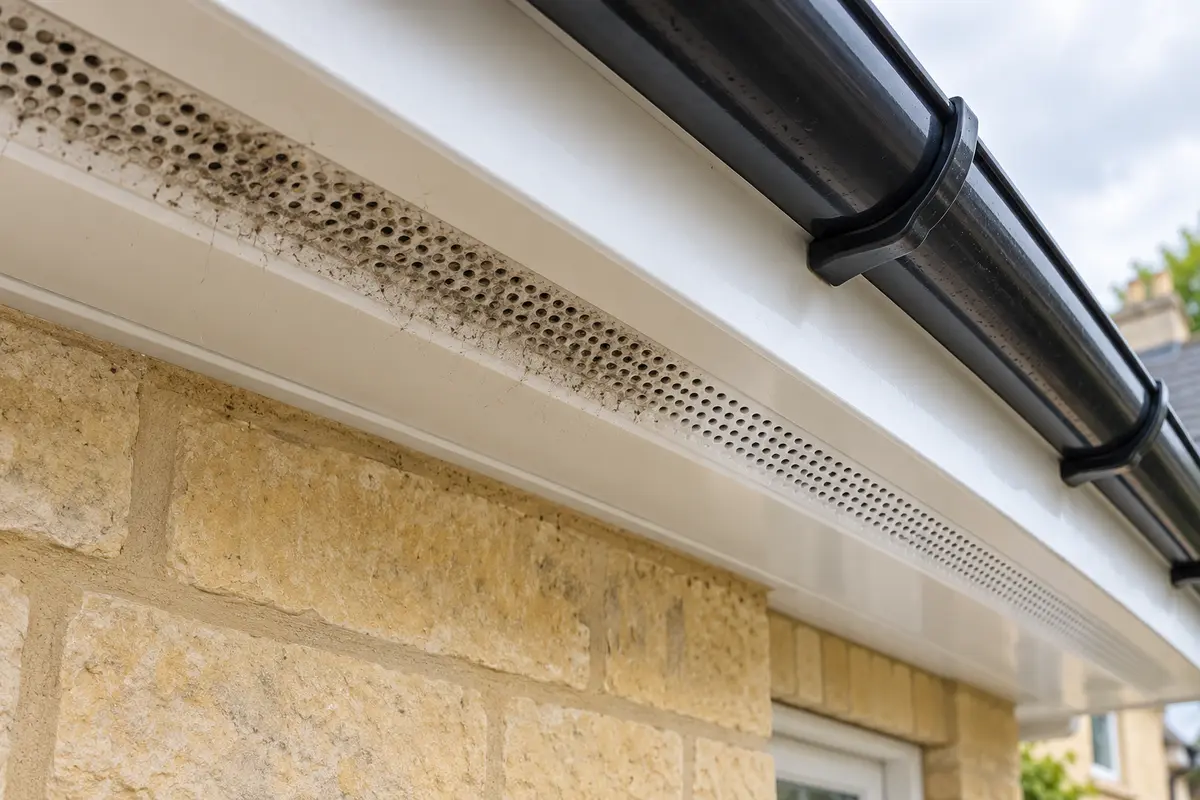
 01 · SMALL OPENINGS MAY HAVE AN IMPORTANT JOBA continuous strip or perforated panel beneath the eaves may provide part of the roof’s ventilation route. Surface cleaning should leave every opening clear.AI-generated illustration · not a customer property or job
Soffits form the underside of the roof edge between the wall and fascia. On some properties they are simply a covering; on others they include vents that help move outside air into a roof void. Those openings can be easy to overlook when the roofline is being washed.
A good clean should remove surface film, cobwebs and loose dirt without filling, sealing or damaging the ventilation openings. It should also distinguish ordinary exterior cleaning from a ventilation or condensation problem that needs inspection by a roofer or other competent specialist.
What does a soffit vent look like?
Common arrangements include:
- a narrow continuous slot or grille running along the eaves;
- a perforated strip fitted within a solid soffit board;
- regular rows of small holes formed in a ventilated uPVC panel;
- individual circular or rectangular vents at intervals;
- an over-fascia ventilator hidden near the top of the fascia rather than in the visible soffit.
Not every roof is ventilated through the soffit. Warm-roof constructions, breathable underlays and other designed systems may use different arrangements. Never cut new holes, seal existing vents or assume that two neighbouring properties should be identical without understanding the roof build-up.
Why the opening needs to remain clear
NHBC’s pitched-roof guidance says ventilation pathways should remain clear and not be blocked by insulation or the structure. It also describes proprietary eaves ventilators and spacers that maintain an airway over the insulation. Bath and North East Somerset Council similarly explains that roof ventilation needs a path from the eaves over the insulation in relevant loft-conversion designs.
The visible soffit opening is only the outside end of that route. Air still needs a clear passage through the eaves detail and into the intended roof void. Cleaning the face will not correct insulation pushed hard into the eaves, a missing ventilation tray or an unsuitable roof design.
What collects on soffit vents?
Because soffits face downwards, they are usually less exposed than gutters, but they can still collect:
- road film, dust and airborne dirt;
- spider webs and insect debris;
- algae or surface staining in damp, shaded positions;
- paint overspray from earlier decoration;
- loose organic matter trapped against a grille;
- residue from an overflowing or leaking gutter above.
Dirt around the holes does not automatically mean the roof is poorly ventilated. Equally, a vent that looks clean from below may lead to an internal path blocked by insulation. Visible condition is one useful clue, not a complete diagnosis.
Gutter clearing and roofline washing are different jobs
A standard gutter clear removes debris from inside the gutter, clears the tops of downpipes and records visible joints and outlets. Washing the outside faces of gutters, fascias and soffits is a separate service because it needs different equipment, extra time and a cleaning method suitable for the materials.
If soffit washing is requested, identify the vent type before work starts. Photographing the roofline first helps confirm which openings were present and highlights staining that may be linked to a leak rather than ordinary dirt.
 02 · USE A CONTROLLED, MATERIAL-SUITABLE METHODA soft brush and controlled rinse can lift surface dirt while keeping the vent strip visible. The method should suit the roofline material and access.AI-generated illustration · not a customer property or job
What careful cleaning should include
For sound uPVC roofline materials, a careful external clean may include:
- Inspect first: identify vents, loose boards, open joints, damaged seals and any electrical fittings.
- Remove loose cobwebs: use a soft brush rather than pushing material into the holes.
- Apply a suitable mild cleaning solution: follow the product and roofline manufacturer’s instructions.
- Agitate gently: avoid aggressive tools that scratch uPVC or disturb brittle fittings.
- Rinse in a controlled way: do not direct high pressure into ventilation openings, roof voids or behind boards.
- Check the result: confirm that perforations or grilles remain visibly open and that no board has moved.
Painted timber, aluminium, asbestos-containing products and older or fragile rooflines may need a different method. If the material is uncertain, stop and identify it before cleaning.
What not to do
- Do not fill vents with sealant, filler, expanding foam or tape to stop draughts.
- Do not paint across a grille or perforated strip without keeping the designed openings clear.
- Do not force a screwdriver, wire or pressure-washer nozzle into the holes.
- Do not remove ventilation components simply because they look untidy.
- Do not assume that visible mould inside a loft will be solved by washing the soffit.
- Do not climb onto a conservatory or extension to reach the eaves.
HSE guidance says work at height should be avoided where possible, for example by using extending equipment from ground level. Where height work cannot be avoided, it must be planned and suitable equipment selected for the property.
Look at the complete ventilation path
Where a safe loft inspection is possible, the eaves may reveal more than the outside face. A designed cold-roof ventilation route may include an external opening, a grille or ventilator, a spacer or tray, and a clear airway above the insulation.
Do not compress, remove or rearrange insulation casually. Moving it may create cold spots or expose electrical and access hazards. If insulation blocks the eaves, if there is damp timber or if the intended route is unclear, arrange a roofing or insulation assessment.
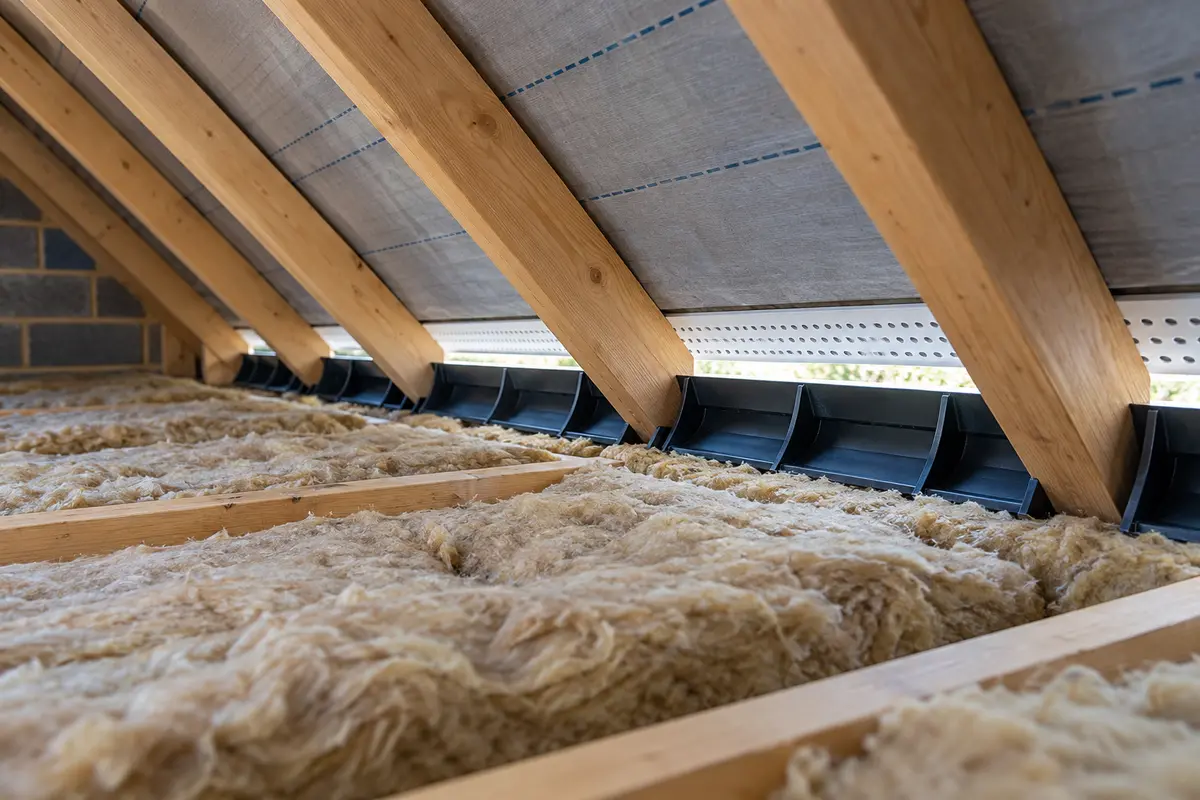 03 · THE OUTSIDE VENT IS ONLY ONE PART OF THE ROUTEIn a relevant cold-roof design, a spacer or tray can keep insulation away from the eaves so the intended air path remains open.AI-generated illustration · not a customer property or job
Cleaning cannot diagnose every condensation problem
Roof-space condensation can have several contributors, including moisture entering from the home, air leakage, insulation arrangement, ventilation design and local cold surfaces. Approved Document C covers protection from harmful effects of interstitial and surface condensation, but the correct solution depends on the building.
Arrange further investigation if you find:
- persistent water droplets on underlay, nails or timbers;
- wet or compressed insulation at the eaves;
- mould growth or a strong musty smell in the loft;
- timber staining, softness or corrosion to metal fixings;
- daylight where a board has come loose rather than through a designed vent;
- water staining immediately below a leaking gutter joint or roof edge.
These signs do not prove one cause. A leaking roof or gutter can produce local wetting, while condensation often needs the whole roof and internal moisture route considered.
What to photograph for a useful quote
From a safe position, provide:
- a wide photograph of each elevation and its access;
- a close view of the soffit, fascia and any visible vent strip;
- staining, algae, loose boards or open joints;
- the gutter above the affected area, including joints and outlets;
- conservatories, extensions, cables or narrow passages that affect access;
- loft-side photographs only where they can be taken safely from a boarded area.
Tell us whether you want the gutters cleared internally, the roofline washed externally, or both. For related advice, see what to ask for with fascia and soffit cleaning, when sagging guttering may involve the fascia and planning access around conservatories and extensions.
Guidance checked on 28 October 2026: GOV.UK—Approved Document C; NHBC Standards—pitched-roof ventilation; Bath & North East Somerset Council—ventilation of rooms and roofs; HSE—work at height; Historic England—maintenance checklist.
Share this guide
Know someone planning to clean their fascias and soffits? Share this guide to keeping roof ventilation openings clear.
Share on FacebookShare on WhatsApp