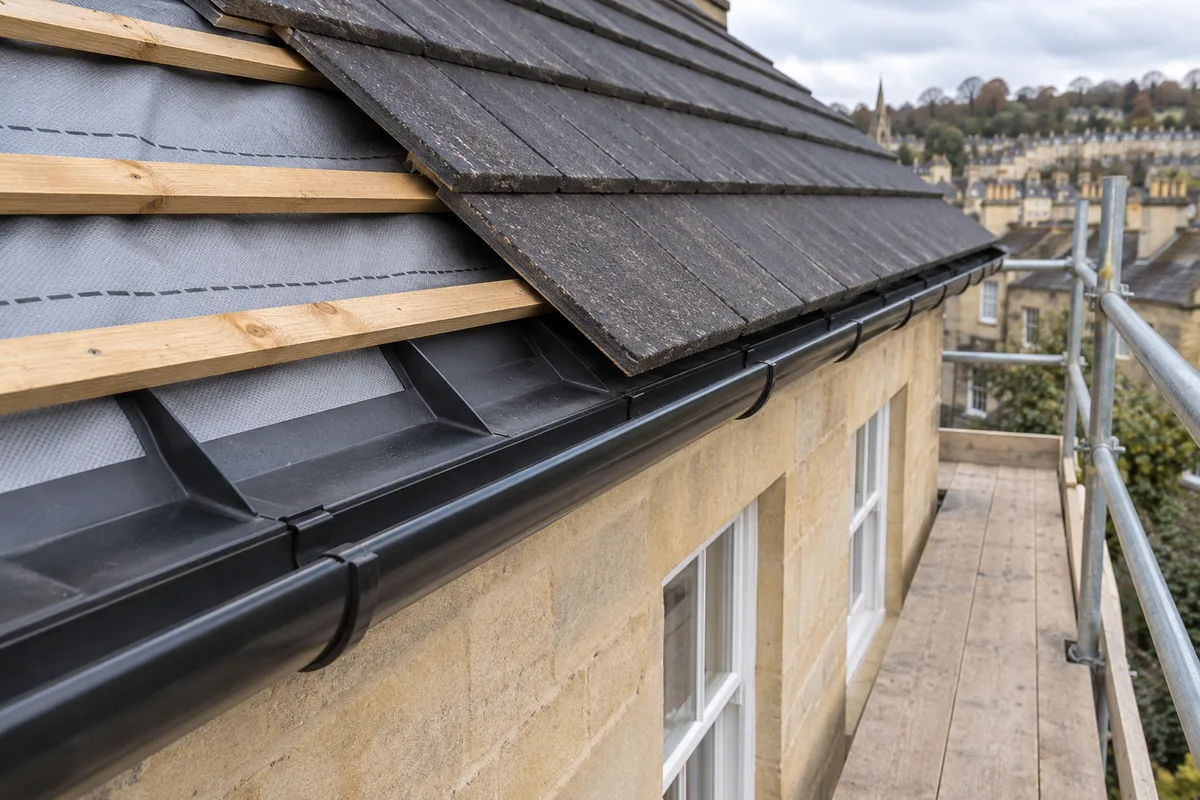
 01 · ASSESS BEFORE YOU REPLACEA re-roof exposes the roof edge and creates useful access. Decide whether the gutter can stay by checking its condition, alignment, supports and capacity—not simply its age.AI-generated illustration · not a customer property or job
Replacing roof coverings is a major job. It is sensible to review the gutters at the same time, but “new roof” should not automatically mean “new guttering”. A sound system may only need clearing, adjustment or a small repair.
The decision should be based on evidence: does the gutter still carry water correctly, are the joints and brackets sound, is the fascia suitable, and will the finished roof edge direct water into it?
The short answer: replace only when there is a reason
Existing gutters can often remain if they are the right size for the roof, securely supported, free from recurring leaks and compatible with the finished eaves detail. Replacement becomes more sensible when there is widespread distortion, brittle or cracked fittings, repeated failed joints, poor alignment, inadequate capacity or an unsound fascia that prevents reliable fixing.
Cleaning and replacement solve different problems. Removing moss and silt restores the waterway; it does not correct a badly positioned gutter, damaged fascia or undersized outlet. Equally, fitting new guttering will not solve water running behind the system if the roof underlay and eaves detail are wrong.
Inspect the complete route before roof work starts
A useful pre-start record lets the roofing and gutter teams distinguish existing defects from issues created during the work. From the ground, photograph each elevation and note:
- the gutter material, profile, colour and approximate age if known;
- joints, angles, stop ends, outlets and any previous sealant repairs;
- sagging, backfall, standing water marks or sections that pull away from the fascia;
- loose brackets, damaged fascia and soffit staining;
- each downpipe route, clip, bend, gully and final discharge point;
- overflow seen during rain and where it occurs; and
- extensions, valleys or additional roof areas that feed the same outlet.
If scaffolding is required for the re-roof, use that planned access to inspect details that cannot be confirmed from below. Do not climb onto the scaffold unless access has been authorised and it is ready for use.
The roof edge, underlay and gutter work as one detail
Water reaching the eaves must cross the roof edge and enter the gutter. The roof covering handles most rainfall, while the underlay provides a secondary drainage path for moisture beneath the tiles or slates.
NHBC guidance says underlay exposed at eaves should be dressed into the gutter, and that it should be supported by a continuous fillet or proprietary eaves support tray laid to a fall so it does not sag and form a water trap. Marley’s sitework guidance likewise shows the underlay lapped onto a UV-stable support tray and warns against water traps behind the fascia.
When a roof is stripped, this eaves detail becomes visible. It is the right time to check that the support tray, fascia line, tile projection and gutter position will work together. Reusing the gutter is reasonable only if the finished roof can still discharge into it cleanly.
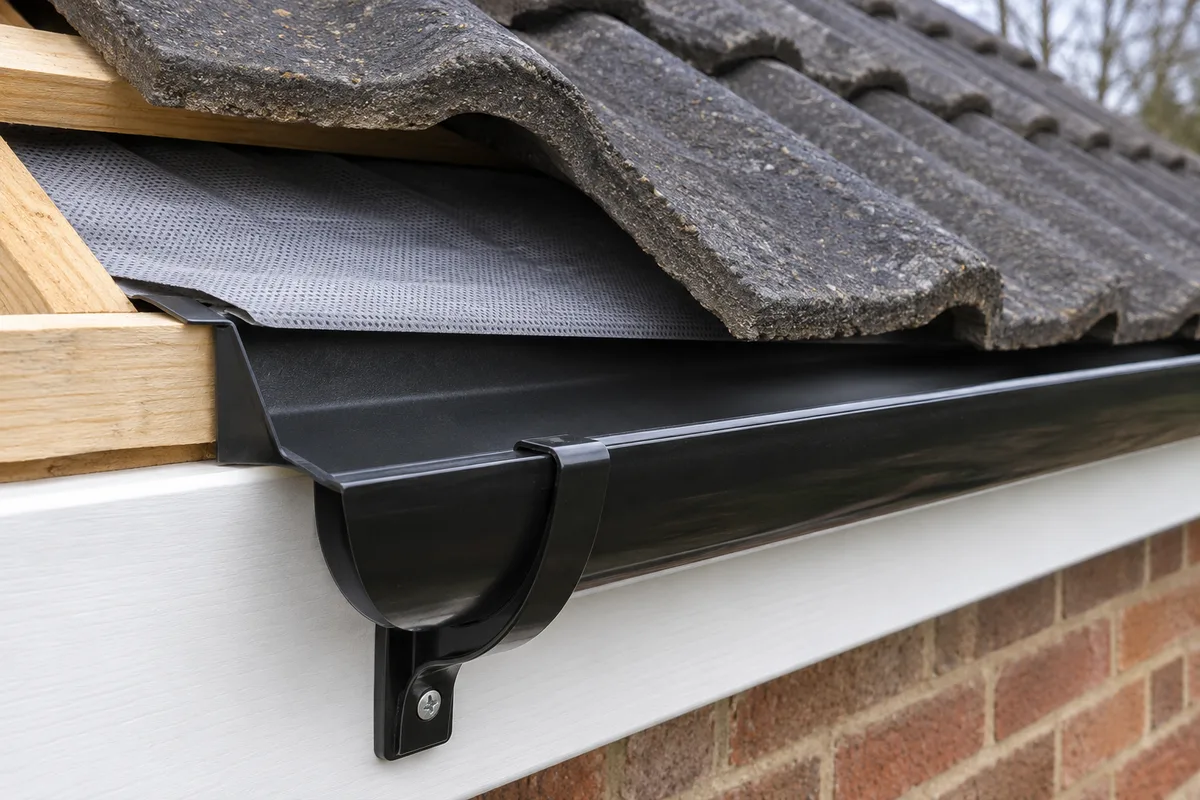 02 · KEEP THE EAVES DRAINAGE PATH CONTINUOUSThe underlay needs suitable support at the roof edge so incidental water reaches the gutter instead of collecting behind the fascia.AI-generated illustration · not customer work
When retaining the existing gutters makes sense
Keeping the existing system may be the best option when:
- gutter lengths and fittings remain sound and correctly joined;
- brackets are secure and spaced for that manufacturer’s profile;
- the gutter line is even and drains towards its outlet without persistent ponding;
- the outlet and downpipe accept the expected flow;
- the fascia or rafter-end fixings are firm;
- the finished tiles or slates will project correctly over the gutter; and
- replacement would add no practical improvement.
The gutter may need to be temporarily released or protected while fascia, underlay support or scaffolding work is completed. Photograph it before removal, label unusual fittings and store sections without twisting or scratching them. Refit system components in accordance with their manufacturer’s instructions.
When repair or replacement should be allowed for
A re-roof is a useful opportunity to address defects that would be awkward to reach later. Consider repair or replacement when inspection finds:
- several cracked, distorted or mismatched components;
- joints that repeatedly leak after correct cleaning and servicing;
- brackets fixed into rotten, split or unsuitable fascia material;
- a gutter run that cannot be aligned to fall towards an outlet;
- an outlet or downpipe that repeatedly restricts the roof flow;
- corrosion, coating failure or impact damage affecting a metal system;
- a discontinued profile with no reliable matching fittings; or
- a changed roof area that needs a new capacity calculation.
One failed stop end does not justify replacing every elevation. Conversely, repeated patching across several joints may cost time without producing a dependable result. Define the defect by elevation and price the necessary work separately.
Has the effective roof area changed?
An extension, dormer, new valley or altered downpipe can send more water to an existing gutter than before. Do not assume that a gutter suitable for the old roof remains suitable after its catchment changes.
Approved Document H says gutters should fall towards the nearest outlet and should be arranged so overflow is discharged clear of the building. It also explains that capacity depends on factors including rainfall intensity, gutter section and outlet form. If the re-roof changes where water is collected or discharged, the designer or installer should review the gutter and downpipe sizing rather than simply matching the old profile.
A blockage can imitate a capacity problem, so begin with a clear system and a traced route. Capacity assessment and routine cleaning are separate tasks.
Coordinate roofing, fascia and gutter responsibilities
Before work starts, agree who is responsible for removing, protecting and refitting the guttering; replacing fascia boards; fitting the eaves support detail; clearing construction debris; and testing the finished route. This avoids a gap between the roofing and gutter scopes.
A good handover should identify any retained components, new components, known limitations and repairs still outstanding. For landlords and managed premises, keep the photographs with the roof warranty and maintenance record.
Test the finished eaves and rainwater route
Once roof work is complete and the gutter is clear, inspect the line and every joint from safe access. Confirm that:
- the tile or slate edge directs water into the gutter;
- the underlay support detail terminates correctly at the eaves;
- brackets, unions, angles, stop ends and outlets are secure;
- water travels towards the outlet without backing up;
- the downpipe and gully accept the flow; and
- no construction debris has been left in the gutter or outlet.
Observation during natural rain is useful, but it should be done from a safe position. Do not walk on a wet roof or lean from a window to watch the gutter.
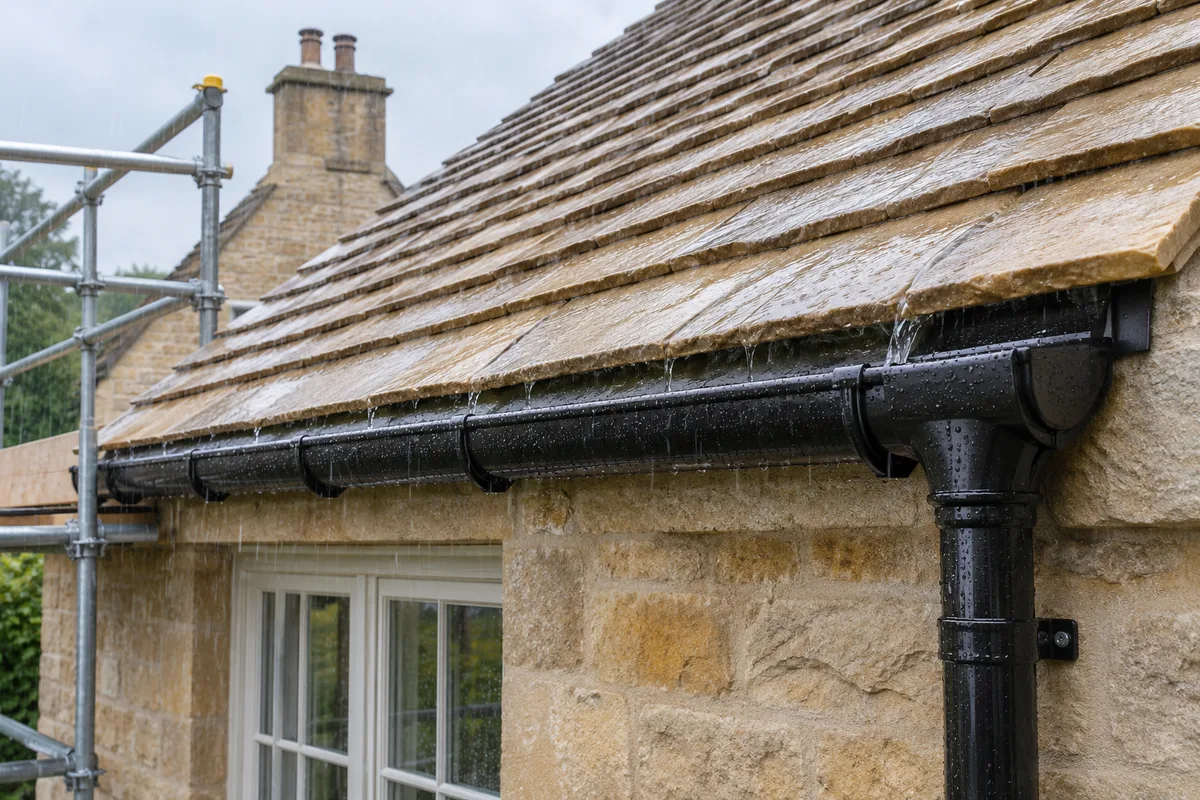 03 · CHECK THE COMPLETED WATER ROUTEAfter the roof edge is finished, confirm water enters the gutter, reaches the outlet and continues through the downpipe without overflow or leakage.AI-generated illustration · not customer work
Use the scaffold opportunity safely
It can be economical to complete necessary gutter or fascia work while suitable scaffolding is already in place, but access must still be planned. The Health and Safety Executive says roof work must be organised, workers must be competent and appropriate fall-prevention equipment must be used. A scaffold erected for one task should not be altered or assumed suitable for another without agreement.
Homeowners should not climb scaffolding to inspect the eaves themselves. Ask for clear photographs and a written note of any defects before approving extra work.
Related guides explain what to check after roof or building work, why water may run behind a gutter, and how to create a useful before-and-after gutter record.
The practical rule
Do not replace sound gutters just because the roof is new. Inspect the eaves as one drainage detail, retain components that remain suitable, and repair or replace only where condition, support, alignment or capacity gives a clear reason.
Sources and further guidance
- NHBC Standards: roofs, underlays and eaves support
- Marley Roofing: sitework guidance for underlay at eaves
- GOV.UK: Approved Document H, rainwater drainage
- Health and Safety Executive: roof work
Share this guide
Know someone planning a re-roof? Share this practical checklist for deciding whether the existing gutters can stay.
Share on FacebookShare on WhatsApp