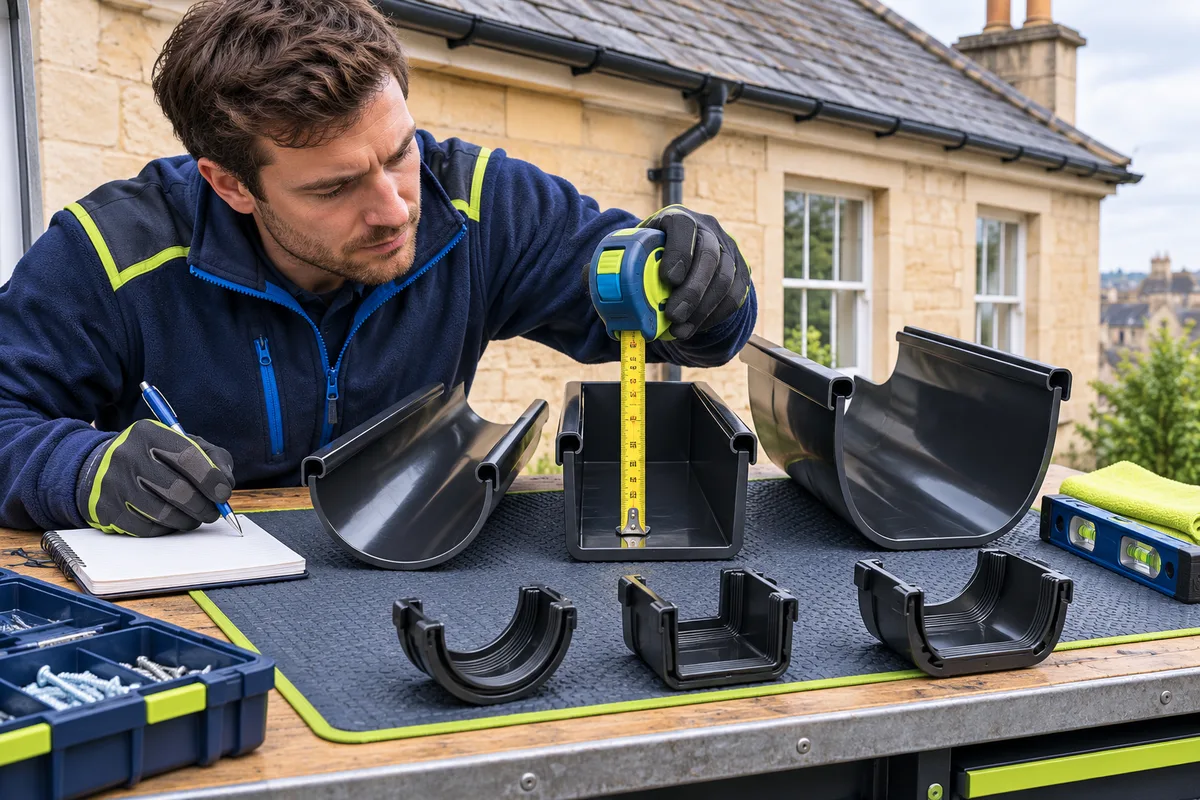
 01 · IDENTIFY THE SYSTEM FIRSTProfile names describe the general shape, but the width, depth, lip and fitting geometry determine whether components actually belong together.AI-generated illustration · not a customer property or job
A leaking union or broken bracket can appear to be a simple one-part repair. The difficult part is often identifying the existing rainwater system well enough to choose a fitting that seals, supports and moves with it correctly.
Black plastic guttering is not one universal system. Manufacturers offer several profiles and sizes, and compatibility varies. Some combinations are formally listed as interchangeable; others need an adaptor; many are not intended to be joined at all.
The short answer: do not rely on appearance alone
Two gutters may both be described as “half-round” yet differ at the front bead, rear lip, depth or overall width. A union can appear to clip on while its rubber seals make poor contact. Squareline and deep-flow systems vary even more, and fittings from one range should not be assumed to suit another.
The correct approach is to identify the existing manufacturer and range where possible, then use the matching fitting or an adaptor specifically approved for that combination. Brett Martin’s own compatibility table, for example, lists certain Roundstyle combinations as interchangeable but marks many Squarestyle, Deepstyle and Prostyle combinations as not interchangeable. That is useful evidence that compatibility is system-specific rather than something that can be judged by colour or a quick trial fit.
Start with the profile, material and size
From safe ground-level access, record the shape and the components at each end of the damaged section. Common domestic uPVC profiles include:
- half-round: a curved channel with shaped front and rear lips;
- squareline: a flatter base and squarer face;
- deep-flow or high-capacity: a deeper curved or semi-elliptical channel;
- ogee or moulded profiles: a decorative front face with its own fittings; and
- mini or extra-large systems: designed for smaller roofs or higher flows.
Material matters too. uPVC, aluminium and cast iron use different jointing, fixing and movement details. A black finish does not mean components share the same material or system.
FloPlast’s current rainwater range illustrates the variation: it lists 76 mm Miniflo, 112 mm Half Round, 114 mm Square Line, 110 mm Niagara, 115 mm Hi-Cap and 170 mm Xtraflo systems. Those figures are one manufacturer’s nominal sizes, not a universal code for every product on the market.
Look for identification before measuring
Inspect the underside of accessible gutter lengths, union fittings, outlets, stop ends and brackets for a moulded name, logo, product code or range mark. Old invoices, extension records and spare fittings stored at the property may also help.
Take clear photographs of:
- the gutter end or cross-section;
- the front bead and rear lip;
- the underside of a union, outlet and bracket;
- the rubber seal arrangement inside the fitting;
- any expansion or insertion mark; and
- the downpipe shape and outlet connection.
Do not pull a sound joint apart simply to search for a mark. If no identification is visible, a small removed damaged section can be measured and compared with manufacturers’ technical information.
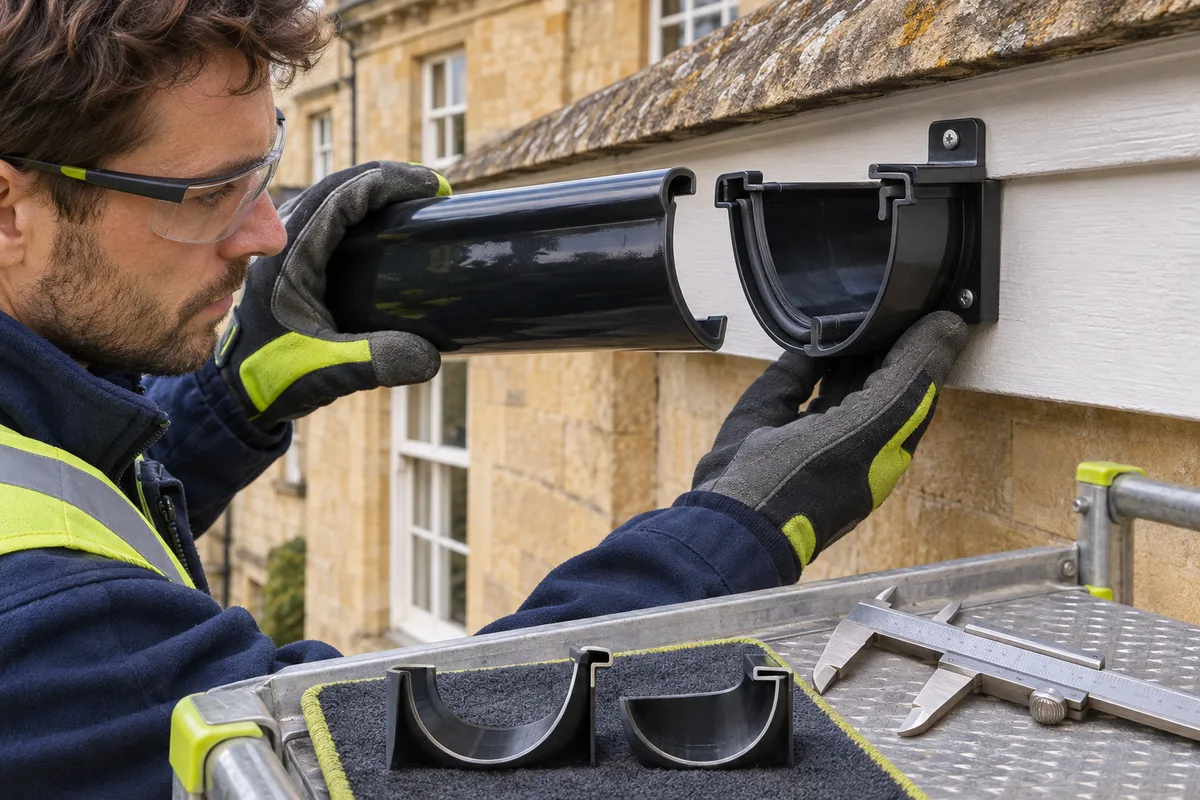 02 · CHECK THE LIPS AND SEAL CONTACTA fitting can look close without gripping both edges or compressing its seals correctly. Compare the full cross-section, not just the nominal width.AI-generated illustration · not customer work
What should be measured?
Measurements help narrow down the range, but they must be taken consistently. Check the overall outside width, internal depth, front bead shape, rear lip shape and the position at which the fitting grips the gutter. For downpipes, record both the external dimensions and whether the section is round, square or rectangular.
A tape measure is useful for the main dimensions; calipers can help with smaller lip details. Compare the result with a current technical drawing or an undamaged known fitting. A few millimetres can be enough to change how a clip holds or how a seal sits.
Colour is only supporting evidence. “Black”, “brown” and “anthracite” finishes can differ between ranges and ages, and a weathered fitting may no longer resemble a new component.
Why an almost-fitting union can still leak
A uPVC union normally performs several jobs at once: it aligns two gutter lengths, supports the joint, compresses seals against the channel and leaves room for thermal movement. A mismatched fitting may fail in one or more of those tasks.
Warning signs include:
- one edge clips in but the other sits proud;
- the gutter can be rocked inside the fitting;
- the rubber seal only touches part of the channel;
- the gutter must be forced beyond an insertion mark;
- the union twists when fixed to the fascia;
- the joint leaks despite clean, undamaged seals; or
- nearby brackets have been removed or bent to make the parts meet.
Do not use a large bead of sealant to disguise a poor mechanical match. On a seal-based system, the lasting repair is to establish why the joint is not seating and use compatible components.
Expansion allowance is part of the match
Plastic gutter lengths expand and contract as temperatures change. Manufacturer fittings therefore include insertion or expansion marks. FloPlast instructs installers to keep the marked expansion allowance and to lubricate gutter seals with the specified silicone spray so the gutter can be fitted without damaging the seals. Brett Martin likewise says each end should not be inserted beyond its expansion allowance line.
A repair that is forced tight into a mismatched fitting may look acceptable on the day but can distort, pull at joints or resist normal movement later. The relevant manufacturer’s installation instructions should govern the finished joint.
Brackets, outlets and downpipes must match as well
Replacing the union alone is not enough if the gutter is being held in unsuitable brackets or the outlet does not suit the profile. Check that:
- the bracket clips fully engage the front and rear edges;
- the bracket spacing follows the range instructions;
- a bracket is positioned near angles and stop ends where required;
- the outlet matches both the gutter profile and downpipe;
- the fascia fixings are sound; and
- the completed line still drains towards the outlet.
FloPlast’s installation guidance gives different maximum bracket spacings for some of its systems, which is another reason not to treat every profile as identical. Use the instructions for the exact range rather than copying the spacing from an unrelated elevation.
When an adaptor is the correct solution
An adaptor can be appropriate where a manufacturer specifically offers one to connect two systems or where a transition is unavoidable. The adaptor should be designed for the profiles concerned and installed with the required seals, supports and movement allowance.
An adaptor is not the same as packing a gap with sealant, trimming clips by guesswork or forcing an oversized fitting. If an official compatibility table describes a modification, it should be followed only by a competent installer who has confirmed both products. If the existing system cannot be identified with confidence, replacing a sensible complete section with one consistent system may be more dependable than creating an improvised junction.
A practical repair sequence
- Trace the defect. Confirm that the leak is at the fitting rather than overflow, poor fall or water arriving from behind the gutter.
- Clear the working area. Remove debris so the profile, seals and insertion marks can be inspected.
- Identify and measure. Record the manufacturer, range, shape, dimensions and downpipe connection.
- Check published compatibility. Use the relevant manufacturer’s current technical guidance or a specified adaptor.
- Inspect the support. Check fascia condition, brackets, alignment and the fittings on either side.
- Fit without forcing. Follow the seal lubrication, insertion and fixing instructions for the system.
- Test the route. Confirm the joint remains dry and water travels to the outlet and downpipe.
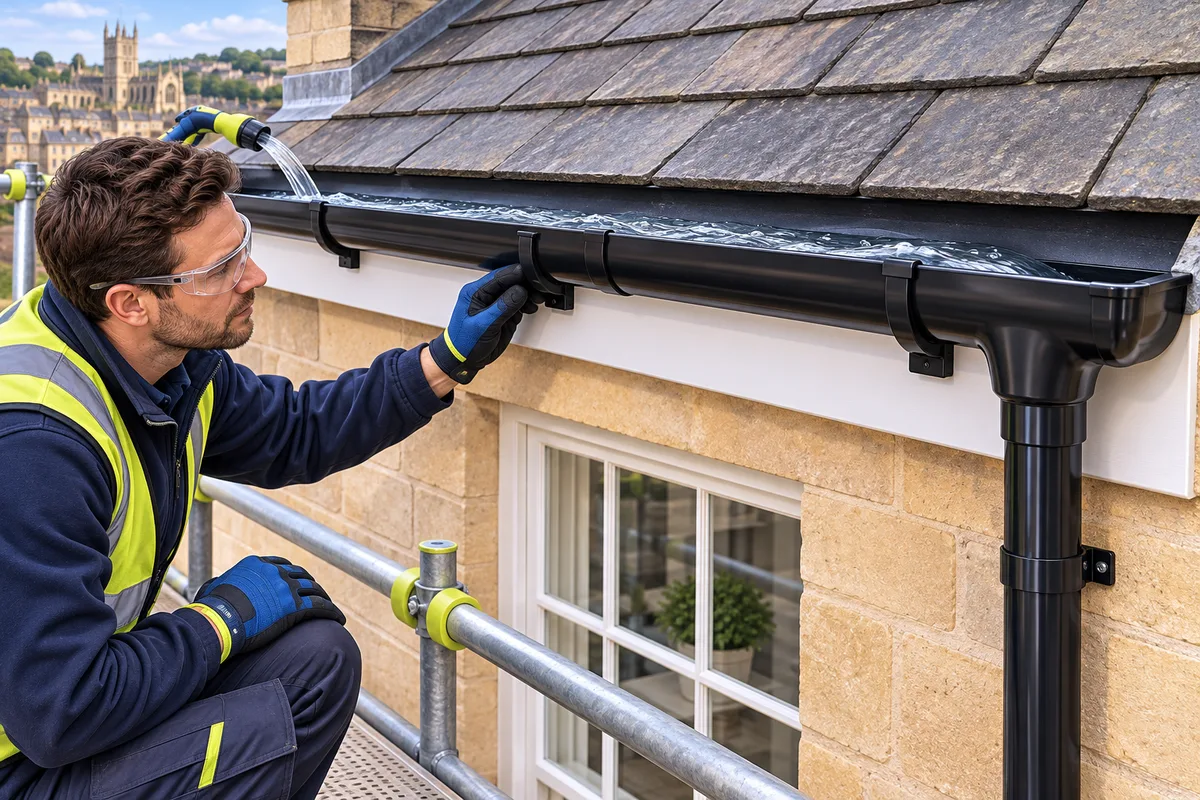 03 · TEST THE COMPLETE WATER ROUTEA matched joint is only part of the repair. Check support, alignment, outlet flow and the downpipe before the access equipment is removed.AI-generated illustration · not customer work
When a small repair becomes a section replacement
A single correctly identified fitting is usually a contained repair. Replacing a longer section may be more appropriate where the profile is discontinued, several components are brittle or distorted, previous mixed fittings have failed, or no approved transition is available.
Define the scope by elevation. A problem on one short run does not automatically mean every gutter on the building needs replacement. Equally, keeping a patchwork of unidentified parts can make repeated call-outs more likely.
Keep the work safe
Most measurements and photographs can begin from the ground. The Health and Safety Executive says work at height should be avoided where reasonably practicable, equipment must be suitable and stable, and ladders must not be rested against weak upper surfaces such as plastic gutters. Close inspection or replacement at eaves level should be planned with appropriate access rather than leaning from a window or overreaching from a ladder.
Related guides explain how to diagnose leaking uPVC gutter joints, when sagging gutters need more than clearing, and what to inspect on aluminium rainwater systems.
The practical rule
Match the complete system, not just the colour and general shape. Identify the range, compare the profile and dimensions, use a listed compatible fitting or adaptor, preserve the movement allowance and test the whole route after repair.
Sources and further guidance
- FloPlast: rainwater systems and installation guidance
- FloPlast: rainwater system ranges and FAQs
- Brett Martin: Rainwater Technical Guide
- Brett Martin: manufacturer compatibility and expansion FAQs
- Health and Safety Executive: working at height safely
Share this guide
Know someone planning a gutter repair? Share this guide to identifying the existing profile before ordering parts.
Share on FacebookShare on WhatsApp