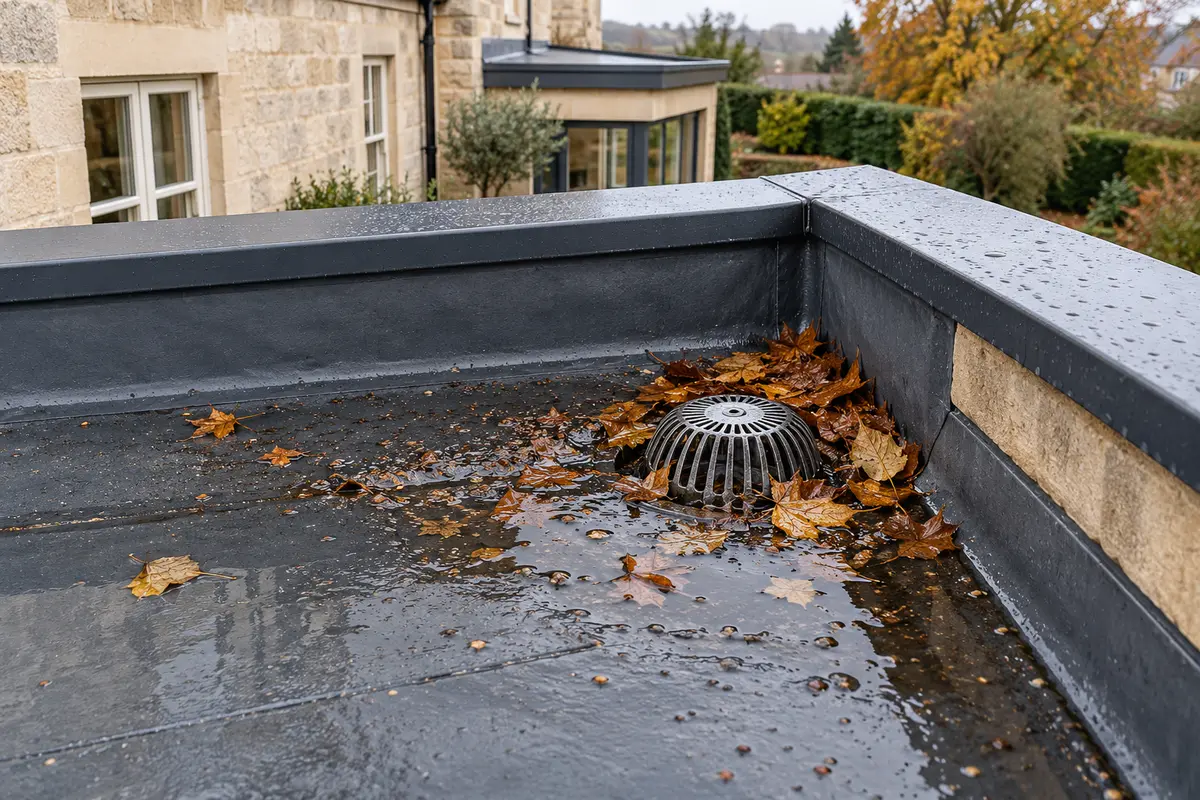
 01 · A SMALL OUTLET MAY DRAIN A LARGE AREALeaves and grit can gather around the lowest point of a flat roof, reducing the open area available for rainwater to escape.AI-generated illustration · not a customer property or job
A flat roof may look simple, but its rainwater often depends on one or two small outlets. When leaves, moss, silt or building debris collect around one of those points, water can spread across a much larger roof area before anyone notices a problem.
This applies to extensions, garages, porches, shop roofs, offices and blocks of flats. The important question is not only whether the visible guard is clear, but whether the complete route—from roof surface to downpipe and ground drainage—is working.
What is a flat-roof outlet?
A flat roof is normally formed with a fall so rainwater moves towards a chosen drainage point. That point may be:
- a circular or square outlet passing through the roof deck;
- a chute or scupper through a parapet wall;
- a channel leading to an external hopper head;
- an outlet connected to an internal rainwater pipe;
- a perimeter gutter serving the edge of the roof.
Many outlets have a removable dome, cage or leaf guard. Its purpose is to reduce the chance of larger debris entering the pipe, but the guard itself still needs inspection. Material can collect around its outside and restrict the available openings.
Why debris gathers at the drainage point
The outlet sits at or near the low point, so moving water carries loose material towards it. Wet leaves can lie flat against a cage. Fine grit, moss and organic matter can settle beneath larger debris and form a dense layer that is not obvious from a distance.
Sources may include nearby trees, roof moss, windblown litter, bird activity and fragments from roof or building work. Gravel-surfaced and green roofs have their own drainage layers and guards; these should be maintained in accordance with the roof system rather than disturbed casually.
A leaf guard is therefore a first line of defence, not a maintenance-free fitting. A clean-looking opening through the top of a dome may still have blocked slots around its base.
Warning signs to look for
From a safe position, useful signs include:
- leaves, moss or silt forming a ring around the outlet guard;
- a clear tide mark showing that water has stood higher around the outlet;
- ponding that remains after the rest of the roof has drained;
- water escaping through a parapet overflow or over an edge;
- a hopper head below the outlet filling or overflowing;
- water staining beneath the outlet, downpipe or parapet chute;
- damp marks on a ceiling or wall below the roof.
Some residual surface water may relate to the roof’s design, tolerances or local depressions rather than a blocked outlet. Equally, an internal damp patch does not prove that the drain is blocked. Splits in the covering, failed seams, defective upstands, penetrations and condensation can create similar symptoms.
Trace the whole drainage route
A useful inspection follows the rainwater in order:
- Roof surface and falls: can water reach the outlet, or is it trapped in another low area?
- Guard and outlet mouth: are the slots, flange and immediate surround clear?
- Outlet throat: is loose material lodged just below the visible opening?
- Rainwater pipe or hopper: does water pass away without backing up?
- Ground discharge: does the downpipe reach a clear gully or another known drainage connection?
- Overflow route: if fitted, is it unobstructed and has it recently carried water?
This prevents a common mistake: clearing the roof-side guard while leaving a restriction in the pipe or ground drainage. It also helps separate a routine clearance from a roof-covering repair or drainage investigation.
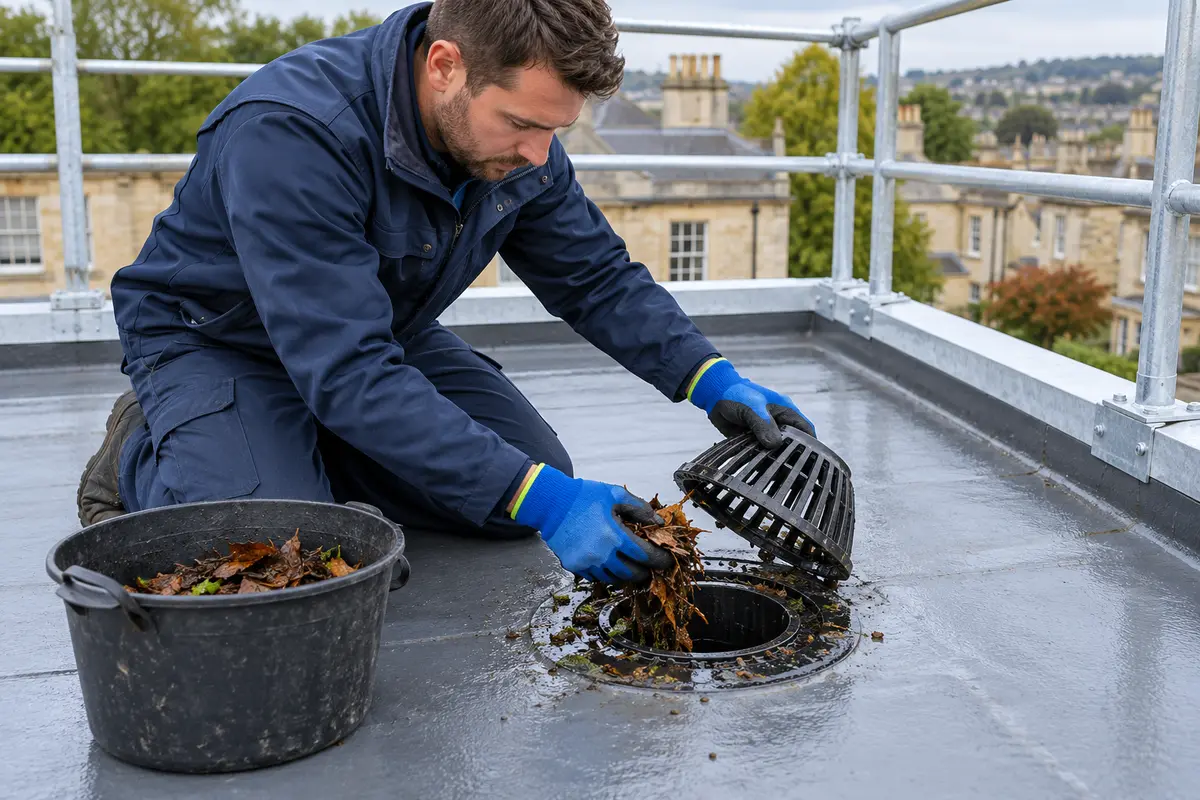 02 · REMOVE DEBRIS WITHOUT DAMAGING THE ROOFLoose material should be collected and the removable guard checked carefully. Sharp tools and uncontrolled pressure can harm the waterproof covering or outlet seal.AI-generated illustration · not a customer property or job
What careful clearing should include
Where access is suitable and the outlet is designed to be opened, the process may include:
- collecting loose leaves and larger debris before removing the guard;
- lifting the guard without forcing brittle or corroded fixings;
- removing compacted material from the outlet mouth by hand or with non-damaging tools;
- checking the visible membrane-to-outlet junction for splits, lifting or distortion;
- refitting the guard securely and in the correct position;
- confirming that debris has been taken away rather than swept into another outlet.
High-pressure water, sharp scrapers and improvised rods can damage the waterproofing, disconnect a hidden fitting or push a plug further into the pipe. The roof system manufacturer’s maintenance instructions take priority where they are available.
A controlled flow check has limits
After loose debris has been removed, a modest controlled flow can help show whether water reaches the outlet and passes into the visible discharge route. The downstream gully or hopper should be observed at the same time where possible.
A successful short test does not prove that every concealed joint or underground drain is fault-free, and large volumes should not be added to a system of unknown condition. If water backs up, escapes at a joint or fails to appear at the expected discharge point, stop and investigate rather than forcing more water through.
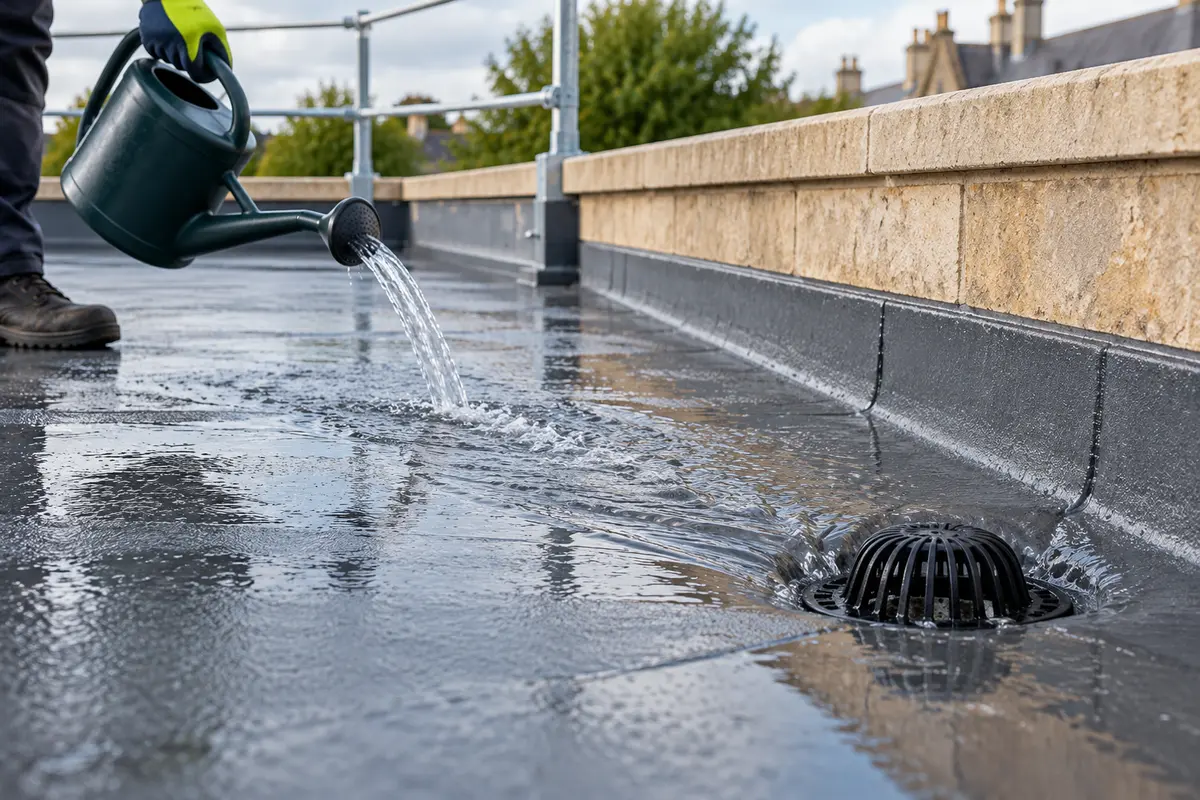 03 · CONFIRM THE VISIBLE WATER PATHA modest flow check can show whether water follows the roof fall and enters the outlet, but it cannot certify every concealed pipe or underground drain.AI-generated illustration · not a customer property or job
An overflow is a warning, not the normal drain
Some flat roofs include an emergency overflow or scupper. Its purpose is to give water another visible route if the main drainage becomes restricted or rainfall exceeds the intended path. If an overflow is running in ordinary conditions, treat that as a reason to inspect the primary outlet rather than as proof that the system is working normally.
NHBC guidance for flat roofs says drainage arrangements should be effective to prevent ponding or standing water and should include a suitable overflow so that a blocked outlet or downpipe does not flood the building. The design and capacity of outlets are roofing and drainage matters; routine cleaning should not be presented as a redesign.
Flat does not mean safe to walk on
A flat roof can still have an unprotected edge, fragile rooflights, hidden weak areas or a covering that can be punctured by foot traffic. Conservatory roofs, old decking, corroded sheets and rooflights may be especially hazardous.
HSE guidance requires work at height to be properly planned, risk-assessed and carried out by competent people with suitable equipment. Access may require edge protection, a tower, scaffold, a mobile elevating work platform or another property-specific method. Do not climb through a window or walk onto a roof simply because the outlet looks close.
When cleaning is not the complete answer
Clearing the outlet will not repair:
- a split or blistered roof covering;
- a failed seam or outlet flange;
- cracked parapet render or defective coping details;
- poor falls or structural deflection that hold water away from the outlet;
- a damaged rainwater pipe below the roof;
- a blocked underground drain;
- internal condensation or an unrelated plumbing leak.
Record what was found and how the outlet behaved after clearing. If ponding, leakage or internal damp remains, the next step may be a roofing inspection, repair quotation or drainage investigation rather than repeated gutter cleaning.
How often should outlets be checked?
The right interval depends on trees, roof size, exposure and previous problems. Historic England recommends inspecting flat roof coverings twice a year. Its general maintenance checklist also advises clearing rainwater debris after heavy leaf fall, at least every autumn and preferably more often where conditions require it.
Useful additional checks include after strong winds, roofing work or a report that an emergency overflow has run. Landlords and facilities managers should record the outlet location, condition, photographs, debris removed and any defect referred for repair.
What to photograph for a useful quote
Only from a safe position, provide:
- a wide photograph showing the building, roof height and access route;
- the outlet, guard and surrounding roof surface;
- any parapet chute, overflow, hopper or external downpipe;
- the downpipe’s ground discharge or gully;
- visible ponding, tide marks or staining;
- rooflights, conservatories, cables, plant or other access obstructions;
- the ceiling or wall below if internal damp has appeared.
For related advice, see our guides to hidden valley, box and parapet gutters, blocked hopper heads and following a blockage from downpipe to ground gully.
Guidance checked on 26 October 2026: Historic England—maintenance checklist; NHBC—best practice guide, Section 10: flat roofs; HSE—work at height frequently asked questions; HSE—roof work.
Share this guide
Know someone with a flat-roof extension, garage or commercial roof? Share this practical outlet-maintenance guide.
Share on FacebookShare on WhatsApp