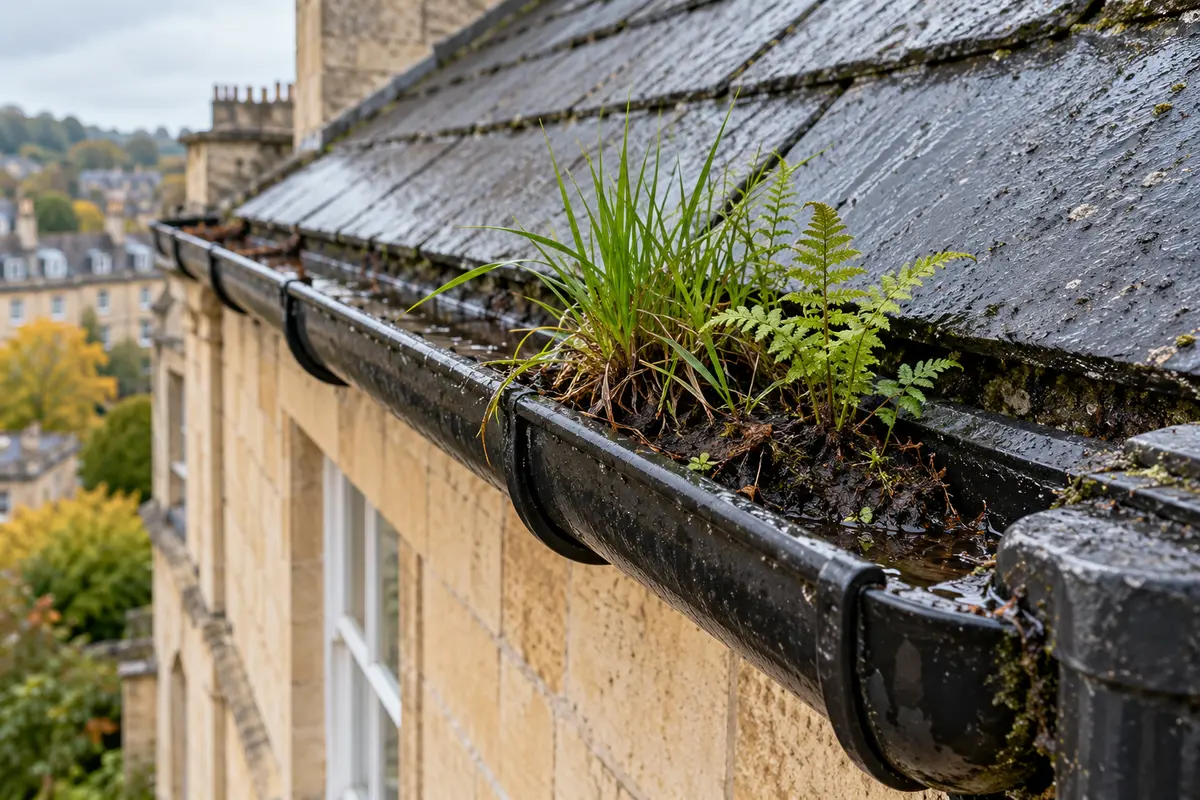
 01 · PLANTS NEED A BED TO GROW INVisible shoots usually sit above damp silt and organic matter that has remained in the gutter long enough for roots to establish.AI-generated illustration · not a customer property or job
Green shoots are the obvious sign, but they are rarely the whole obstruction. Established gutter plants commonly grow through a dense layer of wet silt, moss fragments and decayed debris. That layer can reduce the space available for rainwater and gather around outlets, joints and low points.
Plant growth does not prove that the gutter leaks or that the roof is defective. It does show that material and moisture have been retained. The useful response is to remove the complete growing layer, check the rainwater route and inspect for any separate defect that helped water or debris collect.
What does plant growth tell you?
A seed or spore can arrive by wind, birds or nearby vegetation, but it cannot establish on clean, fast-draining plastic or metal alone. It needs retained material. Fine roof dust, silt, moss fragments, leaf particles and other organic debris can settle into a damp bed. Roots then bind that material together.
Water may continue to pass beneath or around the root mat, so the gutter can appear to work in light rain. Capacity is reduced, however, and the first clear warning may be overflow during a heavier shower. Water can also be diverted over the front, towards a joint or behind the gutter.
Why pulling the tops is not enough
Tugging the visible stems may snap them above the root mass. The heavier part of the obstruction—and much of the silt holding moisture—can remain in the channel. Loose material can then move towards the outlet in the next downpour.
A thorough clear treats the plants and their growing bed as one obstruction. The bulk should be lifted into a container, not broken up and washed into the downpipe. Fine sediment can then be removed so the channel and outlet can be inspected.
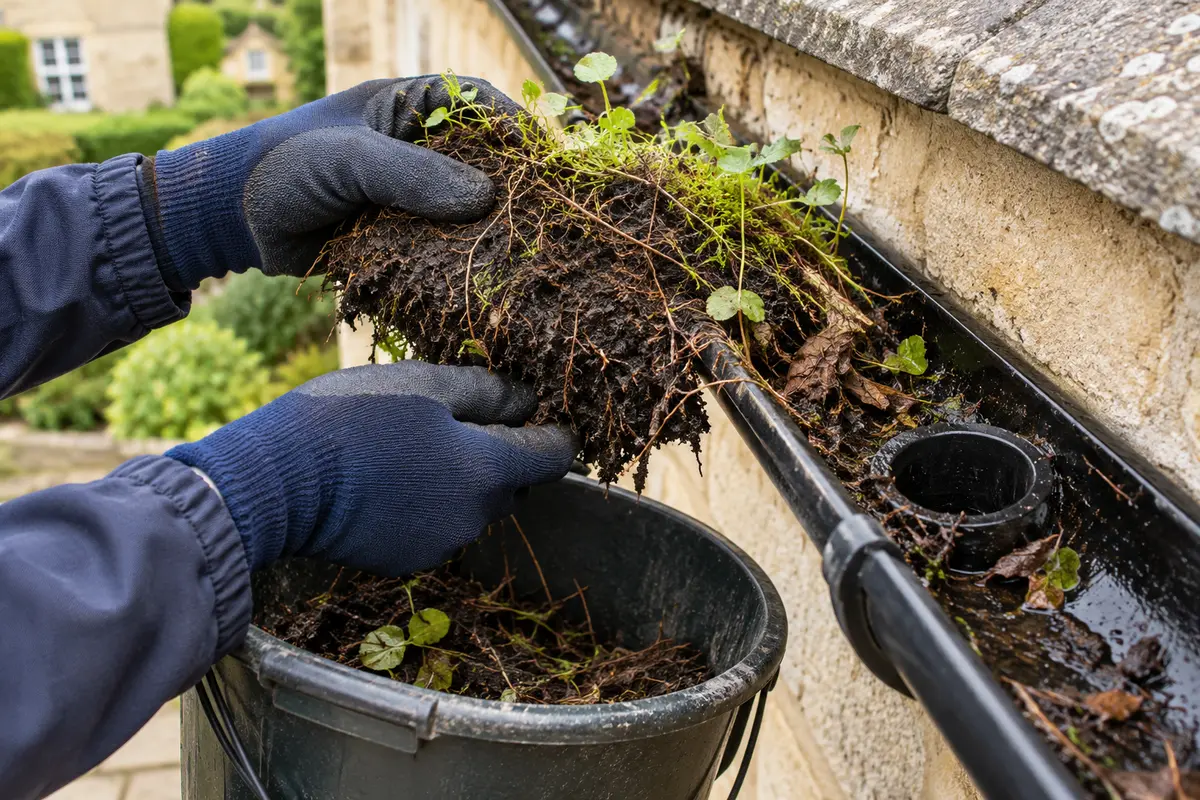 02 · REMOVE THE ROOT MAT AND SILT TOGETHERLifting the material into a container keeps the bulk away from the outlet and reveals the condition of the gutter beneath.AI-generated illustration · not a customer property or job
What a careful clear should include
High-level work should be planned around safe access and suitable equipment. HSE guidance says work at height should be avoided where reasonably practicable and otherwise properly planned and carried out by competent people. Do not lean a ladder on a weak gutter or climb onto a roof to reach vegetation.
Once safe access has been arranged, a useful process is to:
- check for active nesting or wildlife before disturbing the area;
- lift established plants, roots and bulk debris into a container;
- remove the remaining fine silt rather than pushing it towards the outlet;
- clear around the outlet and inspect the accessible top of the downpipe;
- check joints, stop ends, brackets, low points and visible distortion;
- look for staining or deterioration on the fascia, soffit and wall below;
- confirm that the receiving shoe, water butt or ground gully is not obviously obstructed;
- use a controlled water test only where it is safe and appropriate.
If there may be an occupied nest, stop and read our guide to bird nests in gutters before cleaning. For loose moss and small debris, see what gutter cleaning can—and cannot—solve.
Do not wash the root mat into the downpipe
A hose can make the visible channel look cleaner while driving roots and silt into a narrower bend or offset. That simply transfers the restriction to a harder-to-reach part of the system. Remove solids first, keep the outlet protected during the bulk clear and only test the route after the opening is visibly clear.
A gentle test can confirm that water enters the outlet and continues through accessible sections. It cannot prove that a buried drain is sound. If the downpipe fills, gurgles or discharges slowly, stop adding water and trace the route using our guide to blocked downpipes and gullies.
When growth points to a separate repair
Routine clearing is not the answer to every plant. Arrange a closer roofline, roofing or drainage inspection where:
- vegetation appears to emerge from behind the gutter, roof covering, parapet or masonry joint;
- the gutter remains full of water after debris is removed;
- the run sags, brackets are loose or the channel has twisted;
- a joint, stop end or outlet is cracked or repeatedly leaking;
- the downpipe or gully remains restricted after the accessible section is cleared;
- damp staining continues on the wall, fascia or soffit.
Older and traditionally constructed buildings may need material-sensitive repair. Avoid pulling rooted growth from masonry, leadwork or roof coverings without understanding what it is attached to.
Should herbicide be used?
For plants rooted in removable gutter sediment, physical removal is normally the direct first step: take away the plant, roots and growing medium, then correct the reason material collected. Spraying does not remove the obstruction and can introduce a product into a rainwater route.
Do not improvise chemical treatment around roofing materials, painted finishes, stonework, water butts or drainage. If vegetation is rooted in the building fabric rather than loose gutter silt, obtain advice suited to the plant, material and location before treatment.
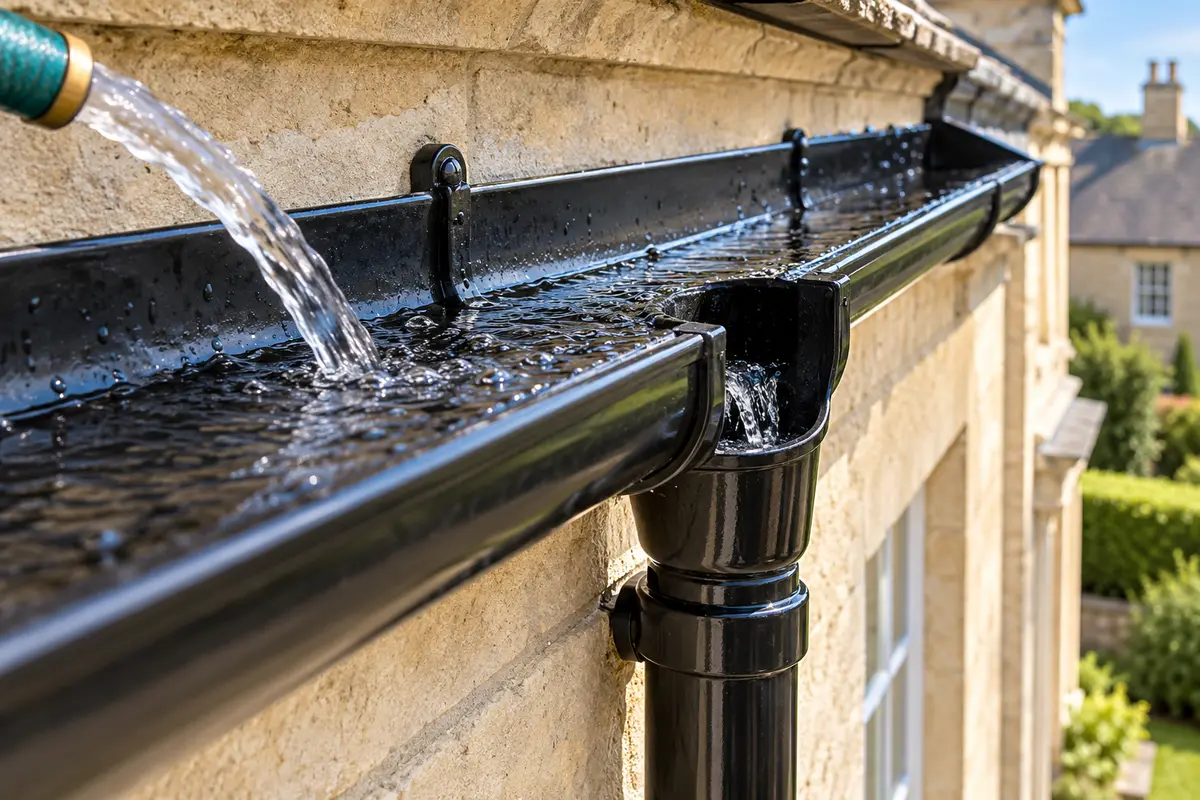 03 · CONFIRM THE OUTLET IS OPENAfter solids and fine sediment are removed, a controlled test can show whether water reaches and enters the outlet without pooling.AI-generated illustration · not a customer property or job
How often should gutters be checked?
Historic England advises clearing debris and blockages after autumn leaf fall and checking more frequently where conditions require it. SPAB also recommends autumn clearing of plants, leaves and silt, with a spring check for fresh growth and winter damage.
The best interval depends on the property. Trees above the roof, shaded elevations, mossy coverings, bird activity and awkward low points can increase how quickly material returns. Use the observed rate of build-up: if vegetation has established, inspect sooner than you did last time rather than waiting for another visible plant.
Useful records for homes, rentals and commercial sites
For landlords, managing agents and businesses, photograph the cleared channel, outlet and final discharge point where access permits. Record the date, areas reached, material removed, water-test result and any repair that was outside the cleaning scope. Homeowners can use the same simple record to compare how quickly each elevation gathers debris.
From a safe position, send Bill’s Gutters a wide photograph of the property, a closer view of the vegetation, access photographs and the number of storeys. This helps separate a routine clear from a job that may need specialist access or an additional repair.
Guidance checked on 30 October 2026: Historic England—maintenance checklist; Historic England—rainwater-system inspection and maintenance; SPAB—Maintenance Week; SPAB—rainwater fittings; HSE—working at height.
Share this guide
Know someone with plants growing from a gutter? Share this guide to the root-and-silt layer beneath the visible shoots.
Share on FacebookShare on WhatsApp