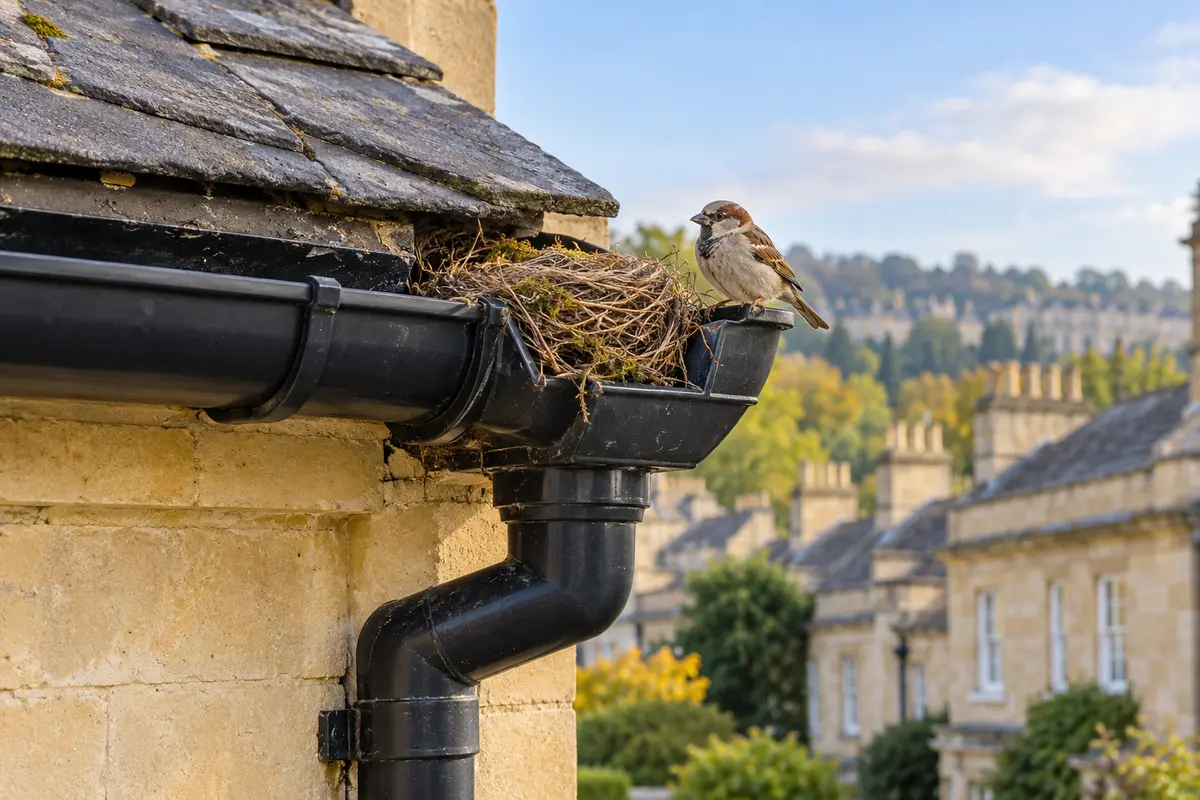
 01 · PAUSE BEFORE CLEARINGIf birds are carrying nesting material or food to the roofline, treat the area as potentially active and do not disturb it.AI-generated illustration · not a customer property or job
Stop and observe before anyone starts work
A nest at a gutter, hopper or roof edge changes an ordinary maintenance visit. Do not reach into it, poke it with a pole, flush it with water or block the birds’ access. First step back and watch quietly from firm ground.
A brief quiet spell does not prove that a nest is empty. Parent birds may be away feeding, and some nests are partly hidden behind fascia boards, under tiles or inside an eaves gap. Record the exact point birds enter and leave rather than assuming the visible material is only loose debris.
The legal point in England
Natural England and Defra guidance says all wild birds, their eggs and nests are protected by law. It is an offence to intentionally take, damage or destroy a wild bird’s nest while it is being used or built. Section 1 of the Wildlife and Countryside Act 1981 sets out that protection.
This guide is general property-maintenance information, not legal advice. If the status of a nest is uncertain, pause the job and obtain appropriate wildlife advice rather than trying to decide from a close inspection at height.
Signs that a nest may be active
- birds repeatedly carrying grass, moss, feathers or other material to one point;
- adults returning with food or removing droppings;
- regular entry into the same gutter corner, hopper or eaves gap;
- calls coming from one fixed position under the roof edge;
- fresh droppings, feathers or newly arranged nesting material near the access point.
None of these signs should be used as a reason to climb up for a closer look. The Health and Safety Executive recommends doing as much work as possible from the ground.
 02 · RECORD FROM THE GROUNDUse phone zoom to show the whole elevation, the birds’ access point, nearby outlets and the route of the downpipe.AI-generated illustration · not a customer property or job
Do not rely on a calendar date alone
Natural England’s guidance recommends timing work to avoid the breeding season where possible, but the condition that matters is whether a nest is being built or used. Local weather, species and the site itself can affect timing, so “it is autumn” is not proof that a nest is inactive.
If you see recent bird activity, postpone intrusive cleaning around that point. Other clearly separate sections may sometimes be assessable, but the work method and access must not risk disturbing the nesting area.
What if water is overflowing near an active nest?
Do not remove the nest to solve the blockage. Photograph the overflow from a safe position, note whether water is reaching walls, windows, paving or an entrance, and keep people away from any slippery area below. Then contact an appropriate wildlife adviser and a gutter professional so the situation can be assessed without unplanned interference.
An overflow may have more than one cause. The nest might be beside the outlet, while the restriction is actually farther down the downpipe or in the ground gully. It is useful to record the entire water route rather than focusing only on the most visible object.
When can an old nest be removed?
GOV.UK guidance on managing wild birds says a nest can be removed without a licence when you are certain wild birds are no longer using it. Do not treat one photograph or a few quiet minutes as certainty. If there is any doubt, seek competent advice.
Once inactivity has been established and removal is lawful, the maintenance scope should be clear: remove the old nesting material and loose debris, clear the outlet, check the accessible downpipe and test whether water follows the intended route. Record any leak, loose bracket, open joint or damaged roof-edge detail separately for repair.
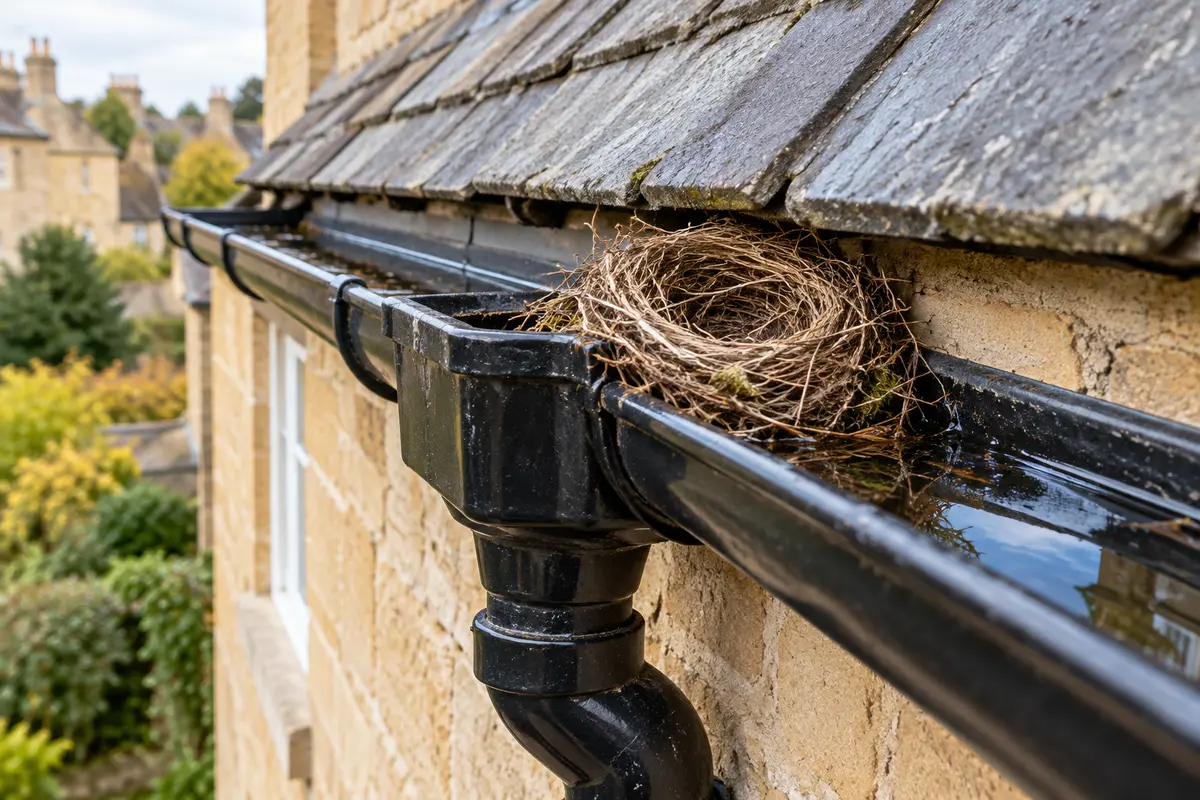 03 · EMPTY-LOOKING IS NOT PROOFAn old nest beside an outlet can restrict flow, but confirm it is no longer in use before removal or cleaning begins.AI-generated illustration · not a customer property or job
Plan prevention after the nesting issue is resolved
Ask a competent roofer to assess loose fascia boards, damaged soffits, displaced tiles or other unintended openings. Do not seal a known access point while birds may still be using it. If a gutter guard is being considered, remember that guards still require inspection and maintenance and must not be installed over an active nest.
Keep the jobs separate: wildlife assessment establishes whether work can proceed; gutter clearing restores the water path; downpipe or gully work deals with restrictions below; roofing repairs address defects at the eaves.
What to send with your quote request
- postcode, property type and number of storeys;
- a wide photograph showing the whole elevation and roof edge;
- a zoomed photograph of the suspected nest or access point;
- notes on bird movements you have observed and when;
- the location of the nearest gutter outlet, hopper and downpipe;
- photographs of any overflow, staining or water reaching the wall;
- access constraints such as conservatories, extensions or narrow side passages;
- whether you are requesting an inspection, a future clean after nesting, or separate repair advice.
For related maintenance advice, see our terraced-house gutter guide, overflowing gutter checklist and service areas across Bath, Bristol and surrounding towns.
Guidance checked on 14 October 2026: Natural England and Defra—wild bird protection and licences; Wildlife and Countryside Act 1981, section 1; GOV.UK—preventing wild birds damaging land or business; HSE work-at-height guidance.
Share this guide
Know someone who has spotted birds nesting near their gutters or roofline? Share this practical guide.
Share on FacebookShare on WhatsApp