
 01 · NOTE WHEN THE SOUND STARTSA click as the sun reaches the gutter suggests something different from a gurgle during heavy rain or a rattle that only appears in wind.AI-generated illustration · not a customer property or job
Gutters are fitted outside bedrooms, offices and living spaces, so a small movement or drip can sound much louder indoors—especially at night. The useful question is not simply “why is the gutter noisy?” but “what is happening when the noise begins?”
Sound alone cannot confirm a defect. Start by recording its location, rhythm, duration and the weather. Those clues help separate normal movement from a loose fitting, standing water or a restricted rainwater route.
Clicking or creaking as the temperature changes
PVC-U guttering expands when it warms and contracts when it cools. Correctly designed joints allow the gutter lengths to move while the fittings remain fixed. A brief click or creak can occur when a length slides through a seal or bracket as sunshine reaches the roofline, cloud cover returns or evening temperatures fall.
FloPlast’s technical guidance says normal daily expansion and contraction can be around 10 mm over a four-metre gutter length. Its installation instructions therefore require the gutter to be positioned at the marked expansion allowance in each fitting, the seals lubricated as specified and a small expansion gap left at the top of the downpipe.
Movement noise is more likely to need investigation when it is new, unusually loud, concentrated at one fitting or accompanied by a joint pulling apart, distortion, leaking or a gutter end pressing hard against a wall.
Why a clean joint still needs room to move
Cleaning debris from a union can help a seal close correctly, but it does not correct a gutter length installed beyond its expansion line. Equally, adding screws through a gutter length to stop a click can prevent the movement the system was designed to accommodate and may transfer stress elsewhere.
Use the installation guidance for the actual manufacturer and profile. Different systems have their own fittings, bracket centres and expansion details, so a measurement from one brand should not be copied blindly onto another.
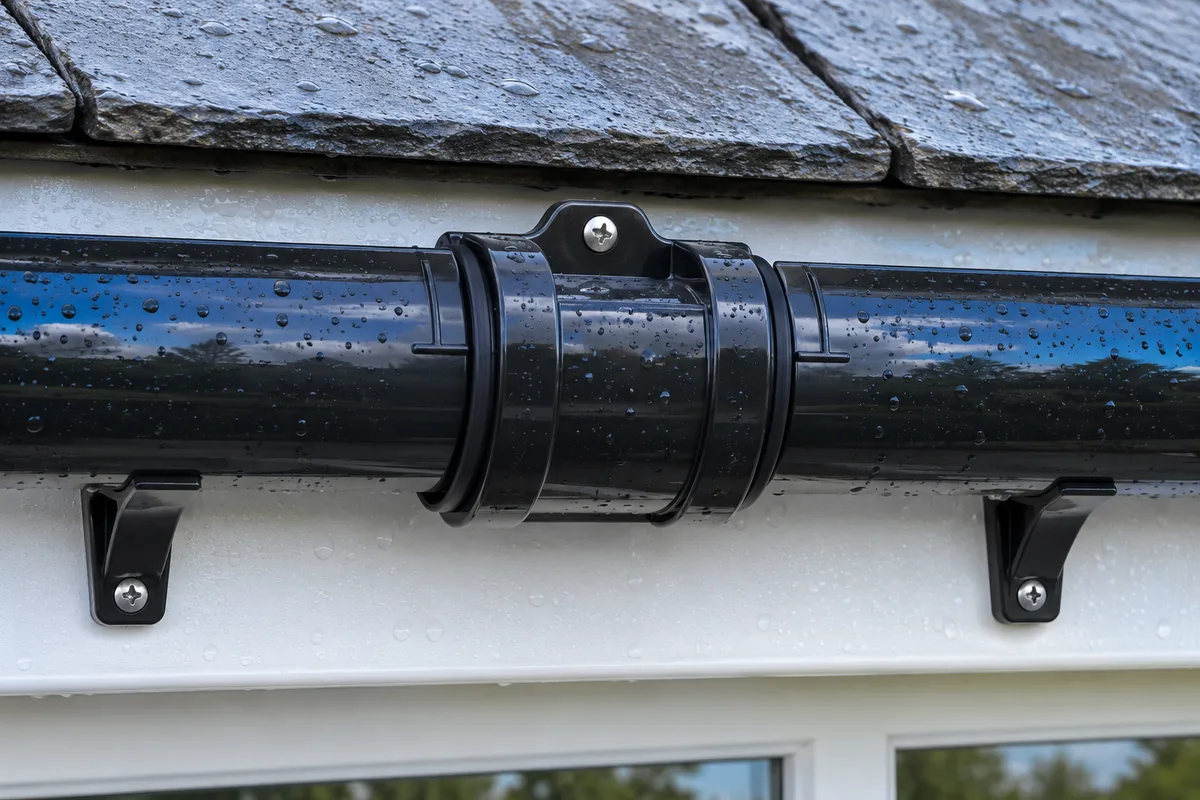 02 · ALLOW THE JOINT TO DO ITS JOBUnion fittings hold seals around both gutter lengths while leaving the manufacturer’s specified allowance for thermal movement.AI-generated illustration · not customer work
Tapping or dripping during and after rain
A regular tap can be as simple as water falling from a pipe shoe onto a metal grate or from a roof detail onto a lower gutter. Brief dripping as a rainwater system empties is not automatically a problem. The location and how long it continues are the important clues.
Arrange a closer check if the tap comes from beneath a joint, stop end or outlet; if it continues long after nearby surfaces have dried; or if it is accompanied by staining. Possible causes include:
- a seal that is dirty, displaced, worn or under strain;
- water standing in a low section because the gutter fall or support is wrong;
- a partly blocked outlet that drains very slowly;
- water tracking behind the gutter from the roof edge; or
- a downpipe shoe releasing water onto an unsuitable surface.
Do not diagnose a leaking gutter from an indoor noise alone. Water can travel along a fascia, soffit, pipe or window ledge before the drop becomes audible.
Gurgling, gulping or bubbling during rain
Gurgling often means water and air are moving through the same restricted route. The sound may come from the outlet, a swan-neck bend, a downpipe socket, a water-butt diverter or the gully below. It can become more obvious in heavy rain when the incoming flow increases.
A gurgle is a reason to trace the whole route, not proof of where the blockage sits. Start at the gutter outlet, then follow the downpipe through every bend and connection to the final gully or drain. If water backs up from below the downpipe, the restriction may be a separate ground-drainage problem.
Rattling or knocking in windy weather
A sound that follows wind gusts usually points towards movement rather than water flow. Check from ground level for a downpipe touching the wall, a loose clip, a separated socket, a shoe without support, a vibrating bracket or a cable tapping against the pipe.
Manufacturer guidance matters here too. FloPlast’s installation guide calls for pipe clips below offsets and at specified intervals, with additional support for fittings such as shoes, sockets, branches and bends where necessary. The correct spacing and fixing method depend on the actual system and the condition of the wall or fascia.
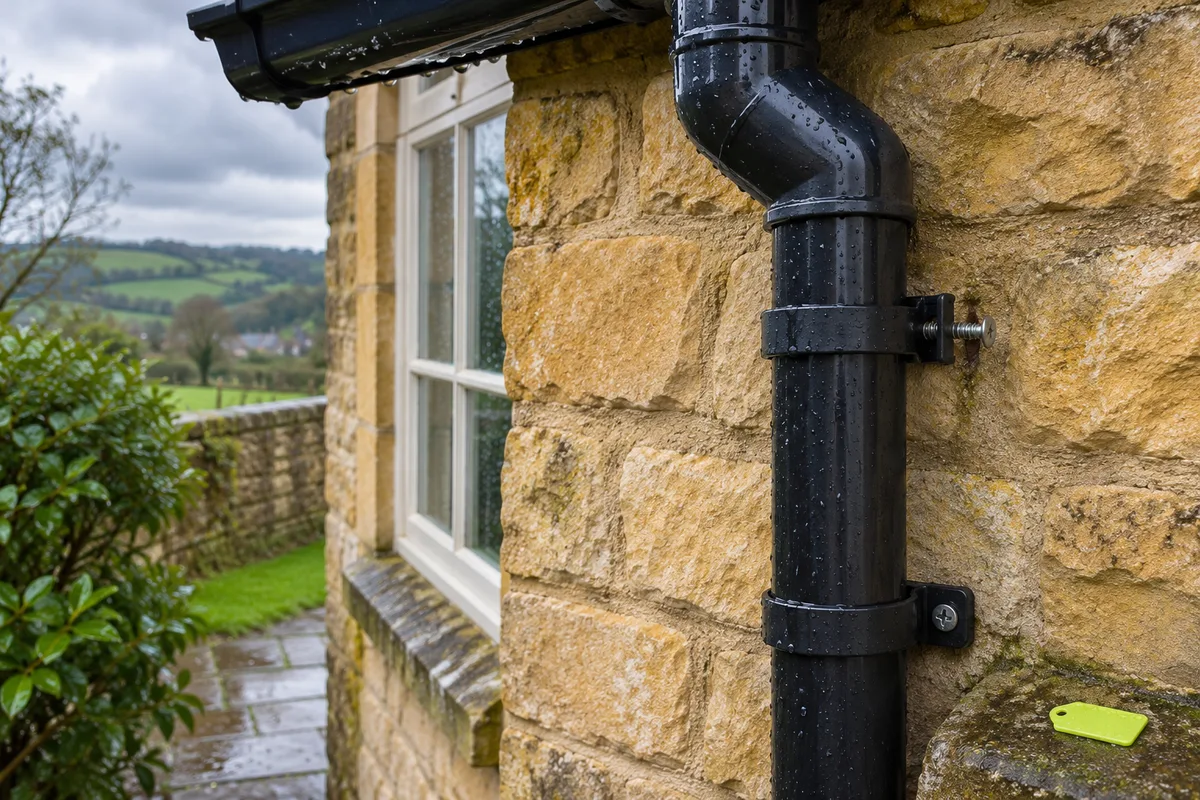 03 · CHECK SUPPORTS AND CONTACT POINTSA backed-out fixing, loose clip or unsupported bend can let a downpipe tap the wall when the wind changes direction.AI-generated illustration · not customer work
A useful sound record
A short phone recording can help, but pair it with notes and safe ground-level photographs. Record:
- the exact area: front, rear or side elevation and the nearest window, outlet or downpipe;
- the trigger: sunshine, cooling after sunset, light rain, heavy rain or wind;
- the pattern: single click, repeated ticking, steady drip, gurgle or intermittent knock;
- the duration: only during the weather event or continuing afterwards;
- visible evidence: overflow, staining, a gap at a fitting, sagging or a moving pipe; and
- recent changes: cleaning, roof work, replacement fascias, scaffolding or storm damage.
For landlords and business premises, these details help identify the correct elevation before access is planned and provide a baseline if the sound returns after work.
What can be checked safely from the ground?
- Watch from indoors and outside to confirm whether the sound is truly at the roofline.
- Observe the gutter during rain only from a safe position.
- Use zoomed photographs or a ground camera to check fittings and supports.
- Look for fresh water marks, separated joints or a pipe moving in wind.
- Check whether the ground gully is taking water or backing up.
- Send the recording, timing notes and wide photographs with the quote request.
Do not lean from a window, reach across a conservatory or rest a ladder against plastic guttering. The Health and Safety Executive advises doing as much work as possible from the ground and using suitable equipment where work at height cannot be avoided.
When should noise be treated as urgent?
Arrange a prompt inspection if sound is accompanied by water entering the building, a visibly detached pipe, a gutter section pulling away, falling parts, a rapidly worsening overflow or water collecting near electrical equipment. Keep people clear of the area below any loose component.
A minor click with temperature change may simply need monitoring, but it is sensible to have it checked if the system also leaks or has moved. The aim is to identify the source before applying sealant, extra screws or replacement parts that may not address the cause.
Related guides explain how to assess leaking uPVC gutter joints, what to check around loose downpipe clips and wall fixings, and how to tell a blocked downpipe from a blocked gully.
The practical rule
Match the noise to the conditions. Temperature-related clicks, rain-related drips and gurgles, and wind-related rattles each point towards a different inspection—yet none should be diagnosed from sound alone.
Sources and further guidance
- FloPlast: rainwater system installation guidance
- FloPlast: rainwater FAQs and expansion guidance
- Health and Safety Executive: working at height safely
Share this guide
Know someone trying to identify a click, drip, gurgle or rattle at the roofline? Share this practical guide.
Share on FacebookShare on WhatsApp